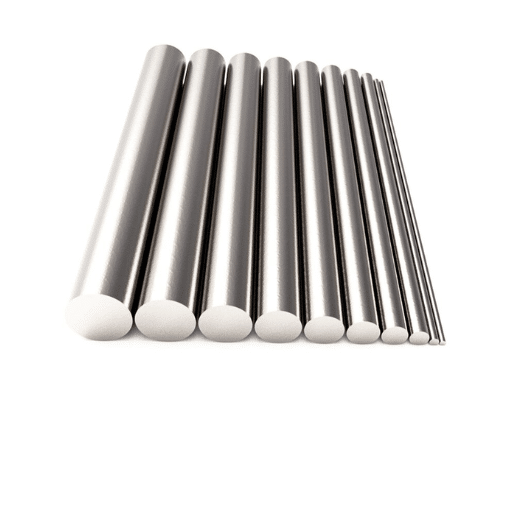
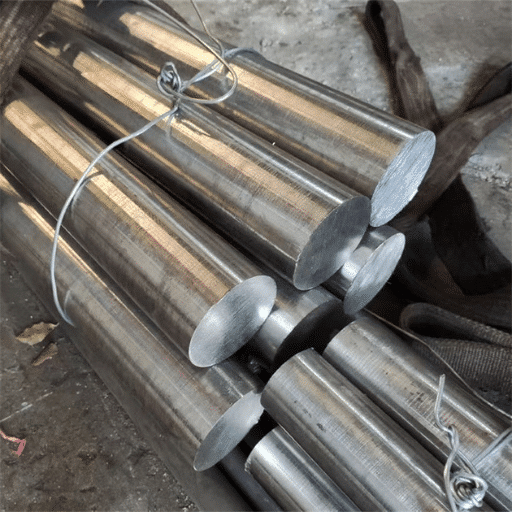
Grade 5 titanium, also known as Ti-6Al-4V, is the most widely used titanium alloy in the world, accounting for roughly half of all titanium metal consumed globally. It pairs high strength (895 MPa minimum tensile strength) with low density (about 4.43 g/cm3) and outstanding corrosion resistance. That combination is why the same alloy flies in jet engine fan blades, holds up hip implants, and frames the Apple iPhone 15 Pro.
Chances are you have touched grade 5 titanium without realizing it. Every iPhone 15 Pro ships with a Ti-6Al-4V outer frame, chosen for the same reason aerospace engineers use the alloy: exceptional strength per unit of weight, about 45% lighter than steel, plus strong corrosion and scratch resistance.
Consider Sarah, a design engineer at a marine equipment firm. Her team needed a component that could survive constant seawater exposure and repeated loading. Stainless steel 316L pitted in service, and aluminum was too soft. She reviewed the titanium vs stainless steel comparison, then specified grade 5 titanium. The part has run for three years without a single corrosion failure.
This guide covers what grade 5 titanium is, its properties, standards, applications, fabrication, and 2026 pricing, so you can judge whether Ti-6Al-4V fits your project and how to specify it.
Key Takeaways
- Grade 5 titanium (Ti-6Al-4V) is the most widely used titanium alloy, about half of global titanium consumption.
- It delivers 895-1,070 MPa tensile strength at a density of 4.43 g/cm3, giving a strength-to-weight ratio roughly double that of stainless steel.
- Grade 5 is heat treatable to over 1,100 MPa in the solution-treated and aged (STA) condition.
- Grade 23 (Ti-6Al-4V ELI) is the medical-implant variant required by ASTM F136, with better fracture toughness at a 15-40% cost premium.
- Grade 5 titanium costs about $24-28/kg for bar and plate in 2026, but finished-part cost is driven by machining time and tool wear, not raw material.
What Is Grade 5 Titanium (Ti-6Al-4V)?

Grade 5 titanium is an alpha-beta titanium alloy containing roughly 90% titanium, 6% aluminum, and 4% vanadium. It is identified by the designation Ti-6Al-4V, UNS R56400, and Werkstoff number 3.7165, and it is the workhorse alloy of the titanium industry.
The aluminum in the alloy stabilizes the alpha phase, while vanadium stabilizes the beta phase. That dual-phase structure is what gives grade 5 titanium its unusual balance of properties: the alloy is stronger than any commercially pure titanium grade, yet it keeps enough ductility to be forged, machined, and welded.
Chemical Composition of Grade 5 Titanium
| Element | Composition (wt%) |
|---|---|
| Titanium (Ti) | Balance (about 90%) |
| Aluminum (Al) | 5.50 – 6.75% |
| Vanadium (V) | 3.50 – 4.50% |
| Iron (Fe) | 0.40% max |
| Oxygen (O) | 0.20% max |
| Carbon (C) | 0.08% max |
| Nitrogen (N) | 0.05% max |
| Hydrogen (H) | 0.015% max |
These limits come from ASTM B348, the standard for titanium bars and billets. The same chemistry applies across sheet, plate, forgings, and pipe. Tight control of oxygen matters most, because small increases raise strength but reduce ductility and toughness.
Other Names You Will See
Grade 5 titanium travels under several names. Ti-6Al-4V and Ti-6-4 are the most common shorthand, Chinese mills call it TC4, and aerospace buyers know it by AMS 4911 (sheet) and AMS 4928 (bar). Whichever label you see, it refers to the same alloy. Our titanium properties guide covers the full grade family.
Grade 5 Titanium Properties at a Glance
The property values below are for grade 5 titanium in the annealed condition, with the STA (solution-treated and aged) figures shown where they differ. Data follows ASTM and common supplier values.
Physical Properties
| Property | Value |
|---|---|
| Density | 4.43 g/cm3 |
| Melting point | 1,604 – 1,660°C |
| Beta transus | about 980°C |
| Elastic modulus | 105 – 120 GPa |
| Thermal conductivity | 6.7 – 7.1 W/m·K |
| Coefficient of thermal expansion | 8.6 – 9.0 µm/m·°C |
| Magnetic response | Non-magnetic (paramagnetic) |
The two values engineers quote most are density and modulus. At 4.43 g/cm3, grade 5 titanium is about 45% lighter than steel and roughly 40% heavier than aluminum. Its elastic modulus of about 110 GPa is roughly half that of steel, which means a titanium part deflects more under load unless geometry compensates. Titanium’s low thermal conductivity, meanwhile, is the reason machining and welding need careful heat management.
Mechanical Properties
| Property | Annealed | STA (solution-treated and aged) |
|---|---|---|
| Tensile strength | 895 – 1,070 MPa | up to 1,170 – 1,190 MPa |
| Yield strength (0.2% offset) | 828 – 1,000 MPa | about 1,100 MPa |
| Elongation | 10 – 15% | lower, typically 6 – 10% |
| Hardness | HRC 30 – 36 | higher, near HRC 40 |
| Fatigue strength | 140 – 510 MPa | improved with heat treatment |
| Fracture toughness | 75 – 100 MPa·m1/2 | varies with processing |
These numbers place grade 5 titanium in a useful middle ground. It is about 2.5 to 3 times stronger than Grade 2 commercially pure titanium, yet it is not brittle. The STA condition pushes strength above 1,100 MPa for structural and fastener applications, though ductility drops.
For a direct comparison with the alloy buyers most often weigh it against, see our grade 5 titanium vs 316 stainless steel guide.
Grade 5 Titanium vs Other Titanium Grades

Titanium comes in two broad families: commercially pure (CP) grades and alloys. Grade 5 is the best-known alloy, but buyers frequently compare it with Grade 2 and Grade 23.
Grade 5 vs Grade 2 (Commercially Pure Titanium)
Grade 2 titanium is commercially pure, about 99% titanium. It is the CP grade most used for corrosion service, winning on seawater resistance, formability, and weldability. It also costs 30-50% less than grade 5 in raw material form.
Grade 5 wins decisively on strength. Its 895 MPa minimum tensile strength is roughly 2.5 to 3 times that of Grade 2, with similar density, so it offers a far better strength-to-weight ratio. When loading is high, sections are thin, or fatigue life matters, grade 5 earns its premium.
When corrosion is the only real enemy and stresses are modest, Grade 2 is often the smarter buy. Our titanium grade 2 vs grade 5 comparison walks through the full trade-off.
Grade 5 vs Grade 23 (Ti-6Al-4V ELI)
Grade 23 is not a different alloy. It is grade 5 with tighter limits on interstitial elements, especially oxygen, which is held to 0.13% maximum instead of 0.20%. That small change matters enormously for implants. Lower oxygen raises fracture toughness and fatigue crack growth resistance, the properties a hip stem or trauma plate needs to survive millions of in-body load cycles.
Medical and dental implants therefore use Grade 23, specified under ASTM F136, not standard Grade 5. The premium is roughly 15-40% over Grade 5, and the two are not interchangeable in implant applications. For non-implantable hardware such as surgical instruments and external fixation frames, standard Grade 5 is acceptable.
Standards & Specifications for Grade 5 Titanium
If you are buying grade 5 titanium, you will encounter the standards below. Each covers a specific product form, and your supplier’s mill test certificate should cite them.
| Standard | Product Form | Notes |
|---|---|---|
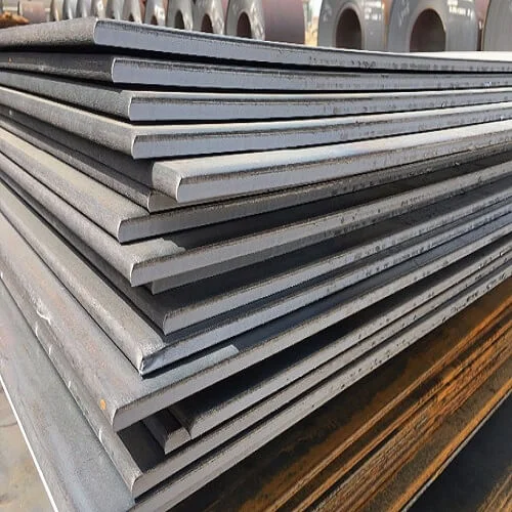
| ASTM B265 | Sheet, strip, and plate | Most common for flat products |
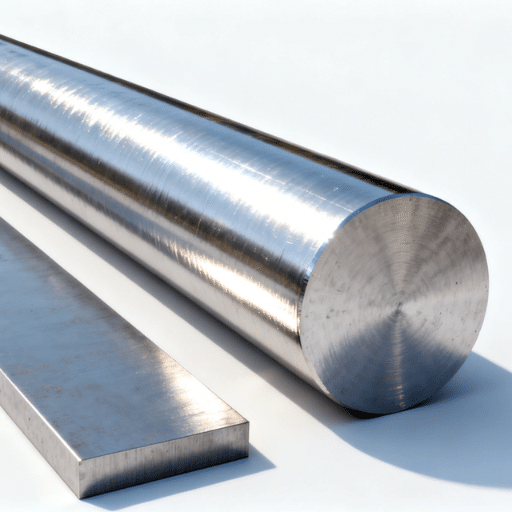
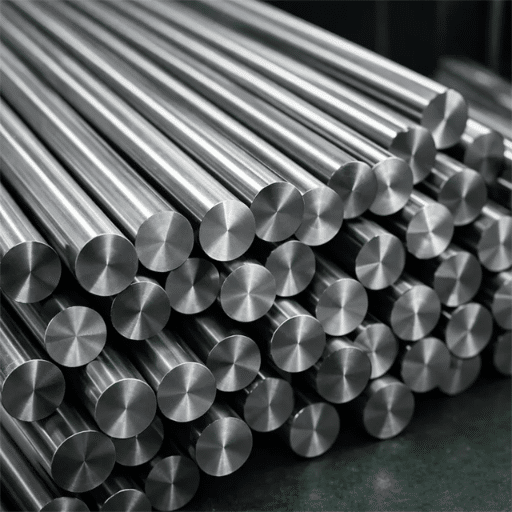
| ASTM B348 | Bar and billet | Rounds, flats, and billets |
| ASTM B381 | Forgings | Rotor forgings and custom shapes |
| ASTM B367 | Castings | Sand and investment castings |
| ASTM B861 / B862 | Seamless / welded pipe | Tubular products |
| ASTM F136 | Surgical implant grade | Grade 23 (Ti-6Al-4V ELI) |
| ASTM F1472 | Implant bar and wire | Wrought Ti-6Al-4V |
| AMS 4911 | Sheet and strip | Aerospace |
| AMS 4928 | Bar, forgings, and wire | Aerospace |
| ISO 5832-3 | Surgical implants | International medical |
| EN / UNS | 3.7165 / R56400 | European and US designations |
For any critical application, request a mill test certificate (MTC) that confirms the chemistry and mechanical properties match the specified standard. Traceability is non-negotiable in aerospace and medical work. If you need help interpreting a spec or selecting a form, our technical consultation team can review your requirements.
Grade 5 Titanium Applications by Industry
Grade 5 titanium earns its keep in applications where strength, light weight, and corrosion resistance must coexist.
Aerospace and Defense
Aerospace is the largest consumer of Grade 5 titanium. The alloy forms airframe structures, jet engine fan blades and compressor discs, landing gear, fasteners, and rocket engine cases. A single widebody aircraft carries more than 25 tons of titanium, much of it Ti-6Al-4V. Boeing and Airbus have pushed titanium content in their newest widebodies to around 15% of airframe weight.
The alloy’s behavior under fatigue is well studied, which is why the September 30, 2017, failure of an Air France A380 engine drew so much attention. The fan hub, machined from Ti-6Al-4V, fractured through cold dwell fatigue, a mechanism unique to titanium’s hexagonal crystal structure. The case shows grade 5 titanium is not indestructible. It demands correct design, heat treatment, and inspection, which is why aerospace procurement insists on full traceability and AMS specifications.
Medical and Dental
Grade 5 titanium is biocompatible, non-toxic, and effectively non-magnetic, so it is used for surgical instruments and external fixation hardware. Load-bearing implants use the Grade 23 ELI variant under ASTM F136. Titanium implants osseointegrate, meaning bone grows directly onto the surface, and the alloy contains no nickel, a common allergen in stainless steels.
Marine, Chemical, and Energy
The self-healing titanium dioxide oxide layer gives grade 5 titanium excellent resistance to seawater and chloride pitting, with a corrosion rate below 0.0005 mm/year in ambient seawater. That makes it valuable for offshore hardware, heat exchanger tubing, and chemical processing equipment. It does have limits: hydrofluoric acid, hot concentrated hydrochloric acid, and hot caustic solutions attack it, and it can form galvanic corrosion couples with dissimilar metals unless isolated.
Automotive, Motorsport, and Consumer Goods
High-performance cars use grade 5 titanium for valves, springs, connecting rods, and exhaust components where weight savings justify cost. In consumer goods, it appears in watches, EDC tools, knife framelocks, and bike frames. The iPhone 15 Pro frame brought the alloy to the mainstream: Apple chose it for strength, light weight, and scratch resistance. If you are evaluating Grade 5 titanium against stainless steel for a product application, our team can help you compare the trade-offs, including stainless steel alternatives we supply.
Fabrication: Machining, Welding & Forming Ti-6Al-4V
Grade 5 titanium is not the easiest metal to process. Success depends on managing heat and contamination.
Machining Grade 5 Titanium
Titanium’s low thermal conductivity keeps cutting heat concentrated at the tool tip instead of carrying it away in the chip. That drives tool wear and makes machining time the dominant cost factor, not raw material. Effective machining uses lower speeds, higher feed rates, sharp positive-rake carbide tools, and high-pressure coolant, typically 70-100 bar.
The alloy also work-hardens and galls, so rigid setups and proper tooling matter. Machining shops with titanium experience, like RivCut, emphasize that the setup matters more than the machine.
Welding Grade 5 Titanium
Welding grade 5 titanium requires complete inert-gas shielding above about 250°C. Molten titanium aggressively absorbs oxygen, nitrogen, and hydrogen, and contamination causes irreversible embrittlement called alpha case. Welders use TIG with 99.99% minimum purity argon, a trailing shield over the weld bead, and back purging of the weld root, with ERTi-5 filler wire and interpass temperature below 100°C. A detailed grade 5 titanium welding guide from Chalco covers the full procedure.
Forming Grade 5 Titanium
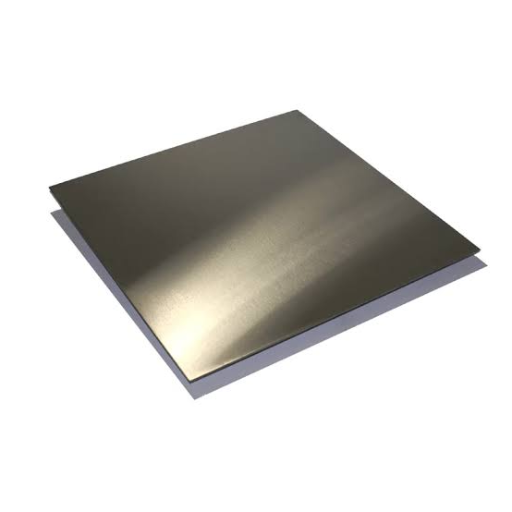
Thin sheets of grade 5 titanium can be cold formed with allowance for springback, which is pronounced because of the alloy’s low elastic modulus. Complex shapes and thicker sections are hot formed at 700-900°C, where ductility improves and forming forces drop. Annealing is done at about 732°C followed by controlled cooling. If your project involves cutting or forming, custom processing services can handle the fabrication stage for you.
Grade 5 Titanium Cost & 2026 Market Outlook

Grade 5 titanium pricing in 2026 is driven by a strong aerospace demand cycle and tight supply.
2026 Price Snapshot
| Product Form | 2026 Price (approx.) |
|---|---|
| TC4 ingot, US FOB | $22 – 24.50/kg |
| Bar and plate, US spot | $24 – 28/kg |
| Aerospace-grade bar, Western market | $45 – 66/kg |
| Ti-6Al-4V ELI aerospace fasteners | $102+/kg |
| Small-diameter tubing | $250+/kg |
These figures are a snapshot from early-to-mid 2026 and move with market conditions. Global aviation titanium orders rose roughly 12% in 2026, and a single widebody airliner requires more than 25 tons of the metal.
The United States designated titanium a strategic stockpiled metal in February 2026 under the “Project Vault” program, adding government demand to commercial orders. Supply is constrained by reduced Russian concentrate exports and limited melting capacity, so producers have locked in most 2026 alloy capacity to long-term contracts.
The practical lesson for buyers is to look at cost per part, not cost per kilogram. Raw material is a fraction of the total; machining time, tool wear, and specialized welding often exceed the material price.
When weight savings, fatigue life, or corrosion performance justify the premium, grade 5 titanium is worth it. When a stainless steel grade like 316L can meet the requirements, it is usually the lower-cost path. Our titanium vs stainless steel cost analysis compares the two.
How to Buy Grade 5 Titanium
Before you request a quote, decide on the basics.
- Product form. Sheet, plate, bar, billet, tube, wire, or forgings. Each has its own standard.
- Condition. Annealed for general use, or STA for maximum strength.
- Specification. ASTM, AMS, or ISO, depending on your industry and final use.
- Dimensions and finish. Size, tolerance, and any surface treatment.
- Certification. Request a mill test certificate with full chemistry and mechanical test results.
Not every supplier carries titanium, and the alloy’s supply chain is tighter than for stainless steel. LIANYUNGANG DAPU METAL supplies stainless steel, nickel alloy, copper alloy, aluminum alloy, galvanized steel, and carbon steel across sheets, plates, coils, rods, and pipes.
If your project needs a corrosion-resistant stainless steel alternative to titanium, our 316 stainless steel products and stainless steel sheets are stocked for global delivery, and our complete stainless steel guide explains the grades in detail.
Frequently Asked Questions
Is grade 5 titanium magnetic?
No. Grade 5 titanium is paramagnetic and effectively non-magnetic. If a strong magnet sticks to a part labeled titanium, it is likely steel or contaminated with iron from tooling. See if titanium is magnetic.
Is grade 5 titanium stronger than steel?
Grade 5 titanium is comparable to many steels in absolute tensile strength but roughly half the density, so it wins on strength-to-weight ratio. On raw strength and stiffness, high-strength steels and titanium are close, and steel has a higher modulus. See whether titanium is stronger than steel for the full comparison.
Is grade 5 titanium safe for skin?
Yes. It is biocompatible, hypoallergenic, and contains no nickel, the common allergen in stainless steel jewelry. Titanium is used for implants and body jewelry for exactly this reason.
How much does grade 5 titanium cost?
In 2026, TC4 ingot runs about 22- 24/kg, bar and plate about 22- 24/kg,barand plate about24-28/kg, and aerospace-grade bar $45-66/kg. Finished parts cost far more because machining and processing dominate.
What is the difference between grade 5 and grade 23 titanium?
Grade 23 is Ti-6Al-4V ELI, the same alloy with lower oxygen and iron limits. It has higher fracture toughness and fatigue resistance and is the ASTM F136 implant grade. It costs 15-40% more and is required for load-bearing medical implants.
Why is grade 5 titanium used in aerospace?
Because it delivers the highest practical combination of strength, low weight, corrosion resistance, and fatigue performance for aircraft structures and engines, where every kilogram of weight saved reduces fuel burn.
Conclusion
Grade 5 titanium, Ti-6Al-4V, is the workhorse of the titanium industry for good reason. It combines high strength, low density, corrosion resistance, and biocompatibility in one alloy, which is why it appears in aircraft, implants, marine hardware, and the phone in your pocket.
The key decisions come down to three questions. Is strength-to-weight critical? Then grade 5 titanium is a leading candidate. Is the environment aggressive but loading moderate? A commercially pure grade like Grade 2 or a stainless steel such as 316L may serve better at lower cost. Is it a load-bearing implant? Then Grade 23 ELI under ASTM F136 is required.
Always compare total cost per part, not just price per kilogram, and specify your form, condition, standard, and certification before ordering.
If you are evaluating materials for your next project, our team can help you weigh grade 5 titanium against stainless steel options. Contact us for material selection guidance, standards support, or a quote on the metals we supply. We work with engineers and procurement teams to choose the material that performs, meets the standard, and fits the budget.