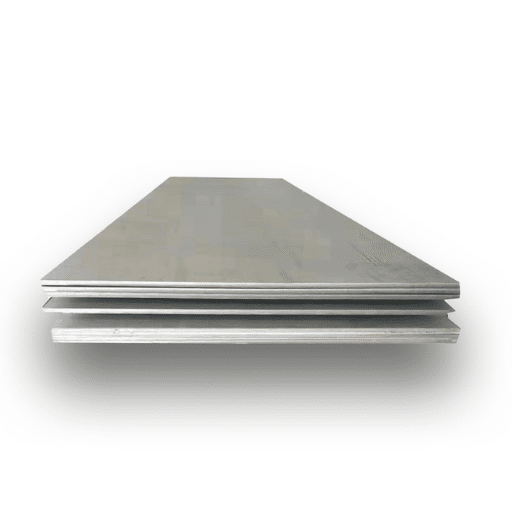
Duplex 2205 is a two-phase austenitic-ferritic stainless steel, specified as UNS S31803 or the tighter-controlled S32205 and as EN 1.4462. It contains roughly 22% chromium, 3% molybdenum, and nitrogen, which produces a PREN near 35 and about twice the yield strength of 316.
Here’s what most specification sheets leave out. “2205” is one commercial name covering two different ASTM compositions, and only one of them can be certified as the other. The grade is also sensitive to how it’s cooled after annealing in a way that 304 and 316 aren’t, and that sensitivity doesn’t show up anywhere on a chemistry certificate.
This guide covers duplex 2205 stainless steel from the buyer’s side of the desk: which specification to write, what each standard covers, what the properties actually mean, how the heat treatment works, and how to confirm that what arrives at your dock is the material you ordered.
Key Takeaways
- Duplex 2205 exists as two UNS compositions, S31803 and S32205. S32205 meets the S31803 specification, but S31803 doesn’t meet S32205, so specify S32205 and accept dual-certified material.
- Yield strength is 450 MPa minimum, roughly double 316, with a tensile minimum of 655 MPa for S32205 and 620 MPa for S31803.
- The grade must be solution annealed at 1020 to 1100 °C and rapidly cooled. Slow cooling through 600 to 900 °C precipitates brittle sigma phase that destroys toughness and corrosion resistance.
- The product standard changes by form. ASTM A240 covers plate, A182 F51/F60 covers forgings and flanges, A790 covers pipe, and A789 covers tube.
- A chemistry certificate proves the heat, not the heat treatment. Where sigma risk matters, the ASTM A923 result is the document that speaks to it.
If you’re choosing between duplex 2205 and 316 rather than specifying 2205 on its own, the full duplex 2205 vs 316 comparison covers that decision in detail. This article stays with the grade itself.
What Is Duplex 2205 Stainless Steel?

“Duplex” describes the microstructure, not the alloy family. Where 304 and 316 are fully austenitic and ferritic grades are fully ferritic, 2205 contains both phases in roughly equal measure. The target is 40 to 60% ferrite in an austenite matrix, and that balance is what gives the grade its character.
The trade names vary by mill and region: Alloy 2205, SAF 2205, 22Cr duplex, F51, F60, and 1.4462 all refer to the same material family. It was developed for pulp and paper bleaching lines, where chloride-bearing process liquors were destroying austenitic grades. Today it accounts for roughly 80% of all duplex stainless steel produced.
The two phases each contribute something specific. The austenite brings ductility and weldability. The ferrite brings the high yield strength and, importantly, interrupts crack propagation, which is why the grade resists chloride stress corrosion cracking so much better than 316.
Within the duplex family, 2205 sits in the middle. Lean duplex grades such as 2304 and LDX 2101 sit below it on alloy content and cost. Super duplex 2507 sits above it. For most chloride service that has outgrown 316, 2205 is the first step up rather than the last.
Not sure whether 2205 is the right step for your service conditions? Our technical team reviews chloride level, temperature, and geometry before recommending a grade. Request a material selection consultation.
S32205 vs S31803: Which Specification Should You Write?
It’s the question almost no supplier page answers, and it’s the one that decides what shows up on your mill certificate.
S31803 was the original UNS designation for 22Cr duplex. As steelmaking improved, producers began aiming at the specification’s top end to guarantee better corrosion performance. That tighter version received its own UNS number: S32205.
| Element | S31803 | S32205 |
|---|---|---|
| Carbon (max) | 0.030% | 0.030% |
| Chromium | 21.0 to 23.0% | 22.0 to 23.0% |
| Nickel | 4.5 to 6.5% | 4.5 to 6.5% |
| Molybdenum | 2.5 to 3.5% | 3.0 to 3.5% |
| Nitrogen | 0.08 to 0.20% | 0.14 to 0.20% |
The practical rule is simple. S32205 meets the S31803 specification, but S31803 doesn’t meet S32205. That’s why S32205 is routinely dual-certified as both grades, while the reverse is impossible.
Why does it matter commercially? Nitrogen does more than raise PREN. It stabilizes austenite, which helps the material rebalance its phases after welding.
Molybdenum raises pitting and crevice resistance. When both elements sit at the bottom of the S31803 range, the actual PREN of that heat can land closer to 32 than 35.
Consider what happened to Daniel, a procurement engineer at a fabrication shop in Rotterdam. He ordered “2205” plate for a brackish water manifold and received two heat certificates in the same shipment, one showing S31803 and one showing S32205.
Both were technically 2205. Only one could have been certified as the other, and the S31803 heat sat at the bottom of the molybdenum range. The shop had to re-qualify the welding procedure for the lower-alloy heat before the customer’s inspector would accept it.
Write the specification as S32205, accept dual-certified material, and require the actual heat chemistry on the certificate. That closes the gap before it opens.
The stainless steel composition guide explains how chromium, molybdenum, and nitrogen each build the passive film, which is useful background if you want the mechanism behind the numbers.
Duplex 2205 Stainless Steel Composition and Equivalent Grades
The full ASTM A240 composition ranges for duplex 2205 stainless steel are below. Manganese is capped at 2.00%, silicon at 1.00%, phosphorus at 0.030%, and sulfur at 0.020% for both UNS numbers.
Under EN 10088, the same material is 1.4462, steel name X2CrNiMoN22-5-3. The EN nitrogen range is typically 0.10 to 0.22%, which is slightly wider than the ASTM ranges and worth noting when you compare certificates from a European mill against an Asian one. If a drawing calls for a duplex 2205 equivalent under a different standard system, the tables below show the direct mapping.
Each element earns its place:
- Chromium builds the passive oxide layer. At 22%, 2205 sits well above the 10.5% threshold that makes a steel “stainless.”
- Molybdenum raises resistance to pitting and crevice corrosion, the two failure modes that end chloride service.
- Nitrogen raises PREN, strengthens the austenite, and keeps the phase balance stable after welding.
- Nickel holds the austenite fraction in place. At 4.5 to 6.5%, it’s far lower than 316’s 10 to 14%, which is a major reason 2205 costs less to produce per unit of performance.
Equivalent Grades Across Standards Systems
| System | Designation |
|---|---|
| UNS | S31803 (original) / S32205 (tighter) |
| EN / DIN | 1.4462, X2CrNiMoN22-5-3 |
| ASTM A182 forgings | F51 (S31803) / F60 (S32205) |
| JIS | SUS 329J3L (S31803) / SUS 329J4L (S32205) |
| GB (China) | 022Cr22Ni5Mo3N / 022Cr23Ni5Mo3N |
| Common trade names | Alloy 2205, SAF 2205, 22Cr duplex |
For orientation, the neighbouring duplex grades map as follows: 1.4362 and S32304 are lean duplex 2304, 1.4410 and S32750 are super duplex 2507, 1.4501 and S32760 carry tungsten, 1.4507 and S32550 correspond to Ferralium 255, and 1.4658 and S32707 are hyper duplex.
Langley Alloys publishes a useful cross-reference for the 1.4462 equivalents if you need to verify a supplier’s mapping.
Mechanical and Physical Properties of Duplex 2205 Stainless Steel

Mechanical properties are where 2205 separates itself from the austenitic grades. The duplex 2205 stainless steel properties below are the ones that decide whether the grade beats 316L in your application, and they are shown as ASTM A240 minimums.
| Property | S31803 | S32205 |
|---|---|---|
| Tensile strength (min) | 620 MPa | 655 MPa |
| Yield strength, 0.2% (min) | 450 MPa | 450 MPa |
| Elongation (min) | 25% | 25% |
| Hardness (typical, not a spec limit) | ~293 HBW (~31 HRC) | ~293 HBW (~31 HRC) |
Against 316L, whose yield strength sits between 170 and 250 MPa, the 450 MPa minimum is the headline. It means a designer can often cut wall thickness substantially at the same pressure rating, which is where duplex 2205 starts to pay for its alloy premium.
There’s a caveat that comes with the strength. Elongation of 25% is lower than 316L’s 40%. Duplex 2205 is stronger but less ductile, which affects forming limits and the amount of springback you get on a press brake. Both are manageable, but they’re real differences on the shop floor.
The Ferrite Window Is the Property That Matters Most
The “roughly 50/50” description is a target, not a fixed number. ASTM A182 F51 specifies 40 to 60% ferrite. Most engineering guidance accepts 35 to 65%, with 45 to 55% cited as ideal for standard duplex.
Ferrite content is measured, not assumed. ASTM E562 uses metallographic point counting, ISO 17781 provides the international equivalent, and a ferritescope calibrated to AWS A4.2 gives a fast field reading. Filler metals and heat treatment both exist to hold that window, which is why they matter so much more here than in an austenitic grade.
One more point that surprises people: duplex 2205 can’t be hardened by heat treatment. It strengthens only through cold work. If your process assumes a hardening step, the grade is the wrong choice.
Physical Properties
| Property | Duplex 2205 | 316L |
|---|---|---|
| Density | 7.80 g/cm³ | 8.00 g/cm³ |
| Elastic modulus | ~200 GPa | ~193 to 200 GPa |
| Thermal expansion (20 to 100 °C) | ~13.7 µm/m·°C | ~16.0 µm/m·°C |
| Thermal conductivity (100 °C) | ~19 W/m·K | ~16.3 W/m·K |
| Magnetic response | Magnetic (ferrite phase) | Non-magnetic (annealed) |
Two consequences follow from that table. First, 2205 is roughly 2.5% lighter per unit volume than 316L, and when you combine lower density with a thinner wall, the weight saving on a piping run becomes substantial. The duplex 2205 vs 316 cost analysis works through the per-metre effect.
Second, the lower coefficient of thermal expansion reduces thermal stress in long piping runs and at dissimilar-metal joints. The modulus is essentially the same as 316L, so duplex stiffness comes from strength rather than from a stiffer material.
The magnetic response comes from the ferrite phase. Annealed 304 and 316 aren’t magnetic; 2205 is. That matters for magnetic particle inspection, for instrumentation that can’t carry residual magnetism, and occasionally for equipment that uses magnetic separators.
The stainless steel properties guide covers how these values compare across the wider grade family, and the steel density reference explains the weight calculations in more depth.
Need 2205 plate, sheet, or pipe with traceable documentation? We supply stainless steel in multiple forms with mill test certification and full heat traceability.
Product Standards: Which Specification Covers Which Form
That’s where more mistakes happen than anywhere else on the page. “2205” isn’t a purchase specification on its own. The standard changes with the product form, and so do the requirements attached to it.
| Product form | Standard |
|---|---|
| Plate, sheet, strip | ASTM A240 / ASME SA-240; EN 10088-2 |
| Bar | ASTM A276, ASTM A479 / ASME SA-479 |
| Forgings, flanges, valves | ASTM A182 F51 (S31803) / F60 (S32205) |
| Seamless and welded pipe | ASTM A790 / ASME SA-790 |
| Welded pipe with filler | ASTM A928 |
| Tube, including heat exchanger | ASTM A789 |
| Buttweld fittings | ASTM A815 |
| Castings | ASTM A995 Grade 4A (CD3MN); ASTM A890 |
| Pressure tube (EN) | EN 10216-5 / EN 10217-7 |
| Sour service | NACE MR0175 / ISO 15156 |
Here’s the trap. ASTM A240, which covers plate, has no heat treatment requirement attached to it. ASTM A182, which covers forgings and flanges, does. The same physical shape ordered against the wrong standard arrives with no verified heat treatment and no ferrite balance requirement.
There’s a second, subtler version. ASTM A182 lists the grade as F51 for S31803 and F60 for S32205. A purchase order that says “A182 F51” is asking for the looser composition. If your design calculations assume PREN 35, the specification and the assumption don’t match.
So the discipline is: name the form and the standard together. Write “A182 F60” for a flange, “A790 S32205” for pipe, “A240 S32205” for plate. Then add the additional requirements you need on top, such as ferrite content reporting and ASTM A923 results.
Heat Treatment and the Sigma-Phase Trap
Duplex 2205’s corrosion resistance and toughness are properties of its microstructure, and the heat treatment is what creates that microstructure. Duplex 2205 heat treatment is therefore not a finishing step but the step that decides what material you actually receive. Get it wrong and the chemistry certificate still reads perfectly while the material behaves badly.
Solution Annealing
The correct heat treatment is a solution anneal at 1020 to 1100 °C (1870 to 2010 °F) followed by rapid cooling, either water quench or forced air. ASTM A790 states this explicitly in its heat treatment table for S32205, and ASTM A182 applies the same requirement to F51 and F60.
The temperature isn’t a suggestion. It’s a floor. Sigma phase, the intermetallic that causes most duplex problems, dissolves completely above roughly 985 to 1000 °C. An anneal that runs below 1020 °C risks leaving some behind.
Note that at least one commercial source specifies 1040 to 1120 °C for fittings. Treat 1020 to 1100 °C as the standards basis and confirm the actual range with your mill.
Why the Cooling Rate Matters
The second half of the heat treatment is cooling, and it gets far less attention than the soak temperature. Secondary phases precipitate when the material passes slowly through roughly 600 to 900 °C, with the worst of it around 750 to 850 °C. Technical literature cites a minimum cooling rate of about 55 °C/min for standard 2205, with water quenching preferred above roughly 6 mm section.
That reported figure isn’t a written ASTM requirement. The standards language is “rapid cooling in water or by other means,” which leaves room for interpretation. In practice, the interpretation determines whether you receive duplex or something that only tests like duplex.
Sigma Phase: The Failure Mode That Doesn’t Show on a Datasheet
Sigma phase is a brittle intermetallic compound rich in chromium and molybdenum. It nucleates at the ferrite-austenite boundaries and grows quickly in that 750 to 850 °C window.
The consequences are severe. Chromium and molybdenum are pulled out of the surrounding matrix, which lowers local PREN and creates pitting initiation sites. Toughness collapses, with reported Charpy values falling from more than 100 J to below 20 J.
Cracking can appear during hydrotesting or in service. That’s the defect behind the widely quoted observation that roughly half of analyzed duplex failures involve sigma phase.
Where does it come from in practice? Slow cooling out of the anneal, and stress-relief post-weld heat treatment. That second one deserves emphasis: stress relief in the 600 to 650 °C band is never required and always harmful for duplex 2205. If stress relief is unavoidable, it belongs in the 300 to 500 °C range, and even then it needs care.
Marta, a QA engineer on a desalination project in the Gulf, learned this the hard way on a heavy-section 2205 flange. The chemistry certificate matched the specification. The tensile and yield tests passed. The ultrasonic examination was clean.
What nobody requested was the Charpy test. When the flange failed to meet the 54 J acceptance limit, the cause turned out to be a cooling rate too slow for its section thickness. The paperwork had been perfect the whole time.
Verifying Heat Treatment
ASTM A923 exists specifically for this problem and provides three methods:
- Method A uses an electrolytic etch with metallographic examination to reveal intermetallic phases.
- Method B is a Charpy impact test with an acceptance value of 54 J (40 ft·lbf) or better.
- Method C is a ferric chloride immersion test that must show no pitting at 20× magnification.
Ferrite content is measured separately by ASTM E562, ISO 17781, or a ferritescope per AWS A4.2.
If your application involves heavy sections, welded assemblies, or any service where sigma formation would be a credible risk, specify A923 testing. It’s an inexpensive addition to a purchase order and the only document that speaks directly to the heat treatment.
Outokumpu publishes duplex datasheets with austenite-ferrite balance data that are useful when you’re setting acceptance criteria.
Product Forms and Applications
Duplex 2205 is produced in a wide range of forms.
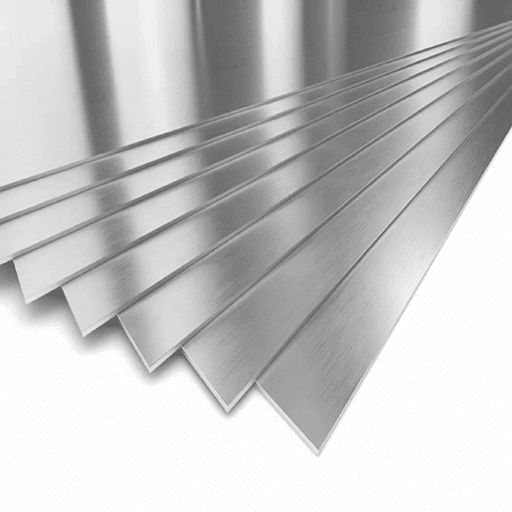
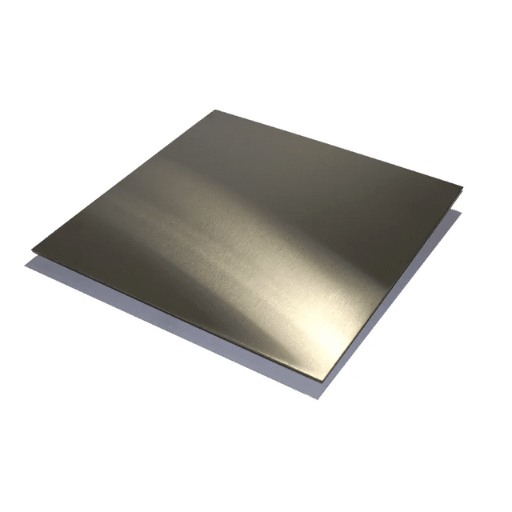
- Sheet and coil: cold rolled, typically 0.3 to 6.0 mm
- Plate: hot rolled, typically 3 to 100 mm
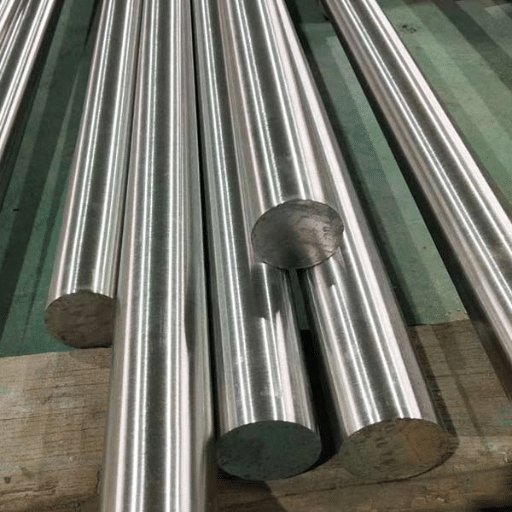
- Bar: round, flat, square, hex, and hollow
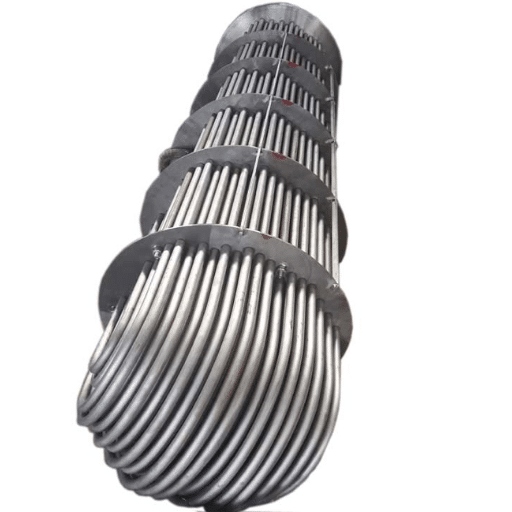
- Pipe and tube: seamless and welded
- Fittings and flanges: butt-weld fittings and forged flanges to A182 F60
- Wire and wire mesh
Because 2205’s strength allows thinner walls, the grade often wins on weight even when it loses on price per kilogram. That’s particularly true for pipe racks, supports, and transport-sensitive assemblies.
Where Duplex 2205 Is Specified
- Pulp and paper: digesters, bleaching lines, and stock handling, the applications the grade was created for.
- Seawater and desalination: reverse osmosis high-pressure piping, brine systems, cooling water, pumps, and valves.
- Oil and gas: flowlines, separators, pressure vessels, pumps, and valves, within the limits set by NACE MR0175 and ISO 15156 for sour service.
- Chemical processing: chloride-bearing acids and brines, organic acids, reactors, and storage tanks.
- Flue gas desulfurization: scrubbers and flue gas handling equipment.
- Marine and offshore: propeller shafts, rudders, shaft seals, fasteners, topside piping, and cargo tanks.
- Hygienic service: pharmaceutical and food-adjacent piping, where 2205 increasingly replaces 316L when chloride exposure or strength demand rises.
- Structural and architectural: footbridges, storage tanks, and load-bearing elements where the strength-to-weight ratio pays for itself.
The stainless steel applications guide covers the broader picture across industries. If your application is specifically pipe or tube, the seamless vs welded pipe comparison explains which route suits which service, since duplex is supplied both ways.
How to Verify Duplex 2205 on Delivery

Documentation is where a specification either holds or falls apart. These are the checks worth building into your incoming inspection process.
- Heat-specific chemistry and calculated PREN on the mill certificate. Ask for the calculated PREN for the delivered heat, not the datasheet value. That’s the single most useful number on the page.
- Dual certification. Confirm the certificate states S32205, and S31803 as well if the mill offers it.
- The correct product standard for the form supplied. A240 for plate, A182 for forgings, A790 for pipe, A789 for tube. A certificate listing the wrong standard is a red flag, not a technicality.
- Ferrite content reported inside the 40 to 60% window, with the method named.
- ASTM A923 results where the specification requires them, particularly for heavy sections and weld qualification.
- EN 10204 3.1 certification with the heat number traceable from the certificate to the marking on the material.
- PMI or XRF on receipt, plus a molybdenum spot check. It’s the same verification discipline our guide on how to tell 304 from 316 stainless steel applies one grade family down, and it works just as well here.
Be clear about what each document proves. A chemistry certificate proves the heat’s composition. It says nothing about heat treatment. Where sigma risk is real, the A923 result is the document that closes that gap, and it’s the one most often missing from a shipment.
If your project needs cut-to-size material with documentation prepared to your specification, our custom processing service covers cutting, finishing, and certification preparation.
Duplex 2205 in the Duplex Family: 2304, 2205, 2507
It helps to see where 2205 sits relative to its neighbours before you commit to it.
| Grade | UNS | Typical PREN | Position |
|---|---|---|---|
| Lean duplex 2304 | S32304 | ~26 | Corrosion similar to 316L, roughly double the strength, lower cost |
| LDX 2101 | S32101 | ~26 | Leaner still, positioned against 304 |
| Standard duplex 2205 | S31803 / S32205 | ~35 | The workhorse grade for chloride service |
| Super duplex 2507 | S32750 | ~40 to 43 | Heated seawater, sour service, higher chloride |
| Hyper duplex | S32707 | >45 | Extreme service, niche availability |
Two moves are common from 2205. Downward, a lean duplex such as 2304 can replace 316L at higher strength and often lower cost, which is worth checking before defaulting to 2205. Upward, super duplex 2507 becomes the answer when chloride levels climb, temperature rises, or sour service enters the picture.
For the corrosion triggers behind each step, the duplex 2205 vs 316 corrosion breakdown sets out the chloride and temperature thresholds. For the cost side, the 2205 vs 316 cost article covers price by form and lifecycle payback.
Frequently Asked Questions
What is duplex 2205 stainless steel?
Duplex 2205 is a two-phase stainless steel with roughly equal austenite and ferrite, specified as UNS S31803 or S32205 and as EN 1.4462. Its 22% chromium, 3% molybdenum, and nitrogen content give it a PREN near 35 and about twice the yield strength of 316.
What is the difference between S31803 and S32205?
S32205 tightens the chromium range to 22.0 to 23.0%, the molybdenum range to 3.0 to 3.5%, and raises minimum nitrogen from 0.08% to 0.14%. S32205 meets the S31803 specification, but S31803 doesn’t meet S32205, so S32205 is routinely dual-certified.
Is 2205 the same as 1.4462?
Yes. EN 1.4462, steel name X2CrNiMoN22-5-3, and UNS S31803/S32205 describe the same duplex 2205 material. The EN nitrogen range is typically 0.10 to 0.22%, slightly wider than the ASTM ranges.
What are F51 and F60 in ASTM A182?
F51 is the ASTM A182 designation for S31803 and F60 is the designation for S32205. When ordering forged flanges, fittings, or valves, specifying F60 asks for the tighter composition.
What is the composition of duplex 2205?
S32205 contains 22.0 to 23.0% chromium, 4.5 to 6.5% nickel, 3.0 to 3.5% molybdenum, 0.14 to 0.20% nitrogen, and 0.030% carbon maximum. S31803 uses wider ranges of 21.0 to 23.0% chromium, 2.5 to 3.5% molybdenum, and 0.08 to 0.20% nitrogen.
What are the mechanical properties of duplex 2205?
The minimum yield strength is 450 MPa, and the minimum elongation is 25%. Tensile minimums are 655 MPa for S32205 and 620 MPa for S31803. Hardness is capped around 293 HBW, roughly 31 HRC.
What is the density of duplex 2205?
Duplex 2205 has a density of approximately 7.80 g/cm³, compared with about 8.00 g/cm³ for 316L. The lower density, combined with reduced wall thickness, produces meaningful weight savings.
Can duplex 2205 be hardened by heat treatment?
No. Duplex 2205 can’t be hardened by heat treatment and strengthens only through cold work. It’s solution annealed to restore the ferrite-austenite balance, not to increase hardness.
What temperature is duplex 2205 solution annealed at?
The standard range is 1020 to 1100 °C (1870 to 2010 °F) followed by rapid cooling in water or forced air. At least one commercial source cites 1040 to 1120 °C for fittings.
What is the maximum service temperature of duplex 2205?
Continuous service is generally limited to about 300 to 315 °C. Above that range, sigma phase and 475 °C embrittlement degrade toughness and corrosion resistance, and the damage can only be corrected by a full solution anneal.
Is duplex 2205 magnetic?
Yes. The ferrite phase makes duplex 2205 magnetic, unlike annealed 304 and 316, which aren’t. This matters for magnetic particle inspection and for instrumentation sensitive to residual magnetism.
Can duplex 2205 be welded?
Yes, using GTAW, GMAW, SMAW, or SAW with over-alloyed ER2209 filler. Heat input, interpass temperature, and shielding gas composition all need control to hold the ferrite balance after welding.
What is the PREN of duplex 2205?
S31803 typically achieves a PREN of about 30 to 33, while the tighter S32205 reaches about 34 to 36. PREN is calculated as %Cr + 3.3 × %Mo + 16 × %N.
What forms is duplex 2205 available in?
Sheet and coil, hot-rolled plate, bar in several profiles, seamless and welded pipe and tube, forged flanges, butt-weld fittings, wire, and wire mesh.
How do I verify that duplex 2205 is genuine?
Request the heat-specific chemistry and calculated PREN on the mill certificate, confirm the product standard matches the form, check the ferrite content report, and ask for ASTM A923 results where relevant. Confirm EN 10204 3.1 certification and run PMI or XRF on receipt.
Conclusion
Duplex 2205 stainless steel rewards buyers who read the details. It’s one commercial grade with two specifications, and specifying S32205 rather than S31803 is the difference between a guaranteed PREN near 35 and one that may land closer to 32.
Three actions cover most of the risk:
- Write S32205 as the specification and accept dual-certified material.
- Name the product standard for the form, because A240, A182, A790, and A789 don’t impose the same requirements.
- Require the documentation that matters: heat-specific chemistry, ferrite content, EN 10204 3.1, and ASTM A923 where heavy sections or welds are involved.
The heat treatment deserves the same attention as the chemistry. Solution annealing at 1020 to 1100 °C with rapid cooling is what produces the duplex microstructure, and slow cooling through 600 to 900 °C destroys it in ways a chemistry certificate won’t reveal.
A pulp mill in Southeast Asia found this out when it replaced 316L bleach plant piping with 2205 and then extended the same specification to a set of heavy-section fittings. The piping performed as expected.
The fittings, supplied without A923 testing and with an unverified cooling practice, developed cracking within the first year. The alloy choice had been right. The documentation had not been enforced.
If you’re specifying duplex 2205 and want the paperwork to hold up, our technical team can review your requirements before the order goes out. Contact LIANYUNGANG DAPU METAL for duplex 2205 and 316/316L availability, mill test documentation, custom processing, and a quote on the forms you need.