Duplex 2205 (UNS S32205) is roughly twice as strong as 316 stainless steel and far more resistant to chloride pitting, crevice corrosion, and stress corrosion cracking, with a PREN of about 35 against about 25 for 316L. It costs 1.8 to 2.2 times more per kilogram and works only between roughly -50°C and 300°C. Choose duplex 2205 for warm chloride and seawater service. Stay with 316 above 300°C, below -50°C, or in clean, cold, low-chloride duty.
That single paragraph decides most projects. The hard part is knowing which side of the line your service falls on, and that is where the numbers matter more than the marketing.
Consider a chemical plant that ran a 316L brine line at 45°C. The line met every specification at commissioning. Eighteen months later, pinhole leaks from chloride pitting shut the process down for four days.
The 2205 replacement has now run seven years without a wall-thickness alarm. The material cost doubled. The failure cost far more than the material ever did.
Most engineers already know 316 is the default answer for stainless steel. This duplex 2205 vs 316 stainless steel guide gives you the thresholds, the mechanical data, the welding rules, and the 2026 pricing you need to decide when the duplex premium pays for itself. For the broader grade picture first, see our complete stainless steel guide.
Key Takeaways
- Duplex 2205 delivers a minimum yield strength of 450 MPa against 170 MPa for 316L, so the same pressure rating often permits a 30 to 50% thinner wall.
- PREN separates the two grades decisively: about 35 for 2205 against about 25 for 316L. That gap is a step change in chloride performance, not a marginal gain.
- 2205 resists chloride stress corrosion cracking past 100°C, while 316 can crack above roughly 60°C under tensile stress.
- The temperature window is the catch. 2205 is limited to about -50°C to 300°C because of sigma phase and 475°C embrittlement. 316 covers -196°C to about 800°C.
- Welding 2205 requires ER2209 filler, heat input of 0.5 to 2.5 kJ/mm, interpass below 150°C, and no post-weld heat treatment. Austenitic fillers like ER316L must never be used.
What Is the Difference Between Duplex 2205 and 316 Stainless Steel?

Duplex 2205 is a two-phase stainless steel with roughly equal parts austenite and ferrite. 316 is fully austenitic. That single microstructural difference explains almost everything else: the doubled yield strength, the higher pitting resistance, the magnetic response, and the tighter welding discipline.
Three differences decide real projects.
- Strength. 2205 reaches at least 450 MPa yield, so thinner walls carry the same pressure. This changes cost, weight, and support spacing.
- Chloride corrosion resistance. PREN of about 35 makes 2205 suitable for seawater and warm brine that 316 cannot handle.
- Fabrication discipline. 2205 is less forgiving. Filler metal, heat input, and interpass temperature are not suggestions.
Everything that follows in this comparison flows from those three points. A quick table sets the baseline.
| Property | 316 / 316L | Duplex 2205 | Advantage |
|---|---|---|---|
| Microstructure | 100% austenite | ~50% austenite, ~50% ferrite | 2205 |
| Yield strength (min) | 170-205 MPa | 450 MPa | 2205 (2.2-2.6x) |
| Tensile strength (min) | 485-515 MPa | 620 MPa | 2205 |
| PREN | 24-26 | 34-36 | 2205 |
| Chloride SCC threshold | ~60°C | >100°C | 2205 |
| Max service temperature | ~800°C | ~300°C | 316 |
| Min service temperature | -196°C | ~-50°C | 316 |
| Magnetic | No (annealed) | Yes | Neutral |
| Price per kg (pipe, 2026) | $2.20-4.30 | $4.80-7.20 | 316 |
Neither column wins outright. The right answer depends on which row your project is limited by.
Duplex 2205 vs 316 Chemical Composition and Grade Equivalents
The composition difference is where the performance comes from. Duplex 2205 carries more chromium and molybdenum than 316, adds nitrogen, and uses far less nickel.
| Element | 316 / 316L | Duplex 2205 |
|---|---|---|
| Chromium | 16.0-18.0% | 22.0-23.0% |
| Nickel | 10.0-14.0% | 4.5-6.5% |
| Molybdenum | 2.00-3.00% | 3.0-3.5% |
| Nitrogen | ≤0.10% | 0.14-0.20% |
| Carbon | ≤0.08 / ≤0.03% | ≤0.03% |
| Manganese | ≤2.00% | ≤2.00% |
| Silicon | ≤0.75% | ≤1.00% |
Grade Equivalents
Both grades cross-reference across standards, and buyers should confirm equivalents on the mill certificate before ordering.
- Duplex 2205: UNS S32205 (and the older S31803), EN 1.4462, X2CrNiMoN22-5-3, ASTM A182 F51 for forgings, F60 for higher-strength forgings.
- 316: UNS S31600, EN 1.4401, ASTM A182 F316.
- 316L: UNS S31603, EN 1.4404 (and 1.4435 for the low-carbon variant), ASTM A182 F316L.
Note one specification detail that trips up buyers. UNS S32205 and S31803 are both sold as “2205,” but S32205 has tighter ranges on chromium, molybdenum, and nitrogen. When corrosion resistance matters, specify S32205 explicitly. Our article on stainless steel composition covers how alloying elements drive performance across the grade family.
The PREN Formula
PREN, the Pitting Resistance Equivalent Number, is the fastest way to rank stainless steels for chloride service.
PREN = %Cr + 3.3 × %Mo + 16 × %N
Running the midpoint compositions:
- Duplex 2205: 22 + (3.3 × 3.25) + (16 × 0.17) = about 35
- 316L: 17 + (3.3 × 2.5) + (16 × 0) = about 25
A ten-point PREN gap changes which environments a material survives. The International Molybdenum Association maintains reference data on duplex metallurgy and PREN calculations if you want to verify values for other grades.
One commercial nuance is worth noting. Because 2205 uses roughly half the nickel of 316, its price tracks nickel volatility less closely. In a rising nickel market, that can narrow the cost gap faster than buyers expect.
Corrosion Resistance: Duplex 2205 vs 316 Stainless Steel
Corrosion is usually the reason the comparison happens at all. The two grades separate clearly here, and the separation is measurable.
| Corrosion Test | 316 / 316L | Duplex 2205 |
|---|---|---|
| PREN | 24-26 | 34-36 |
| Critical pitting temperature (ASTM G48 Method E) | ~15-18°C | ~35-40°C |
| Critical crevice temperature (ASTM G48 Method F) | Below 0°C | ~20-25°C |
| Chloride SCC threshold | ~60°C | >100°C |
| Seawater service | Not qualified | Entry-level grade |
Pitting and Crevice Corrosion
The critical pitting temperature is the useful design number. For 316L, pitting begins in the 15 to 18°C range in standard chloride test conditions. For 2205, that threshold sits near 35 to 40°C. Crevice corrosion is the more damning comparison: 316L effectively fails below 0°C in the standard crevice test, while 2205 holds to roughly 20 to 25°C.
In practice, crevices form at gaskets, under deposits, at weld toes, and inside threaded joints. Those are exactly the places 316 fails first in warm chloride service, and exactly the places 2205 buys you margin.
Stress Corrosion Cracking
Chloride stress corrosion cracking is the failure mode that ends 316’s career in warm service. Fully austenitic stainless steels can crack above roughly 60°C when tensile stress and chlorides combine, which is why insulated 316 lines in coastal plants fail without warning.
Duplex 2205 resists chloride SCC well beyond 100°C, because the ferrite phase interrupts crack propagation. This is the single strongest argument for the upgrade in chemical and process environments.
Seawater
Under NORSOK M-001, the Norwegian offshore material selection standard, 316L is not qualified for seawater service. Duplex 2205 is listed as the entry-level seawater material, with 6Mo alloys and super duplex 2507 above it. Our article on 316 stainless steel for marine service covers where austenitic grades stop, and the full corrosion mechanics sit in our stainless steel corrosion resistance guide.
Where 2205 Still Fails
Duplex is not immune. Hot concentrated brine, tight crevices, and chlorides combined with oxygen at elevated temperature can attack 2205 as well. Those limits are what trigger the step up to super duplex 2507 or a 6Mo alloy. For a deeper treatment of thresholds and test methods, our companion article on duplex 2205 vs 316 corrosion resistance goes further.
Not sure which grade your chloride service needs? Our engineers review service conditions, chloride levels, and temperature profiles daily. Get material selection help from our technical team before you commit to a specification.
Strength and Mechanical Properties
This is where duplex 2205 makes its case as an engineering material rather than just a corrosion upgrade.
| Property | 316L | 316 | Duplex 2205 |
|---|---|---|---|
| Yield strength (0.2% offset, min) | 170 MPa | 205 MPa | 450 MPa |
| Tensile strength (min) | 485 MPa | 515 MPa | 620 MPa |
| Elongation (min) | 40% | 40% | 25% |
| Hardness | ~150-200 HB | ~150-200 HB | ~180-293 HB |
| Density | 8.00 g/cm³ | 8.00 g/cm³ | 7.80 g/cm³ |
| Elastic modulus | ~193 GPa | ~193 GPa | ~200 GPa |
Why the Duplex Microstructure Doubles Yield
The ferrite phase carries load efficiently and constrains plastic flow in the austenite, so the material resists deformation at roughly twice the stress. That is the entire mechanism. The two phases also trade properties: ferrite brings strength and chloride resistance, austenite brings toughness and weldability.
The Modulus Misconception
Stiffness doesn’t improve. The elastic modulus is essentially identical at about 200 GPa against 193 GPa.
This matters commercially. If your design is deflection-limited, such as a long unsupported span, duplex buys you nothing. If your design is stress-limited, such as a pressure boundary, it buys you a lot.
The Trade-off in Ductility
The elongation drops from 40% in 316L to 25% in 2205. That lower ductility is the reason 2205 is harder to bend, harder to deep draw, and less forgiving in forming operations. It also explains the tighter welding discipline, since the material has less capacity to absorb residual strain.
For a full breakdown of the mechanical data, see our article on stainless steel mechanical properties.
The Strength-to-Weight Advantage: Wall Thickness and Cost Impact

The strength advantage translates directly into saved material, and this is the part that changes the cost conversation.
Because allowable stress in pressure design codes scales with yield strength, the same design pressure permits a much thinner wall in 2205. An illustrative comparison: where a 316L line needs 8.0 mm wall, a 2205 line at the same pressure rating may need only 5.0 mm.
The effects compound.
- Less weight. A 30 to 50% thinner wall cuts weight by a similar order, which matters for pipe racks, offshore topsides, and transport.
- Less weld volume. Thinner walls mean less filler metal and faster welding per joint.
- Smaller supports. Lighter pipe needs lighter structural support.
- Lower cost per metre. The per-kilogram premium narrows considerably once you compare cost per metre at equal pressure rating, and in some specifications it nearly disappears.
That last point is the one buyers miss most often. Comparing duplex 2205 and 316 by price per kilogram alone systematically overstates the duplex premium. The honest comparison is cost per metre, or cost per pressure rating, at the wall thickness each grade actually needs.
Want the numbers for your own specification? Send us your line sizes and pressure ratings and we will work through the wall-thickness and cost comparison with you. Request a quote for duplex or 316 stainless products.
Temperature Limits: Where Each Grade Works
This section is where duplex loses, and ignoring it is how 2205 projects go wrong.
| Service Condition | 316 / 316L | Duplex 2205 |
|---|---|---|
| Cryogenic | Good to -196°C | Not suitable below ~-50°C |
| Ambient to 300°C | Excellent | Excellent |
| Above 300°C | Good to ~800°C | Not suitable |
| Design cap (ASME Section II Part D) | Well above 300°C | 315°C (600°F) |
| Long exposure 300-525°C | Acceptable | 475°C embrittlement risk |
Why 2205 Has a Ceiling
Two embrittlement mechanisms set the upper limit.
Sigma phase. Between roughly 550°C and 1000°C, and most aggressively at 700 to 950°C, chromium-rich sigma phase precipitates at the ferrite-austenite boundaries. In 2205 it can nucleate within 2 to 5 minutes at 800 to 900°C. The damage is twofold: chromium depletion next to the precipitate drops the local PREN below the pitting threshold, and impact toughness collapses from above 100 J to below 20 J. Roughly half of analysed duplex failures involve sigma phase.
475°C embrittlement. Prolonged exposure between 300°C and 525°C embrittles the ferrite through alpha-prime precipitation. This is a slow, cumulative mechanism, which makes it easy to miss until a component cracks.
Why 316 Has No Practical Ceiling in Comparison
Austenitic 316 has no ferrite phase, so neither mechanism applies. It holds toughness down to liquid nitrogen temperatures and resists oxidation to roughly 800°C, though its strength falls off well before that. For cryogenic service and high-temperature service, 316 is simply the correct answer.
The practical rule is short. If your service is above 300°C or below -50°C, duplex 2205 is off the table. Our article on duplex 2205 temperature limits covers the embrittlement bands in detail.
Duplex Stainless Steel Welding and Fabrication
Welding is where 2205 projects most often fail, and where the trade-off becomes practical rather than theoretical.
Filler Metal Is Not Negotiable
Use ER2209 for duplex 2205 and for 2205-to-316 dissimilar joints. Never use ER308L, ER316L, or ER309L on duplex.
The reason is metallurgical. Duplex welding burns out nitrogen, which is a potent austenite stabilizer. ER2209 compensates by carrying 2 to 4% more nickel than the base metal, so the weld deposit can rebalance toward the target phase mix.
Austenitic fillers carry no such compensation. A deposit made with ER308L comes out more than 80% ferritic, far below the base metal PREN, and prone to solidification cracking.
That isn’t a theoretical risk. An offshore contractor once welded 2205 subsea pipe with ER308L wire that was already in the shop. Solidification cracks propagated through the girth welds within three months, and the repair bill ran into six figures. The Welding and Fabrication technical library covers the ferrite number requirements in ASME SFA-5.9 if you want the consumable specification detail.
Procedure Parameters
- Heat input: 0.5 to 2.5 kJ/mm, with 0.8 to 1.5 kJ/mm as the practical sweet spot.
- Interpass temperature: 150°C maximum. Seawater specifications often tighten this to 120°C, and super duplex 2507 caps at 100°C. Austenitic 316L permits 175°C.
- Shielding and purge gas: argon with 1 to 2% nitrogen. Pure argon produces too much ferrite.
- Ferrite target: 30 to 65 ferrite number, roughly 35 to 65% ferrite by volume, verified by ferritescope or metallography during procedure qualification.
Heat input cuts both ways. Too low, and fast cooling leaves excess ferrite and chromium nitrides in the heat-affected zone. Too high, and slow cooling through the 800 to 900°C band gives sigma phase time to form.
No Post-Weld Heat Treatment
Conventional stress relief sits at 595 to 760°C, directly inside the sigma precipitation zone. Applying it to duplex turns a sound weld brittle. The as-welded condition is correct.
The only acceptable thermal treatment is a full solution anneal at 1020 to 1100°C followed by a rapid water quench, and only when ferrite balance falls outside the target range or corrosion testing fails. Procedure qualification should include ASTM A923 Methods A/B/C to screen for detrimental intermetallic phases.
Machining and Formability
Duplex 2205 machines more slowly than 316L, typically 20 to 30% lower cutting speeds, with higher tool wear and more attention to work hardening. Forming is harder too. The lower elongation of 25% and higher springback make bending and deep drawing less forgiving.
A fabricator who normally runs 316 will need to adjust speeds, feeds, and tooling. Our article on duplex 2205 machining and formability covers shop-floor practice, and Northern Manufacturing publishes a useful fabrication overview for duplex grades.
If your workshop has not run duplex before, plan a procedure qualification before the production run rather than during it. That single step prevents most of the failures described above.
Is Duplex 2205 Magnetic?
Yes. Duplex 2205 is noticeably magnetic because of its ferrite phase, with relative permeability typically in the 1.5 to 5 range. Annealed 316 is essentially non-magnetic, with permeability close to 1.0.
Three practical consequences follow.
- Inspection. Magnetic particle inspection works on 2205 but gives misleading results on annealed 316. NDT procedures must match the material.
- Instrumentation. Magnetic flowmeters and other magnetic-sensitive devices need review when duplex replaces austenitic grades.
- Field identification. A magnet will attract 2205, which helps distinguish it from annealed 316. It will not distinguish it from carbon steel, so a magnet is a screening tool rather than a test.
One caveat on 316: cold working induces strain-induced martensite, so heavily cold-formed or machined 316 becomes weakly magnetic. That’s normal and doesn’t indicate a material problem. Duplex is a different case entirely, since its magnetism comes from the microstructure itself. Our article on duplex stainless steel magnetism covers the mechanisms, and our guide on telling 304 from 316 covers field identification more broadly.
Cost Comparison: Duplex 2205 vs 316 Stainless Steel in 2026
The premium is real, and buyers should know its size before they evaluate the trade.
| Product Form | 316 / 316L | Duplex 2205 |
|---|---|---|
| Pipe, welded | $2.45-3.80/kg | $5.00-7.00/kg |
| Pipe, seamless | $2.85-4.30/kg | $4.80-7.20/kg |
| Bar and plate | Varies by size | Typically 1.8-2.2x 316 |
Expect duplex 2205 to run roughly 1.8 to 2.2 times the price of 316L per kilogram in typical pipe sizes, with small volumes and demanding specifications running higher. Prices move with alloy surcharges, so treat these as indicative ranges and confirm at quote.
What Drives the Premium
Two elements do the work. Duplex 2205 carries more chromium and substantially more molybdenum, both of which cost more than iron or nickel. The offsetting factor is nickel: 2205 uses 4.5 to 6.5% against 10 to 14% in 316L.
Because nickel is the most volatile of the alloying elements, 2205’s cost is more stable, even when its absolute price is higher. Our article on 316 vs 304 pricing covers how nickel content drives grade pricing across the family.
Where the Premium Gets Recovered
The per-kilogram gap is not the whole story, and in chloride service it is not even the main one.
A worked example, with assumptions stated. Take a brine cooling line in warm chloride service. A 316L line needs replacement about every 18 to 24 months in this duty. A 2205 line, based on the corrosion thresholds above, can be expected to run many years without replacement.
Set the 316L replacement cost at material plus fabrication plus the downtime for each changeout, and the 2205 premium is typically recovered well inside the second replacement cycle. Published case material from suppliers in this segment consistently reports payback in the range of two to four years in genuinely aggressive chloride service, though the figure depends heavily on downtime cost, which dwarfs material cost in most plants.
The conclusion isn’t that duplex always wins. It’s that cost per kilogram is the wrong metric for a corrosion-limited component. Cost per year in service is the right one.
Comparing options for a specific duty? Our team can work through the lifecycle numbers with you, including the stainless forms we supply. Talk to our material specialists or request a quote.
Applications: When to Choose 2205 vs 316
The application matrix is the fastest way to reach a decision.
| Duty | Recommended Grade | Reason |
|---|---|---|
| Seawater cooling, desalination | Duplex 2205 | Above the chloride limit for 316 |
| Offshore flowlines and manifolds | Duplex 2205 (or 2507) | Chloride SCC resistance plus strength |
| Chemical processing, acetic and phosphoric acid | Duplex 2205 | Higher PREN, better general corrosion resistance |
| Pulp and paper digesters, FGD scrubbers | Duplex 2205 | Chloride plus temperature |
| Chemical tanker cargo tanks | Duplex 2205 | Corrosion plus weight saving |
| High-strength structural, bridges | Duplex 2205 | Yield strength reduces section size |
| Food, dairy, beverage | 316L | Clean, low-chloride, easy to clean |
| Pharmaceutical and hygienic | 316L | Surface finish and cleanability |
| Cryogenic service | 316L | 2205 embrittles below -50°C |
| Service above 300°C | 316L or 316H | Sigma phase limits 2205 |
| Architectural and above-water marine fittings | 316L | Adequate resistance at lower cost |
The Three-Tier Escalation
Think of chloride service as a ladder with three rungs. 316L covers clean, cool, low-chloride duty. Duplex 2205 covers warm chloride, seawater, and strength-driven designs within its temperature window. Super duplex 2507 covers higher chloride at higher temperatures, where PREN above 40 is needed.
Our article on 2205 vs 2507 duplex covers the top rung, and lean duplex vs 316 covers the budget option between the first two rungs.
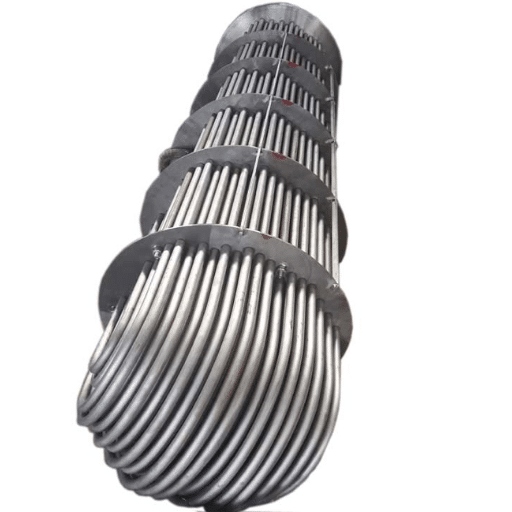
For heat exchanger and seawater duties specifically, our article on duplex 2205 heat exchanger service walks through tube selection.
When 316 Is Still the Right Choice

A comparison that only argues for the premium grade is a sales pitch, not engineering advice. Duplex 2205 is the wrong answer in several common situations.
High-temperature service. Above 300°C, 2205 is unavailable. Use 316 or another austenitic grade.
Cryogenic service. Below -50°C, the ferrite phase in 2205 becomes brittle. 316 holds toughness to -196°C.
Complex forming. The lower elongation of 2205 makes deep drawing, tight bending, and complex press work harder and more expensive. If the part is heavily formed, 316 usually wins on total cost.
Clean, cold, low-chloride duty. If the environment will not attack 316, the duplex premium buys nothing. Paying it is a cost, not a safety margin.
Magnetic sensitivity. Magnetic flowmeters, magnetic separation, and magnetic-sensitive assemblies may rule out duplex.
Availability. 316 and 316L are stocked in far more sizes, finishes, and forms than 2205. Lead time and minimum order quantity are real selection criteria.
The costliest specification error in this comparison runs in both directions. Specifying 316 in warm chloride service produces failures. Specifying 2205 in clean, cool service produces invoices with nothing to show for them. Our 316 stainless steel guide covers the austenitic side in full, and the 304 vs 316 comparison covers the grade decision one rung below this one.
Frequently Asked Questions
Is duplex 2205 better than 316 stainless steel?
2205 is better where chlorides, seawater, or high strength drive the design, because it has roughly twice the yield strength and a PREN of about 35 against about 25. 316 is better above 300°C, below -50°C, in heavily formed parts, and in clean, cold service where the duplex premium buys nothing.
Why is duplex 2205 stronger than 316?
2205 has a two-phase microstructure of roughly 50% austenite and 50% ferrite. The ferrite phase carries load and constrains plastic flow in the austenite, so 2205 reaches a minimum yield of 450 MPa against 170 MPa for 316L. Elastic modulus, however, is nearly identical, so stiffness does not improve.
What is the PREN of duplex 2205 vs 316?
Using the formula PREN = %Cr + 3.3 × %Mo + 16 × %N, duplex 2205 calculates to about 35 while 316L calculates to about 25. That ten-point gap explains the difference in pitting, crevice, and stress corrosion cracking performance.
Can 316 stainless steel be used in seawater?
Generally no, for wetted or immersed service. Under NORSOK M-001, 316L is not qualified for seawater, because its critical crevice temperature falls below 0°C and it is prone to chloride pitting and stress corrosion cracking. Duplex 2205 is the entry-level seawater material.
What is the temperature limit of duplex 2205?
Roughly -50°C to 300°C, with the ASME Section II Part D design limit set at 315°C (600°F). Above that range, sigma phase forms between 550°C and 1000°C, and prolonged exposure between 300°C and 525°C causes 475°C embrittlement.
Is duplex 2205 magnetic?
Yes. The ferrite phase makes duplex 2205 magnetic, with relative permeability typically between 1.5 and 5. Annealed 316 is essentially non-magnetic, though cold working makes it weakly magnetic through strain-induced martensite.
Can duplex 2205 be welded to 316?
Yes. Use ER2209 filler for the dissimilar joint. ER2209 is over-alloyed with extra nickel to compensate for nitrogen loss, which keeps the weld deposit in the correct phase balance. Never use ER308L or ER316L on the duplex side of the joint.
What filler metal is used for duplex 2205?
ER2209. It carries 2 to 4% more nickel than the base metal so the weld can rebalance toward the target phase mix. Austenitic fillers such as ER308L, ER316L, and ER309L must not be used, because they produce weld metal over 80% ferritic that is prone to cracking.
How much thinner can duplex 2205 be than 316 at the same pressure rating?
Typically 30 to 50% thinner, because allowable stress scales with yield strength. An illustrative case: 8.0 mm in 316L against 5.0 mm in 2205 at equal design pressure. This reduces weight, weld volume, and support requirements, and narrows the cost gap considerably.
Is 2205 much more expensive than 316?
Expect roughly 1.8 to 2.2 times the price per kilogram for 2205 in typical pipe sizes, with a 2026 range of about 4.80to4.80to7.20/kg against 2.20to2.20to4.30/kg for 316L. In chloride service, the wall-thickness saving and the avoided replacement cost often recover that premium within a few years.
Conclusion
Duplex 2205 and 316 stainless steel solve different problems. Duplex 2205 brings roughly twice the yield strength, a PREN near 35 against about 25, and chloride stress corrosion cracking resistance beyond 100°C. In exchange, it costs 1.8 to 2.2 times more per kilogram and works only between roughly -50°C and 300°C. It also demands welding discipline that 316 does not, starting with ER2209 filler and no post-weld heat treatment.
The decision comes down to three questions. Is the service chloride-bearing and warm? Is strength driving the design? Is the service temperature between -50°C and 300°C?
Three yes answers point to duplex 2205. Any no answer points back to 316 or 316L.
Get that right, and the duplex 2205 vs 316 stainless steel decision stops being a matter of opinion. It becomes a specification with numbers behind it, and a component that lasts as long as the design intended.
Whether you need duplex 2205 plate, sheet, or pipe, or 316L for applications where austenitic grades are correct, our team can help you specify and source it. Send your service conditions and dimensions, and we will come back with a grade recommendation, a mill certificate scope, and a quote.