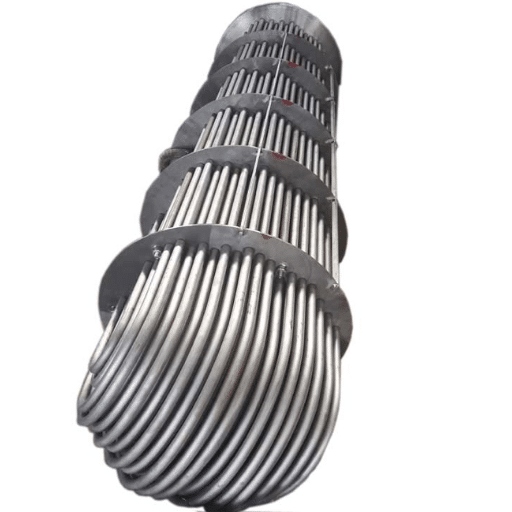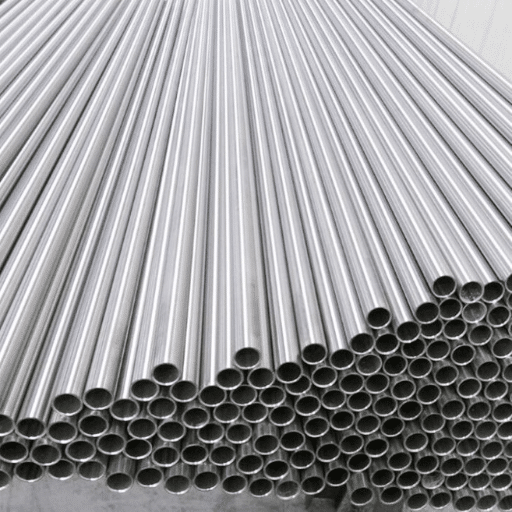
Duplex 2205 heat exchanger tubes (UNS S32205) are specified to ASTM A789 in seamless or welded form, most commonly 19.05 mm or 25.4 mm outside diameter with BWG 14 to 18 wall, solution annealed at 1020-1100°C to hold a 40-55% ferrite balance. They handle seawater, brine, and chloride cooling where 316L pits, inside a design window of roughly -50°C to 315°C. They still fail in hot concentrated brine, stagnant crevices, and badly designed tube-to-tubesheet joints.
A seawater-cooled 316L bundle that pits through in eighteen months rarely fails because someone chose the wrong steel grade. It fails because the tubes, the tubesheet, and the joint were specified separately by three people who never compared notes. Duplex 2205 solves the grade problem and quietly leaves the other two in place.
That gap is what this guide addresses. You’ll get the tube standard and form, the service envelope with real numbers, the tubesheet pairing that actually works, what to demand on the mill certificate, and the twenty-year cost against 316L. If you are still deciding between grades, start with our duplex 2205 vs 316 stainless steel grade comparison.
Key Takeaways
- Duplex 2205 exchanger tube is ordered to ASTM A789 / ASME SA789 in seamless or welded form, most commonly 19.05 mm and 25.4 mm OD with BWG 14-18 wall. ASTM A790 covers pipe, not tube, and the two are not interchangeable.
- 2205 is the entry-level seawater material: PREN ~35 versus ~25 for 316L, immunity to chloride stress corrosion cracking well past 100°C, and about 2.5x the yield strength, which allows 30-50% thinner walls.
- The ASME design ceiling is 315°C (600°F); long-term practice is usually held to 250-300°C because of 475°C alpha-prime embrittlement. Below about -50°C, use 316L instead.
- The tubesheet pairing matters as much as the grade. 2205 tubes in a 316L tubesheet move the failure to the joint. Demand ER2209 filler, orbital GTAW, and ferrite records for both base metal and HAZ.
- A cooling-tower exchanger modeled at 52,000(316L)versus52,000(316L)versus68,000 (2205) returns roughly 134,000versus134,000versus84,000 over 20 years, about 37% lower lifecycle cost with break-even near 18 months.
Can Duplex 2205 Be Used for Heat Exchangers?

Yes. Duplex 2205 (UNS S32205) is the standard entry-level upgrade from 316L for chloride-bearing exchanger duty. Tube is specified to ASTM A789 in seamless or welded form, solution annealed at 1020-1100°C, and used for condensers, seawater coolers, brine heaters, and desalination service within a -50°C to 315°C design window.
The reason comes down to three numbers. Duplex 2205 carries a pitting resistance equivalent number (PREN) near 35, against roughly 25 for 316L. Its yield strength is at least 450 MPa, against 170 MPa. And it resists chloride stress corrosion cracking far beyond the 60°C ceiling where 300-series austenitics begin to crack.
| Property | 316L | Duplex 2205 (S32205) | Which wins |
|---|---|---|---|
| PREN | ~25 | ~35 | 2205 |
| Yield strength (0.2%) | ≥170 MPa | ≥450 MPa | 2205 |
| Chloride SCC threshold | ~60°C | Well above 100°C | 2205 |
| Seawater pitting | Pits in warm, low-flow chlorides | Effectively immune | 2205 |
| Max service temperature | ~800°C | 315°C | 316L |
| Low-temperature limit | ~-196°C | ~-50°C | 316L |
| Weldability | Very easy | Requires control | 316L |
| Relative cost, tube form | Baseline | ~1.2-1.4x | 316L |
The table is deliberately two-sided. Duplex 2205 wins on corrosion and strength. It loses on temperature range, fabrication tolerance, and price.
Image suggestion: service-envelope chart plotting 2205 (-50°C to 315°C, practical 250-300°C) against 316L (-196°C to ~800°C), with the 475°C alpha-prime and sigma-phase bands marked.
Why 316L Bundles Fail in Seawater, and What 2205 Changes
316L fails in seawater through localized attack, not general wastage. Chloride ions break down the passive film at weak points, and the resulting pit penetrates a 0.9 mm tube wall quickly. Above roughly 60°C, chloride stress corrosion cracking adds a second failure path that no corrosion allowance can absorb.
The threshold is driven by chloride concentration more than by anything else.
| Chloride level | Temperature | Recommended grade |
|---|---|---|
| Under 200 ppm | Any normal range | 304L |
| 200-1,000 ppm | Under ~60°C | 316L |
| Above 1,000 ppm | Any | Duplex 2205 |
| Extreme or oxidizing | Any | Super duplex 2507 or titanium |
This isn’t a theoretical ranking. NORSOK M-001, the Norwegian offshore material standard, doesn’t list 316L for seawater service at all. Duplex 2205 is the entry-level seawater material on that list, and the ladder runs upward from there.
Here’s how that plays out in practice. When Dana, a maintenance engineer at a coastal chemical plant, signed off a like-for-like retube of a 316L seawater cooler in 2019, the replacement bundle pitted out in under two years.
Both times the grade took the blame. The real cause was a stagnant zone at the tubesheet and a stainless tubesheet that had been reused rather than replaced. The third bundle went in as 2205 with a duplex-clad tubesheet, and it’s still running.
That story sets up everything below. The grade was the easy part. The corrosion mechanism behind chloride pitting and the selection thresholds are covered in depth in our corrosion article.
Need a second opinion on a failing bundle? Our technical team reviews exchanger duty, chloride level, and temperature before recommending a material.
ASTM A789 Duplex 2205 Heat Exchanger Tube vs A790 Pipe
This distinction causes more specification errors than any other in exchanger procurement. ASTM A789 / ASME SA789 governs seamless and welded duplex tube for condensers and heat exchangers, while ASTM A790 / A790M governs duplex pipe.
The chemistry is similar. The dimensioning, tolerances, and inspection requirements aren’t.
Substituting pipe for tube is a specification nonconformance even when the heat number matches. Tube is dimensioned on outside diameter with a specified wall. Pipe is dimensioned on nominal bore with a schedule. If your drawing says 19.05 mm OD x 0.9 mm wall, that’s A789 tube. The two constructions diverge further on strength and cost, which our seamless vs. welded pipe comparison covers.
Sizing works from a small set of workhorses. The 19.05 mm (3/4 in) and 25.4 mm (1 in) outside diameters cover most shell-and-tube and surface condenser duty, with wall thickness typically falling in the BWG 14 to BWG 18 band. ASTM A789 permits a much wider envelope, roughly 4.76 mm to 101.6 mm OD with 0.51 mm to 5.59 mm wall, and commercial supply extends into U-tubes, coils, and low-fin forms.
The strength advantage is where duplex earns its place on the drawing. Because 2205 yields at 450 MPa and 316L at 170 MPa, a 2205 tube can be specified roughly 30-50% thinner at the same pressure rating. Thinner walls raise heat transfer, cut tube weight, reduce support steel, and lower freight. TEMA and HEI design codes apply to duplex without modification, so the exchanger geometry doesn’t need to change.
Thin walls cut both ways. There’s less mass to resist flow-induced vibration, so baffle spacing and support plate layout become the controlling design constraint rather than an afterthought. Our complete duplex 2205 grade guide carries the full standards map and mechanical data behind these numbers.
Service Limits: Temperature, Sour Service and Pressure

A duplex 2205 heat exchanger has a harder-edged operating envelope than 316L, and exceeding it produces brittle failures rather than gradual wall loss.
The code ceiling is 315°C (600°F). ASME Boiler and Pressure Vessel Code Section II Part D publishes no allowable stresses for duplex above that temperature. Rolled Alloys states plainly that 2205 is not suggested for operation above 600°F.
The practical ceiling is lower, around 250-300°C. Alpha-prime embrittlement, sometimes called 885°F embrittlement, develops between 650°F and 980°F and peaks near 885°F. The Heat Exchanger Design Handbook notes that this confines duplex to applications below roughly 300°C for long-term service.
The low end is about -50°C, limited by the ferrite phase’s ductile-to-brittle transition. For cryogenic duty, 316L remains the correct choice.
Two manufacturing-scale risks sit alongside the operating ones. Sigma phase precipitates between roughly 700°C and 1,000°C, fastest near 870°C, and destroys both toughness and corrosion resistance. That is a fabrication concern rather than an operating one, and it’s why solution anneal control from 1020-1100°C with a rapid quench matters. ASTM A923 provides the screening test.
For sour service, NACE MR0175 / ISO 15156 permits solution-annealed and cold-worked UNS S31803 up to 450°F (232°C), provided hydrogen sulfide partial pressure stays at or below 0.3 psi (0.02 bar), proof strength does not exceed 160 ksi, and hardness stays under HRC 36.
One design rule catches people repeatedly: the maximum inlet temperature is what must stay inside the envelope, not the mean metal temperature. Duplex behaves ductile at temperature and can fail on cooling after a thermal excursion.
That envelope reduces to a single reference table.
| Parameter | Limit | Basis |
|---|---|---|
| ASME design ceiling | 315°C (600°F) | ASME BPVC Section II Part D; no allowable stresses above |
| Conservative long-term practice | 250-300°C | 475°C alpha-prime embrittlement |
| Low-temperature limit | about -50°C | Ferrite ductile-to-brittle transition |
| Sigma-phase window | 700-1,000°C, fastest near 870°C | Fabrication exposure; screen with ASTM A923 |
| Sour service, UNS S31803 | up to 232°C at H₂S ≤0.3 psi | NACE MR0175 / ISO 15156; hardness ≤HRC 36 |
Duplex 2205 Heat Exchanger Tubesheet and Tube-to-Tubesheet Design
Most duplex 2205 heat exchanger failures that reach the field are joint failures, not tube failures. The cause is usually a tubesheet specified independently of the tubes.
The dissimilar-joint trap. When 2205 tubes are rolled or welded into a 316L tubesheet, the pairing creates both a galvanic couple and a thermal expansion mismatch. The duplex tubes are strongly cathodic relative to the austenitic tubesheet, and the joint becomes the new weak point. Marcus, a project engineer at a Gulf Coast refinery, found that out the expensive way when his 2205 retube kept the original stainless tubesheet.
The fix is straightforward once it’s on the drawing: specify a duplex 2205 or duplex-clad tubesheet, and treat the shell side and tube side as separate galvanic systems.
Rolling guidance. Mill fabrication data for 2205 doesn’t leave much room for interpretation here. RA2205 tubes may be rolled to the full thickness of the tubesheet, with no provision needed for staying back from the inside face. Grooving the tubesheet hole won’t increase pull-out strength, because high-alloy stainless doesn’t flow into grooves the way carbon steel does. Three, four, or five-roller expanders all work, and over-expansion is the real risk to control.
Image suggestion: tubesheet joint schematic showing a 2205 tube in a 316L tubesheet against a duplex-clad tubesheet, with the galvanic couple and expansion mismatch marked.
Welding the joint. Automatic orbital GTAW is the industry standard for tube-to-tubesheet joints. Filler metal must be ER2209, a nickel-enriched duplex filler with 8-9.5% nickel that drives ferrite-to-austenite transformation as the weld cools. Austenitic fillers such as ER308L or ER316L must not be used on this joint.
Control points worth writing into the procedure:
- Heat input 0.6-2.5 kJ/mm, with the lower end preferred
- Maximum interpass temperature 150°C
- Shielding and purge gas of argon with 1-2% nitrogen to protect phase balance
- Target ferrite 40-60% in the weld
- No post-weld heat treatment, since conventional stress relief sits inside the sigma range
The arc strike rule. An arc strike on duplex is effectively an autogenous weld that cools almost instantly to near 100% ferrite. Arc scars must be removed by fine grinding. That’s a documented cause of field cracking and a five-second fix at the bench.
Verification. ASTM A923 Methods A, B, and C screen for detrimental intermetallic phases. ASTM G48 Method A at 25°C, with no pitting and weight loss under 3.0 g/m², is the common corrosion acceptance criterion.
Where a Duplex 2205 Heat Exchanger Still Fails
A duplex 2205 heat exchanger raises the threshold. It doesn’t remove it, and honest guidance has to say where it stops working.
Hot concentrated brine. The chloride selection table above assumes moderate temperatures. Above roughly 80°C in seawater or hot chloride, crevice corrosion becomes possible again, and brine concentrators are the classic problem case.
Stagnant zones and crevices. Low-flow regions at the tubesheet, under gaskets, and beneath deposits are where the passive film starves. Under-deposit corrosion follows fouling, which is why surface finish control matters. Bright-annealed or polished tube with Ra under 0.5 µm reduces initiation sites.
High velocity erosion-corrosion. Duplex tolerates far higher flow than 316L, but not unlimited flow. Tube inlet impingement and steam impingement at condenser inlets remain problem locations.
Vibration fatigue. Cracking at the tube-to-tubesheet joint and at baffles has nothing to do with corrosion chemistry. Thin duplex walls make support spacing a load-bearing design decision.
When chloride and temperature together push PREN above 40, the answer is super duplex 2507. It offers better pitting and crevice performance, but costs roughly 30-50% more, is harder to weld, and has narrower mill availability. Above that, the ladder continues to 6Mo alloys and titanium heat exchanger tubing.
That ladder reduces to a short selection table.
| Duty | Grade | Tube form | Why |
|---|---|---|---|
| Seawater cooler, under ~80°C | 2205 (S32205) | Seamless A789, 19.05 or 25.4 mm OD | Entry-level seawater material |
| Produced water, moderate chloride | 2205 (S32205) | Welded A789 | Chloride tolerance at lower cost |
| Hot brine or desalination, above ~80°C | Super duplex 2507 | Seamless A789 | PREN above 40 for crevice resistance |
| High-chloride oxidizing chemical | 6Mo or titanium | Seamless | Beyond duplex capability |
| Clean, cold, low-chloride loop | 316L | ASTM A213 / A269 tube | Duplex earns nothing here |
Duplex 2205 Heat Exchanger vs 316L: The 20-Year Cost
For a duplex 2205 heat exchanger, the purchase price tells you almost nothing about the right answer, because the two materials have different service lives and different wall thicknesses.
Upfront premium. Duplex 2205 tube carries a narrower premium than most buyers assume. Indicative supplier data puts S31803 tube at roughly 1.15-1.30x the cost of 316L and S32205 at roughly 1.20-1.40x. Premiums quoted for plate and large-diameter pipe run considerably higher, so always confirm against your own form, size, and certification scope rather than a general figure.
The strength offset. A 30-50% thinner wall narrows the per-metre cost gap further. Freight, support steel, and welding hours fall along with it. In some projects the installed cost of a 2205 system lands within a few percent of 316L before corrosion is even considered.
The service life gap. This is where the economics invert. A 316L bundle in seawater is commonly reported failing within one to two years. Duplex 2205 brine and exchanger service typically runs ten to fifteen years or more, with installations reporting no failure after fifteen years and under 0.2 mm wall loss across sixteen seasons.
A worked model. Take a shell-and-tube cooler on cooling-tower water. A 316L bundle at 52,000withonetotworeplacementsovertwentyyearslandsnear52,000withonetotworeplacementsovertwentyyearslandsnear134,000 all in, while a 2205 bundle at 68,000withnoreplacementslandsnear68,000withnoreplacementslandsnear84,000.
That’s roughly 37% lower lifecycle cost on about 31% higher capital cost, with break-even near eighteen months. Treat these as representative assumptions and rerun them with your own downtime and energy figures. You’ll usually find those two variables dominate the result.
When 316L Is Still the Right Answer
316L isn’t a compromise option, and specifying duplex where it earns nothing is a cost rather than a safety margin. Stay austenitic when:
- The maximum inlet temperature exceeds 315°C
- Service temperature drops below -50°C
- Chloride levels stay low and the loop is clean
- Maximum formability is needed for a complex geometry
- A fast local repair matters more than twenty-year life
- Magnetic response would interfere with instrumentation
Availability reinforces the point. 316L is stocked in far more sizes, finishes, and wall thicknesses than any duplex grade, and it ships faster. For a closer look at where 316L hits its ceiling in marine service, see our guide to 316 stainless steel for marine environments. Our duplex 2205 vs 316 cost article carries the full price breakdown.
Elena, a project engineer at a food processing plant, once specified 2205 for a cold, clean, low-chloride cooling loop on the reasoning that duplex was simply better. It was better. It was also unnecessary, and it added a price premium and a longer lead time to a project that 316L would have served for its full design life. The audit that caught it took an afternoon.
Specifying and Sourcing Duplex 2205 Heat Exchanger Tube

Specify S32205, not S31803, wherever corrosion performance is the reason for the duplex 2205 heat exchanger upgrade. S32205 carries tighter minimum ranges for molybdenum and nitrogen, which raises the PREN floor. S31803 is often certified as S32205 for less demanding work, but the reverse is not true.
Demand a complete mill certificate. The QA package, not the chemistry, is the most common reason delivered material sits unusable on site. Require:
- EN 10204 3.1 or 3.2 mill test certificate with heat-number traceability
- Chemical composition and mechanical test results
- Solution-anneal records showing temperature, time, and quench method
- Ferrite content for base metal and heat-affected zone
- ASTM A923 intermetallic phase screening
- ASTM G48A corrosion test results
- Eddy current or hydrostatic test confirmation
- Dimensional and visual inspection report
- Packing list with heat-number traceability
Budget for third-party inspection. Independent verification through SGS, Bureau Veritas, TÜV, or Lloyd’s Register typically adds 2-5% of material value and one to two weeks of lead time. Agreeing that scope at quotation stage is far cheaper than discovering it at release.
Plan lead times generously. Stocked S31803 seamless tube ships in two to four weeks and common welded sizes in one to three, while custom seamless runs six to ten weeks, with S32205 typically two to four weeks longer than S31803. Minimum order quantities usually start near 500 kg per size.
We supply stainless steel in sheets, plates, coils, rods, and pipes, and can review duplex 2205 exchanger requirements alongside the stainless steel pipes and tube we stock. For duty review, certification scope, or a quotation, contact our team.
Frequently Asked Questions
Can duplex 2205 be used for heat exchangers?
Yes. Duplex 2205 is the entry-level upgrade from 316L for chloride-bearing exchanger duty. Tube is specified to ASTM A789 in seamless or welded form, solution annealed at 1020-1100°C, and used in condensers, seawater coolers, brine heaters, and desalination within a -50°C to 315°C window.
Is duplex 2205 better than 316L for heat exchangers?
In seawater, brine, and chloride service above roughly 60°C, yes. Duplex 2205 has a PREN near 35 against 25 for 316L, resists chloride cracking far better, and typically lasts ten to fifteen years against one to two for 316L. Above 315°C or below -50°C, 316L is correct.
What standard covers duplex 2205 heat exchanger tubes?
ASTM A789 / ASME SA789 covers seamless and welded duplex tube for condensers and heat exchangers. ASTM A790 covers duplex pipe. European projects also reference EN 10216-5, with EN 10204 3.1 or 3.2 certification.
What is the maximum temperature for a duplex 2205 heat exchanger?
The ASME design ceiling is 315°C (600°F), above which no allowable stresses are published. Because of 475°C alpha-prime embrittlement, conservative long-term practice holds service to 250-300°C. The maximum inlet temperature, not the mean metal temperature, is what must stay inside the envelope.
What tubesheet material should be used with 2205 tubes?
A duplex 2205 or duplex-clad tubesheet. Pairing 2205 tubes with a 316L tubesheet creates a galvanic couple and a thermal expansion mismatch that moves the failure to the joint. Treat shell side and tube side as separate galvanic systems.
What filler metal welds 2205 tubes to a tubesheet?
ER2209 for GTAW and GMAW, or E2209 for SMAW. The 8-9.5% nickel content drives ferrite-to-austenite transformation on cooling. Austenitic fillers such as ER308L and ER316L must not be used on duplex tube-to-tubesheet joints.
Is seamless or welded duplex tube better for exchangers?
Neither is automatically better. Welded duplex tube is cold-worked and solution annealed to develop an equiaxed structure and is standard for most bundles. Seamless suits higher pressure and more aggressive duty, or where an unbroken tube periphery is required.
When should you upgrade from 2205 to super duplex 2507?
When chloride and temperature together require a PREN above 40. Super duplex 2507 offers better pitting and crevice resistance, but costs roughly 30-50% more, is harder to weld, and has narrower mill availability.
Conclusion
Duplex 2205 heat exchanger tubes are the entry-level answer for chloride-bearing duty, and the specification is narrower than most buyers expect. Order S32205 to ASTM A789 in seamless or welded form, most commonly 19.05 mm or 25.4 mm OD with BWG 14-18 wall, solution annealed at 1020-1100°C, and keep the design inside a -50°C to 315°C window.
The grade is one of three decisions. The tubesheet pairing and the tube-to-tubesheet joint decide whether the bundle reaches its design life, which is why ER2209 filler, controlled heat input, ferrite records for both base metal and HAZ, and a duplex-clad tubesheet belong in the specification alongside the chemistry.
Cost follows service life rather than price per kilogram. A 2205 bundle costing roughly 31% more than 316L can return a lifecycle cost around 37% lower, with break-even near eighteen months in aggressive service. Where the loop is cold, clean, and low in chloride, 316L remains the better engineering choice.
Whether you are replacing a failed 316L bundle or specifying a new exchanger, LIANYUNGANG DAPU METAL can review the duty, check the material and certification scope, and quote the stainless forms we supply. Send us the duty and the drawing and we will come back with a material and certification recommendation.