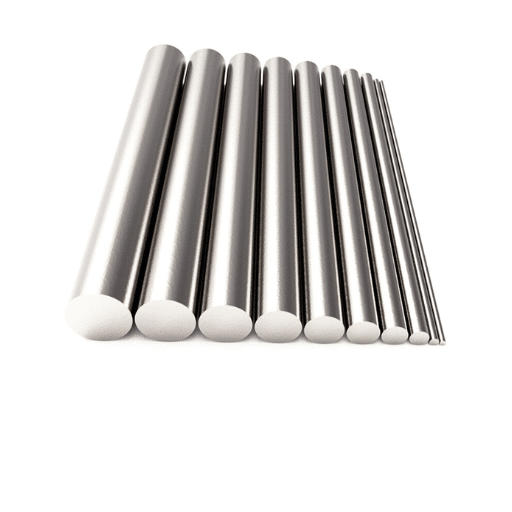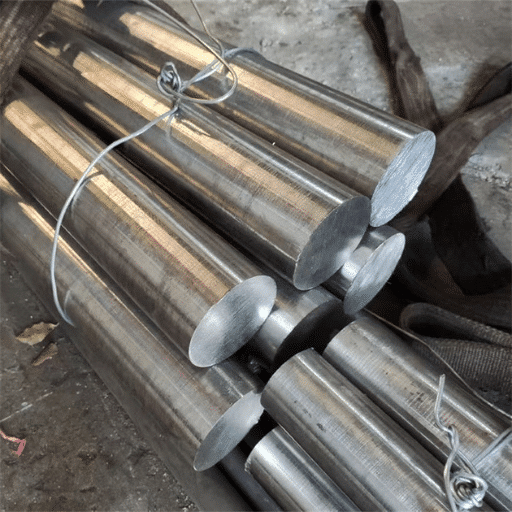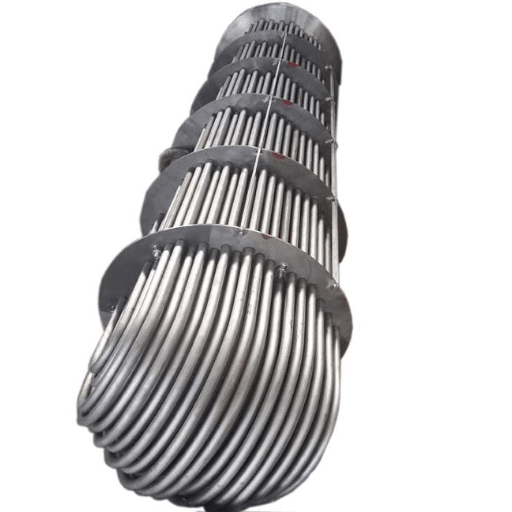
For titanium heat exchanger tubing, Grade 2 (UNS R50400) is the default choice. It is specified to ASTM B338 as seamless or welded tube, most often 19.05 mm or 25.4 mm outside diameter with 0.7 to 0.9 mm walls, for condenser, evaporator, and shell-and-tube service. Grade 5 is chosen only when pressure or fatigue drives the design, and Grade 7 or Grade 12 when hot chlorides exceed the limit of commercially pure titanium.
When a 316L stainless steel tube bundle pits through in two years, the answer is usually titanium. But “titanium” is not a specification. The wrong grade, the wrong tube form, or the wrong tubesheet pairing fails for a completely different reason than corrosion, and the mistake can cost more than the metal itself.
Consider Dana, a project engineer at a chemical plant who replaced a failed stainless bundle with Grade 5 Ti-6Al-4V tubes because it was the strongest titanium she could specify. The bundle was corrosion-limited, not strength-limited, and the alloy’s low thermal conductivity quietly cut its heat duty. She ended up paying an alloy premium for a bundle that moved less heat.
This guide explains why Grade 2 dominates tube service, how Grade 2 and Grade 5 compare for tubing, when to step up to Grade 7 or Grade 12, seamless versus welded selection, tube sizing and standards, tubesheet and galvanic design, and the real lifetime economics against 316L. For the full grade-versus-grade picture, see our titanium grade 2 vs grade 5 comparison.
Key Takeaways
- Grade 2 titanium is the standard grade for heat exchanger tubing, covering roughly 80% of duties including seawater, brackish water, and clean process fluids up to about 250°C.
- Grade 2 conducts heat about 2.4 times better than Grade 5 (roughly 17 versus 7 W/m·K), so the cheaper, purer grade usually moves more heat in tube service.
- Seamless and welded tube are both covered by ASTM B338, and welded tube typically costs 10 to 20% less.
- Titanium tubes paired with a stainless or copper-alloy tubesheet can fail at the joints within two to three years. The tubesheet matters as much as the grade.
- Titanium tubing costs two to four times more upfront than 316L, but in aggressive service it can deliver a lower 20-year cost of ownership with payback in about 1.5 to 2.5 years.
Why Titanium Tubing? The Case for Titanium in Heat Exchangers

Titanium is used for heat exchanger tubing because it resists seawater, chloride, and chemical attack through a self-healing passive film, while allowing thinner, lighter tube walls and a service life of 20 years or more. It removes the corrosion allowance that stainless steel needs, which improves heat transfer and eliminates repeated retubing.
Three properties drive that decision:
- Corrosion immunity. Titanium is effectively immune to seawater and chloride pitting, corroding at roughly 0.0005 mm per year in ambient seawater.
- No corrosion allowance. Because the metal doesn’t need a sacrificial thickness, walls can be made thinner, which lowers weight and improves heat transfer.
- Long life. The material lasts, which removes the retubing cycle that dominates the cost of a stainless bundle in aggressive duty.
You’ll find titanium tubing as the standard material in seawater-cooled power plant condensers, desalination plants using multi-effect or multi-stage flash designs, chemical processing exchangers, offshore cooling circuits, and geothermal brine systems. In each case, the tube is exposed to a chloride-rich or chemically aggressive fluid that would pit or crack a stainless bundle.
The result is a component that many plants treat as permanent rather than consumable, which changes the entire cost calculation. That calculation starts with grade, and in tube service one grade dominates.
Why Grade 2 Titanium Dominates Heat Exchanger Tubing
Grade 2 accounts for roughly 80% of titanium heat exchanger tubing because it balances the four properties that matter most in tube service: corrosion resistance, thermal conductivity, weldability and formability, and cost. No other grade does all four as well at the same price.
Corrosion Resistance
Grade 2 is a commercially pure grade with a stable titanium dioxide passive film. In ambient and warm seawater, it corrodes at a negligible rate, on the order of 0.0005 mm per year, and resists pitting, crevice attack, and chloride stress corrosion cracking. Because it needs no corrosion allowance, it also allows a thinner wall than carbon steel or stainless steel would require. Our grade 2 titanium guide covers the grade in full, and the International Titanium Association publishes corrosion data across grades. The complete ranking lives in our article on which titanium grade is most corrosion resistant.
Thermal Conductivity
This is the factor engineers most often miss. Grade 2 conducts heat at roughly 17 W/m·K, while Grade 5 conducts at only 6.5 to 7.2 W/m·K. Grade 2 therefore moves heat about 2.4 times better, which directly favors it in a heat exchanger.
Weldability and Formability
Grade 2 is a pure alpha structure that welds with a wide process window and cold-bends readily into U-tubes and serpentine bundles. That ease of fabrication lowers both cost and the risk of a defective joint.
Cost
Grade 2 typically costs 30 to 50% less than Grade 5 in material, and it fabricates faster. For a bundle that is limited by corrosion and heat transfer rather than strength, that gap is pure savings.
Grade 1 is even softer and is used where maximum formability matters, such as plate exchangers and deep-drawn parts. Grade 2 remains the balanced workhorse for the large majority of tube duties.
Titanium Heat Exchanger Tubing: Grade 2 vs Grade 5
The comparison between Grade 2 and Grade 5 titanium for heat exchangers looks like a clear win for the stronger alloy until you add thermal conductivity and cost to the table.
| Property | Grade 2 (UNS R50400) | Grade 5 (UNS R56400) |
|---|---|---|
| Tensile strength (min) | 345 MPa | 895 MPa |
| Yield strength (min) | 275 MPa | 828 MPa |
| Thermal conductivity | ~17 W/m·K | ~6.5-7.2 W/m·K |
| Seawater corrosion | Effectively immune | Resistant, needs galvanic care |
| Weldability | Excellent, wide window | Good, strict gas shielding |
| Cold formability | Excellent | Limited, hot-formed 700-950°C |
| Relative cost | Baseline | 30-50% higher material |
| Typical tube duty | Seawater, chloride, chemical | High pressure, high fatigue |
The counterintuitive result is that Grade 5 is roughly 2.5 to 3 times stronger but conducts heat less than half as well and is not more corrosion-resistant in seawater. For a tube design limited by corrosion and heat transfer, Grade 2 usually wins on both performance and cost. Grade 5 earns its place only under high pressure, high fatigue, or weight-critical thin-wall duty, and even then it needs galvanic isolation.
The rule is simple. If corrosion or heat transfer is the design constraint, choose Grade 2. If pressure or fatigue is the constraint, consider Grade 5 and design the assembly for galvanic isolation. Our Grade 5 titanium guide covers the alloy’s mechanical strengths, and the Grade 2 vs Grade 5 titanium cost analysis shows how the finished-part gap often exceeds the raw material gap.
Matching a grade to a tricky duty? Our technical team reviews exchanger conditions, including chloride level, temperature, and stagnation risk, and recommends the right material. Request a material consultation to start.
When to Step Up: Grade 7 and Grade 12 Tubing

Grade 2 has one real weakness in tube service: tight crevices in hot, high-chloride water. The tube-to-tubesheet joint, stagnant brine zones, and biofouling deposits can push localized temperatures above the crevice threshold of commercially pure titanium, which sits around 75 to 82°C.
Above that threshold, the standard fix is Grade 7 (Ti-0.15Pd). The palladium addition stabilizes the passive film and pushes the crevice-corrosion threshold toward 250 to 260°C, which is why Grade 7 serves high-temperature desalination and chemical exchangers.
Grade 12 (Ti-0.3Mo-0.8Ni) delivers roughly 80 to 90% of Grade 7 performance at about half the palladium premium. It also offers better elevated-temperature strength and good weldability, making it the economic tube upgrade when the duty is aggressive but not extreme.
The mechanism behind these thresholds, and the full palladium-grade family, are covered in our guide to the most corrosion-resistant titanium grade. For tube service, the practical point is that Grade 2 handles the large majority of exchangers, and Grade 7 or Grade 12 covers the hot-chloride remainder.
Seamless vs Welded Titanium Tube
ASTM B338 covers both seamless and welded titanium heat exchanger tubing for condensers and exchangers, so the choice between the two is a cost and duty decision rather than a quality one.
Manufacturers draw seamless tube from a hollow billet, cold-reducing it with a continuous periphery at every stage. They form welded tube from annealed flat strip, then cold-work it to final size so the weld develops a typical equiaxed structure before stress relief.
The economics favor welded tube. It typically costs 10 to 20% less and is the default for most condenser and exchanger bundles. Seamless tube suits higher pressure, more aggressive duty, or any application where a fully continuous periphery is required.
The testing requirements differ, and they are a useful quality signal to check on the mill test certificate. Welded tube must pass a reverse-flattening test plus electromagnetic and ultrasonic examination and a hydrostatic or pneumatic test. Seamless tube requires ultrasonic examination plus an electromagnetic, hydrostatic, or pneumatic test. If a supplier cannot show those results, the tube is not being verified to B338. The fabrication side of tube work is covered in our grade 2 vs grade 5 titanium welding guide.
Tube Sizing, Standards & Design Basics
Knowing which standard applies, and the difference between tube and pipe, prevents a costly substitution.
Titanium heat exchanger tubing is specified to ASTM B338, also published as ASME SB338. Titanium pipe for general service is specified to ASTM B861 for seamless and B862 for welded products. Tube and pipe are dimensioned and toleranced differently, so they are not interchangeable even when the outside diameter matches.
The workhorse tube sizes for shell-and-tube exchangers and surface condensers are 19.05 mm (3/4 inch) and 25.4 mm (1 inch) outside diameter with 0.7 to 0.9 mm walls. Tube diameter is a design variable, not a fixed value, because it trades flow velocity against pressure drop. A smaller tube raises velocity and heat-transfer rate but increases pressure drop, while a larger tube does the opposite.
Standard design codes such as TEMA and HEI apply to titanium exchangers without modification. U-tube, serpentine, and helically coiled forms are all available, which is why tube selection should be made alongside the bundle geometry rather than after it. Our titanium grade chart is a useful reference when comparing the forms and grades available.
Tubesheet & Galvanic Design: Where Good Bundles Fail
The most common titanium heat exchanger tubing failure is not corrosion of the tube. It is galvanic corrosion of a less-noble tubesheet that the tube is joined to.
Titanium is strongly cathodic in seawater. When titanium tubes are rolled or welded into a stainless steel or copper-alloy tubesheet, the titanium becomes the cathode and accelerates corrosion of the tubesheet and the joint. In practice, these joints can fail within two to three years even though the tubes themselves are untouched.
The fix is to make the tubesheet compatible with the tube:
- Use a titanium or titanium-clad tubesheet so the joint is the same metal.
- Treat the shell side and tube side as separate galvanic systems.
- Add sacrificial anodes where a mixed-metal design is unavoidable.
- Apply controlled cathodic protection, and watch the potential closely.
Cathodic protection must be controlled carefully. Keep the titanium potential within roughly -0.50 to -0.65 V versus Ag/AgCl. Driving it more negative than about -0.70 to -0.75 V can force hydrogen into the metal, which forms brittle titanium hydride and damages the tube.
Two other design points deserve attention. Thin walls need proper support spacing to avoid flow-induced vibration, and condenser inlets need protection from steam impingement and erosion. Biofouling does not corrode titanium, which is essentially immune to microbiologically influenced corrosion. Biofilm still reduces flow and heat transfer, though, so a chlorination or cleaning strategy should be defined upfront.
The grade was right, but the bundle still failed. That is the lesson from a seawater exchanger retubed with titanium tubes that kept its original stainless tubesheet. A titanium-clad tubesheet is what finally stopped the joint failures.
Titanium vs 316L Stainless Steel for Heat Exchanger Tubes

Many searches for titanium heat exchanger tubing end with a 316L answer, and sometimes that is the correct call. The question is not which metal is better, but which one wins over the life of the bundle.
In aggressive service, titanium wins on life. Grade 2 tubing performs for 20 to 30 years or more in seawater, while 316L pits in warm, low-flow chlorides above roughly 25°C and often needs retubing every two to five years. Titanium also tolerates much higher flow velocities, up to about 30 to 36 m/s against roughly 6 to 9 m/s for 316L, and it is about 45% lighter.
In milder service, 316L wins on economics. Its first cost is far lower, and its thermal conductivity is roughly comparable to titanium at about 16 W/m·K, so titanium’s advantage over stainless is longer life, not better heat transfer. For clean, cold, low-chloride duty, a certified 316L bundle is often the smarter buy.
The deciding factor is total cost of ownership. Consider Priya, a process engineer at a purified terephthalic acid plant running at 220°C with acetic acid and bromide in the process stream. Her 316L tubes needed replacement every four years. Switching to Grade 2 titanium raised heat transfer by about 12% and cut energy use by 15%. Over 20 years, total cost of ownership came in roughly 22% lower than the stainless option, despite the higher purchase price.
The pattern repeats across industries. In chlor-alkali service, a 316L bundle leaked after three years. That single event cost about 220,000 in shutdown, replacement, and lost production, while a Grade 2 titanium bundle lasted 12 years with out aleak. On an offshore platform, 316L seawater exchangers lasted eight years with corrosion near the welds. Titanium cost about four times more up front, but it projected a 25−year life and saved an estimated 220,000 in shutdown, replacement, and lost production, while a Grade 2 titanium bundle ran 12 years without a leak. On an offshore platform, 316L seawater exchangers lasted eight years with corrosion near the welds. Titanium cost about four times more up front, but it projected a 25-year life and saved an estimated 180,000 a year in avoided downtime.
That’s why payback for titanium often lands in the 1.5 to 2.5 year range in aggressive duty, and why the useful comparison is cost per part over the operating window, not cost per kilogram at the purchase order. Where titanium is not justified but 316L feels marginal, duplex 2205 and 254 SMO are the intermediate stainless options that bridge the gap.
| Factor | Grade 2 Titanium Tube | 316L Stainless Tube |
|---|---|---|
| Seawater/chloride | Effectively immune | Pits in warm low-flow chlorides |
| Typical tube life (seawater) | 20-30+ years | 2-5 years |
| Erosion velocity limit | ~30-36 m/s | ~6-9 m/s |
| Thermal conductivity | ~17 W/m·K | ~16 W/m·K |
| First cost | 2-4× 316L | Baseline |
| 20-year TCO (aggressive) | Lower | Higher, from retubing and downtime |
For the wider trade-off across grades, including the cost angle, see our 316 stainless steel guide and the titanium vs stainless steel corrosion comparison. If 316L is the right answer for your duty, we supply 316L stainless steel products in tube, pipe, sheet, and coil form.
Choosing Titanium Heat Exchanger Tubing: A Selection Checklist
Work through these four questions before you write the specification. Each one narrows the grade or the material.
- Is the service seawater or high-chloride, and at what temperature? Ambient to warm seawater points to Grade 2. Crevice or bulk temperatures above about 80°C point to Grade 7 or Grade 12.
- Are there stagnation or crevice zones at the tubesheet? If yes, either upgrade the grade or redesign the joint with a titanium or titanium-clad tubesheet.
- Is pressure or fatigue high, or is heat transfer the limit? Heat transfer favors Grade 2. High pressure or fatigue may justify Grade 5, with galvanic isolation.
- What is the required life and the budget? A 20-year seawater design life usually justifies titanium. A clean, short-life duty may be served by certified 316L or a duplex grade.
One warning applies to all four. Do not over-specify. Paying for Grade 5 on a corrosion-limited bundle wastes money on strength the design never uses, and buying any titanium when a certified stainless grade genuinely handles the duty wastes money on a metal the environment does not require. Our cost comparison shows how quickly that penalty compounds on a large order, and the grade chart reference confirms where each grade fits.
Frequently Asked Questions
What grade of titanium is used for heat exchanger tubing?
Grade 2 (UNS R50400) is the most widely used grade. It combines seawater and chloride corrosion resistance, the highest practical thermal conductivity of the titanium grades at about 17 W/m·K, good weldability and formability, and lower cost than the alloy grades. Grade 1 is used where maximum formability is needed, Grade 7 or Grade 12 for hot chlorides above about 80°C, and Grade 5 only when strength or fatigue drives the design.
Why is Grade 2 used for heat exchangers instead of Grade 5?
Because in tubing the constraint is corrosion plus heat transfer, not strength. Grade 2 conducts heat about 2.4 times better, welds and cold-bends more easily into bundles, and resists seawater at least as well as Grade 5, at 30 to 50% lower material cost. Grade 5 is reserved for high-pressure or fatigue duty.
Is Grade 2 or Grade 5 titanium better for heat exchanger tubing?
For most duties, Grade 2 is better because the design is limited by corrosion and heat transfer. Grade 5 is better only when high pressure, high fatigue, or weight-critical thin walls justify its strength premium and its lower thermal conductivity.
What is ASTM B338 titanium tubing?
ASTM B338, also published as ASME SB338, is the standard specification for seamless and welded titanium and titanium alloy tubes for condensers and heat exchangers. It covers 28 titanium grades, with Grades 1, 2, 7, and 12 the most common for tube service, along with dimensions, tolerances, testing, and marking.
What is the difference between seamless and welded titanium tube?
Seamless tube is drawn from a hollow billet with a continuous periphery, while welded tube is made from strip that is welded and then cold-worked. Both are covered by ASTM B338. Welded tube costs 10 to 20% less and is the default for most bundles; seamless tube suits higher pressure or more aggressive duty.
How long does titanium tubing last in a heat exchanger?
Grade 2 titanium tubing commonly lasts 20 to 30 years or more in seawater and chloride service, with some condensers reporting decades without a corrosion event. For comparison, 316L stainless tube in seawater often fails in two to five years and needs repeated retubing.
Is titanium better than 316L for heat exchangers?
In aggressive service such as seawater, brines, and oxidizing acids, titanium is better because it lasts far longer and avoids retubing. In clean, cold, low-chloride duty, 316L is the more economical choice. The deciding factor is total cost of ownership over the operating life.
What is the maximum temperature for titanium heat exchanger tubing?
Grade 2 is generally used up to about 300°C continuous, with designs usually kept below 430°C to avoid oxidation and embrittlement. Crevice corrosion in hot chlorides, not bulk temperature, is often the real limit, which is why Grade 7 or Grade 12 is specified above roughly 80°C in tight crevices.
Conclusion
Titanium heat exchanger tubing is a component-level decision, and it starts with grade. Grade 2 is the default for condenser, evaporator, and shell-and-tube service because it combines corrosion immunity, the best practical thermal conductivity, easy fabrication, and lower cost. Grade 5 is reserved for strength and fatigue duty, Grade 7 and Grade 12 cover hot chlorides, and seamless or welded tube is chosen on cost and pressure duty.
The details matter as much as the grade. Specify to ASTM B338, confirm the standard tube sizes and testing results, and design the tubesheet so the joint is compatible with the tube. Then compare total cost of ownership against 316L rather than purchase price, because that is where titanium earns its premium in aggressive service.
If you need help matching a material to an exchanger duty, our technical team works with engineers and procurement teams to review operating conditions, recommend the right grade, and support specification and certification. We supply the stainless steel pipes, sheets, and coils that serve the duties where stainless is the right answer, and we will tell you honestly when titanium is the better path. Contact LIANYUNGANG DAPU METAL to discuss your project.