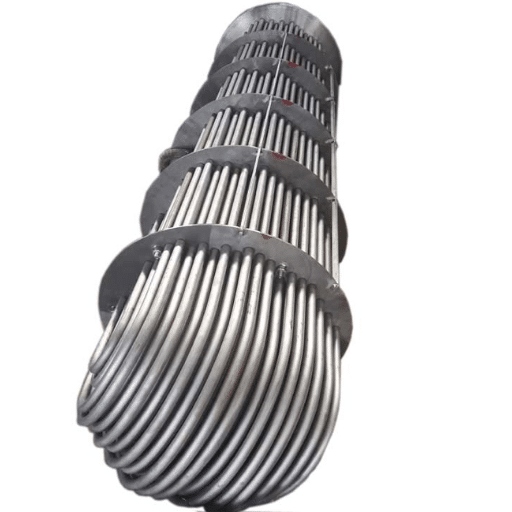
304 and 316 stainless steel pipe have nearly identical mechanical strength and are both produced to ASTM A312, but the two grades are not interchangeable in corrosive service. The practical difference is molybdenum: 316 pipe contains 2-3% molybdenum, which provides significantly better resistance to chloride pitting and crevice corrosion.
Choose 304 pipe as the cost-effective default for mild, chloride-free service. Specify 316 pipe when chlorides, seawater, brine, or aggressive chemicals are present, because 304 will often fail prematurely in those environments.
That simple rule hides most of the real decision. For a piping system, the grade is only one of four variables that determine whether the line performs. Pipe schedule and wall thickness control pressure capacity, the manufacturing method (seamless or welded) affects the same rating, and the applicable standard, such as ASTM A312, defines the allowable chemistry and testing. A pipe selection decision combines all of these, not just the alloy name.
Consider Carlos, a plant engineer who specified 304 pipe for a seawater cooling header to save roughly 30% on material. Fourteen months later, chloride pitting perforated the line at several weld-adjacent points, and the crew replaced the entire header with 316. The replacement cost more than the original savings, before counting the two shutdowns. The alloy was chosen on price; the service environment was not.
This guide gives engineers, procurement managers, and maintenance teams a practical way to choose between 304 and 316 stainless steel pipe for chemical, marine, food, pharmaceutical, and general industrial lines. It covers composition, corrosion, pressure rating, schedule, seamless versus welded, 2026 cost, and how to verify what you receive.
Key Takeaways
- 316 pipe contains 2-3% molybdenum, which gives it much better chloride pitting and crevice corrosion resistance than 304 pipe.
- At room temperature, 304 and 316 pipe have essentially identical pressure ratings; wall thickness (schedule) and manufacturing method, not grade, control that capacity.
- Welded pipe carries a joint efficiency factor of about 0.85, so it is rated roughly 15% lower than seamless pipe of the same dimensions.
- In 2026, 316/316L pipe runs about 25-45% more per ton than 304, but it can deliver a lower total cost of ownership in chloride service.
- Specify the grade, standard, schedule, and manufacturing method on the purchase order, and verify the delivered chemistry against the Mill Test Certificate.
304 vs 316 Stainless Steel Pipe: The Key Difference

The key difference in a 304 vs 316 stainless steel pipe comparison is corrosion resistance in chloride-containing service. Both are austenitic stainless steels. Both are manufactured as seamless or welded pipe under the same product standard, and both offer useful corrosion resistance in atmospheric, freshwater, and many chemical environments.
The difference is molybdenum. Type 316 contains 2-3% molybdenum as a specified alloying addition. Type 304 does not.
That addition raises 316’s resistance to localized corrosion, especially pitting and crevice corrosion driven by chlorides. It is the reason 316 pipe is routinely specified for seawater, marine, chemical, and other chloride-bearing service.
| Element | TP304 / UNS S30400 | TP316 / UNS S31600 | Why it matters |
|---|---|---|---|
| Chromium | 18-20% | 16-18% | Forms the passive oxide layer that gives stainless steel its corrosion resistance. |
| Nickel | 8-10.5% | 10-14% | Supports the austenitic structure and general corrosion performance. |
| Molybdenum | No specified Mo addition | 2-3% | Improves resistance to chloride pitting and crevice corrosion. |
| Carbon (max) | 0.08% | 0.08% | Affects weld sensitization risk; L grades reduce it. |
| PREN (approx.) | 18-20 | 23-28 | Relative index of localized corrosion resistance. |
What TP means and why the L grades matter
In pipe specifications, the prefix TP identifies the grade in the ASTM product standard. TP304 and TP316 refer to the pipe forms of Type 304 and Type 316. The same alloys are supplied as sheet and plate under ASTM A240, as bar under ASTM A276, and as pipe under ASTM A312.
304L and 316L are the low-carbon versions. They limit carbon to a maximum of 0.03%, compared with 0.08% for the standard grades. Lower carbon reduces chromium carbide precipitation in the heat-affected zone during welding, which lowers the risk of intergranular corrosion. For welded piping, the L grades are a sensible default. Many mills supply dual-certified material, such as 304/304L or 316/316L, that meets both chemistry requirements at no cost penalty.
ASTM A312: The Standard for Stainless Steel Pipe
ASTM A312/A312M is the standard specification for seamless, welded, and heavily cold-worked austenitic stainless steel pipe intended for high-temperature and general corrosive service. It covers the workhorse pipe grades including TP304, TP304L, TP316, TP316L, TP321, TP347, and TP310S.
Under ASTM A312, welded pipe must have the weld area solution-annealed and must pass a hydrostatic or eddy current test. These requirements affect both how the pipe is made and how it can be used, so the standard belongs in the purchase specification rather than in the fine print.
The matching stainless pipe dimensions follow ASME B36.19, which defines the wall thicknesses for the common stainless schedules. Fittings under ASTM A403 and flanges under ASTM A182 should be grade-matched to the pipe where the system requires full corrosion resistance at every joint. For the wider context of grades, forms, and properties, review our complete stainless steel guide.
Need help structuring a pipe specification before you send an RFQ? Our technical consultation team can help you align the grade, schedule, standard, and documentation with the actual service conditions.
Corrosion Resistance: Why 316 Pipe Wins in Chlorides
Corrosion resistance is where a 304 vs 316 stainless steel pipe decision is actually made. In most aqueous media, including distilled water, drinking water, and boiler water, the two grades behave similarly. The performance gap appears when chloride ions enter the picture.
General corrosion resistance
Both grades resist general corrosion well in atmospheric exposure, freshwater, and mild chemical service. 304 pipe is a reasonable, economical choice for many standard industrial lines. The limiting factor for both grades is localized attack in specific environments, and that is where 316 earns its premium.
Chloride pitting and crevice corrosion
Molybdenum improves resistance to pitting and crevice corrosion, the two most common failure modes for stainless steel pipe in chloride service, as documented by the International Molybdenum Association. The practical chloride threshold for 304 is roughly 200 parts per million in water, while 316 can tolerate substantially higher levels, commonly cited in the range of 1,000 ppm or more.
Temperature changes the picture. Chloride pitting accelerates when the fluid temperature rises above about 60°C, so a borderline 304 application at ambient temperature can become a premature-failure risk in warm service. For seawater, coastal installations, desalination, brine, and offshore lines, 316 or 316L is the appropriate choice. For a deeper treatment of the corrosion mechanisms, see our 304 vs 316 stainless steel corrosion content.
Stress corrosion cracking
Both 304 and 316 can suffer chloride stress corrosion cracking when three conditions combine: tensile stress, chlorides, and elevated temperature. Adding molybdenum does not eliminate this failure mode. For systems that combine hot, chloride-bearing fluid with high residual or applied stress, the grade selection alone is not enough; the system design and operating limits must be reviewed as well.
Intergranular corrosion in welded piping
Welding heats the heat-affected zone into a temperature range where carbon can combine with chromium to form chromium carbides at grain boundaries. This sensitization depletes the local chromium and can make the area susceptible to intergranular corrosion. The L grades, with their lower carbon limits, reduce this risk. For welded stainless steel pipe in corrosive service, 304L or 316L is the standard recommendation.
Pressure Rating: Does the Grade Matter?

Many buyers assume that 316 pipe can handle higher pressure than 304 pipe. In most cases it cannot, at least not because of the grade. At room temperature, 304 and 316 have essentially the same minimum yield strength and allowable stress, so for a given schedule and diameter their pressure ratings are nearly identical.
What actually drives the pressure capacity of a stainless steel pipe are the wall thickness, the outside diameter, the operating temperature, and the manufacturing method. The grade matters mainly for corrosion and, at high temperature, for the retained allowable stress. For a complete review of pipe schedules, dimensions, and selection, see our steel pipe guide.
How schedule determines pressure capacity
ASME B36.19 defines the stainless steel pipe schedules, including 5S, 10S, 40S, and 80S. For a given nominal pipe size, a higher schedule means a thicker wall and a higher pressure rating. The same grade can be used across schedules; the schedule, not the alloy name, controls the pressure rating.
As a rule, larger diameters carry lower pressure ratings for the same schedule, because the hoop stress in a thin wall increases with diameter. The indicative seamless ratings below for a 316L pipe at room temperature show the pattern:
| NPS | SCH 40S (approx.) | SCH 80S (approx.) |
|---|---|---|
| 1/2″ | 4,200-5,000 psi | 7,000+ psi |
| 1″ | 3,200-4,000 psi | 6,000-7,000 psi |
| 2″ | 2,000-2,500 psi | 4,000-4,500 psi |
| 4″ | 1,650-2,000 psi | 3,000-3,500 psi |
| 6″ | ~1,600 psi | 2,500-3,000 psi |
These values are indicative and vary with the design code, temperature, and manufacturer’s data. A pressure rating must always be checked against the actual diameter, wall, temperature, and design standard. For a complete treatment of schedules and selection, see our schedule 40 vs schedule 80 pipe comparison.
Seamless versus welded: the joint efficiency factor
The manufacturing method affects the pressure rating through the joint efficiency factor. Seamless pipe has a joint efficiency of 1.0, so the full allowable stress is available. Welded pipe is commonly assigned a factor of about 0.85, which lowers the rating by roughly 15% for the same dimensions. A double-submerged arc welded pipe can carry a higher factor.
In practice, an NPS 2 SCH 40S TP316L line rated near 2,000 psi as seamless pipe drops to roughly 1,700 psi as welded pipe at the same dimensions. For high-pressure or critical service, seamless pipe is the conventional choice. For lower-pressure and hygienic lines, welded pipe is often acceptable and more economical.
Temperature derating and the high-temperature case
Allowable stress falls as temperature rises. A 304 pipe rated at about 20,000 psi allowable stress at 100°F drops steadily with temperature, and the same derating curve applies to 316 at lower temperatures. Above roughly 800°F, 316L retains a higher allowable stress than 304L, about 14% higher at 1,000°F in some code values. In elevated-temperature service, the grade choice can therefore affect the pressure rating after all.
For most ambient and moderate-temperature process lines, select the grade on corrosion, not on pressure. Select the schedule on pressure. The two decisions are independent.
Seamless vs Welded Stainless Steel Pipe
Seamless and welded stainless steel pipe are both made in 304 and 316. The choice between them is separate from the grade choice.
Seamless pipe is formed from a solid billet and has no longitudinal weld. It is the default for high-pressure, critical, and elevated-temperature service, and it carries the full joint efficiency factor. It tends to cost more and can have tighter supply for very large diameters.
Welded pipe is formed from strip and joined along a longitudinal seam. It is generally more economical, is well suited to large diameters and long runs, and is common in hygienic and low-to-moderate-pressure service. Under ASTM A312, the weld area must be solution-annealed and the pipe must pass hydrostatic or eddy current testing.
For a detailed comparison of the two manufacturing routes, including the process and cost differences, see our seamless vs welded pipe guide.
An illustrative welded-line scenario
In an illustrative example, Aisha specifies welded 304 pipe for a freshwater utility ring inside a processing plant. The pressure is moderate, the fluid is essentially chloride-free, and the cost saving over seamless is meaningful across several kilometers of line. The specification is approved because the service conditions justify it. The same line, repurposed to carry chloride-bearing washdown water, would require a different conversation about grade, wall, and weld quality.
304 vs 316 Pipe by Application
Choose 304 pipe when
304 is a practical, economical choice when the fluid is mild and chloride exposure is low. Typical applications include general food and beverage processing lines, freshwater distribution, HVAC and utility loops, architectural and drainage systems, and many standard industrial services. Where the environment is indoor, chloride-free, and non-marine, 304 pipe often delivers the required service life at lower cost.
Choose 316 pipe when
316 or 316L is the better choice when chlorides, seawater, brine, or aggressive chemicals are present. That covers marine and coastal installations, offshore platforms, desalination, chemical processing with chloride-bearing or acidic fluids, pharmaceutical and high-purity water systems, and food and beverage lines that handle salt, seafood, or chloride-bearing cleaning chemicals. In these environments, 304 pipe pits and fails far earlier than 316.
Application comparison table
| Industry/application | Recommended pipe | Why |
|---|---|---|
| General food and beverage processing | 304 | Cost-effective, hygienic, cleanable when service is non-chloride. |
| Dairy, brewing, high-salt food processing | 316L | Chloride and aggressive CIP cleaning resistance. |
| Pharmaceutical and high-purity water | 316L | Weldability, corrosion resistance, and purity requirements. |
| Marine, coastal, offshore | 316 / 316L | Chloride and pitting resistance in seawater and salt air. |
| Chemical processing | 316 / 316L | Resistance to acids and chloride-bearing process streams. |
| HVAC, utility, drainage | 304 | Mild service, lower material cost. |
| Oil and gas with brine or produced water | 316L | Chloride and stress corrosion resistance in sour-wet service. |
The table explains why a blanket upgrade to 316 is not always correct. Using 316 pipe where 304 meets every documented requirement raises material cost without improving the outcome. Conversely, using 304 pipe in salt or chloride service creates a premature-failure risk that is far more expensive than the material saving. For more on the marine case, see our 316 stainless steel marine grade guide.
Cost Comparison: 304 vs 316 Pipe (2026 Update)
The price premium
316 and 316L pipe cost more than 304 because of the higher alloy content. In 2026, the premium for 316/316L over 304 has widened to roughly 25-45% per ton in many markets, up from the historical 15-25%. On a per-meter basis, expect roughly $20-80 more for equivalent pipe sizes, with some European tube sizes reaching a 60-70% premium.
Molybdenum cost and the higher nickel content drive the gap. Because nickel makes up a large share of the alloy value, movements in the nickel price move pipe prices directly. A rise in nickel raises the price of both grades, but it raises 316 more because 316 carries more nickel and adds molybdenum.
Lifecycle cost for piping
The relevant comparison is not the price per meter; it is the total cost of ownership over the life of the line. In chloride service, a 316L line can operate for 25 years or more with routine maintenance, while a 304 line may need replacement after 8-12 years. Over 30 years in such service, the lower replacement and downtime cost of 316L can produce a total cost of ownership roughly 37% lower than the cheaper-upfront 304 line.
In mild, chloride-free service, the opposite is true. A correctly specified 304 line can match the service life of 316 at a materially lower installed cost. The decision belongs in the design and procurement record, supported by the actual process conditions rather than a general preference.
When 316 pipe is over-specified
316 pipe is over-specified when the environment provides no chloride or corrosion driver that molybdenum addresses. Indoor utility loops, instrument air lines, and freshwater systems are common examples. Choosing 304 in these cases can reduce material cost by 25-40% without a measurable performance penalty.
An illustrative lifecycle-cost scenario
Noor is comparing two quotes for process piping in a coastal facility. The first vendor prices the entire system in 304. The second prices the process lines in 316L and the non-process utility lines in 304.
Before award, Noor asks three questions: What is the chloride exposure in each line? What temperature and pressure apply? Which lines carry product, and which carry utility service? The answers show that one skid is chloride-free indoor service while another handles brine near the washdown area.
Noor specifies 304 for the utility skid and 316L for the brine line. The procurement team can then compare like-for-like quotes instead of accepting a blanket grade.
How to Specify and Verify Stainless Steel Pipe

What to write on the purchase order
A complete pipe specification protects the buyer. State the following on the purchase order:
- Grade: TP304, TP304L, TP316, or TP316L
- Product standard: ASTM A312, or the applicable equivalent
- Nominal pipe size (NPS): The nominal diameter of the line
- Schedule or wall thickness: SCH 40S, SCH 80S, or the required wall in millimeters
- Manufacturing method: Seamless or welded
- End type: Plain, beveled, or threaded
- Length: Fixed lengths or random mill lengths
- Documentation: Mill Test Certificate, heat-number traceability, or positive material identification
An example specification line reads: TP316L, ASTM A312, NPS 2, SCH 40S, seamless, beveled ends, 6-meter lengths.
Naming the standard matters because it fixes the allowable chemistry, testing, and tolerances. A pipe ordered only as “316 stainless steel” without a standard leaves room for variation in carbon, molybdenum, and testing that may not match the design intent.
Mill Test Certificate verification
The Mill Test Certificate (MTC), also called the material test report, records the actual chemistry and mechanical test results for the heat of steel supplied. On delivery, verify the grade designation, the actual carbon content (0.03% max for L grades), the molybdenum content (2.0-3.0% for 316/316L), and the applicable standard. Confirm that the dimensions on the certificate match the ordered NPS, schedule, and wall thickness, and that the hydrostatic or eddy current test result is present.
Dual-certified material, such as 316/316L, satisfies both chemistry limits. When a project requires it, request heat-number traceability and positive material identification so the delivered pipe can be tied back to its certificate.
Incoming inspection
Portable XRF analysis can confirm the alloy chemistry at the receiving dock, and it is especially useful for large orders or when pipe has changed hands. Measure the outside diameter and wall thickness at several points to confirm the schedule. Watch for mislabeled pipe: a “316” line that reads no molybdenum on XRF is actually 304, and 201-grade material is sometimes sold as 304 in low-cost supply chains.
Carlos’s seawater header and Noor’s coastal skids both illustrate the same lesson: verify before install. A few minutes of inspection at receiving costs far less than a mid-project line replacement. LIANYUNGANG DAPU METAL supplies 304/304L and 316/316L pipe in seamless and welded forms with full material certification, and our custom processing team can support cutting, beveling, and other fabrication needs.
FAQ: 304 vs 316 Stainless Steel Pipe
What is the difference between 304 and 316 stainless steel pipe?
304 and 316 pipe have similar mechanical strength, but 316 contains 2-3% molybdenum, which improves resistance to chloride pitting and crevice corrosion. Use 316 for marine, chemical, and other chloride-bearing service; use 304 as the economical default in mild, chloride-free environments.
Is 316 stainless steel pipe stronger than 304?
No. At room temperature, the two grades have essentially the same minimum tensile and yield strength, and therefore similar pressure ratings for the same schedule and diameter. 316’s advantage is corrosion resistance, not strength.
Can 304 stainless steel pipe be used in saltwater?
Generally not for long service. 304 pipe is vulnerable to pitting in chloride environments, especially above about 60°C, and is not recommended for seawater or marine exposure. 316 or 316L is the appropriate choice for saltwater and coastal service.
How much more expensive is 316 pipe than 304?
In 2026, 316/316L pipe typically costs 25-45% more per ton than 304, which works out to roughly $20-80 more per meter for equivalent sizes. The premium is higher when molybdenum and nickel prices rise.
Do 304 and 316 pipes have the same pressure rating?
Yes for most conditions. At room temperature the allowable stresses are essentially identical, so the schedule and diameter control the rating. Above roughly 800°F, 316L retains a higher allowable stress than 304L.
Is 316L better than 316 for welded piping?
For welded service, 316L is generally preferred. The lower carbon limit reduces sensitization in the heat-affected zone, which lowers the risk of intergranular corrosion. Many mills supply dual-certified 316/316L material.
Which is better for food and beverage, 304 or 316 pipe?
Both can be suitable. 304 is economical for general food and beverage lines with lower chloride exposure. 316L is better for salt, brine, seafood, and chloride-bearing cleaning chemicals. Confirm the product, cleaning program, and surface requirements before specifying.
Is seamless or welded stainless steel pipe better?
Seamless pipe has no longitudinal weld and carries the full joint efficiency factor, so it is preferred for high-pressure and critical service. Welded pipe is more economical and common for lower-pressure, hygienic, and large-diameter lines. Both are made in 304 and 316.
Choose the Grade for the Actual Piping Service
A sound 304 vs 316 stainless steel pipe decision starts with the service conditions, not a general preference. 304 pipe is commonly a practical choice for mild, chloride-free lines at a lower cost. 316 or 316L pipe is the better choice when chlorides, seawater, brine, or aggressive chemicals create a real corrosion risk.
Remember the full framework: choose the grade on corrosion, the schedule on pressure, and the manufacturing method on service and budget. Specify the standard, and verify the delivered chemistry against the Mill Test Certificate.
LIANYUNGANG DAPU METAL supplies stainless steel pipe in 304/304L and 316/316L, in seamless and welded forms, with certification and global delivery. Contact our metal experts with your operating conditions and specification to receive a quote aligned with your application.