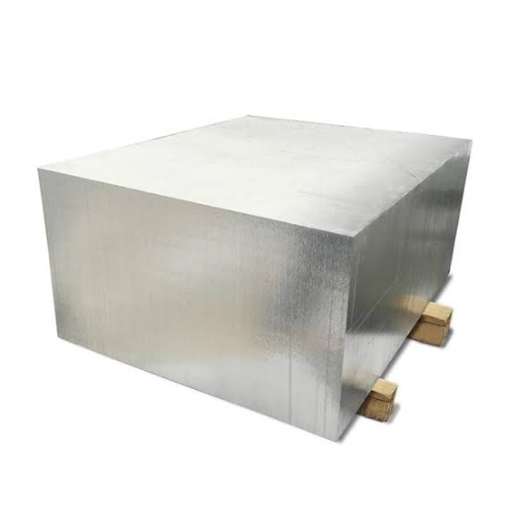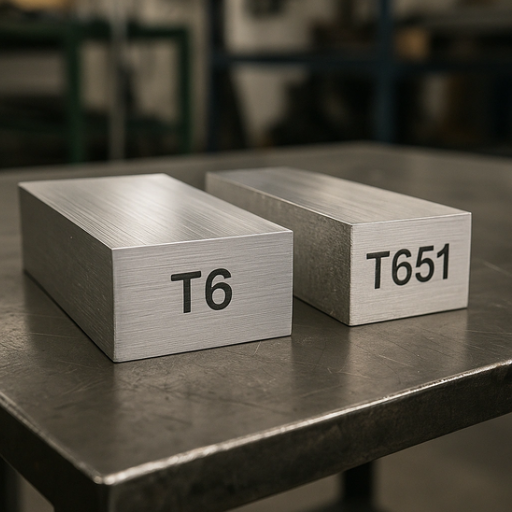
In the 6061 T6 vs T651 question, both tempers deliver the same strength. T651 is 6061-T6 plate that has been stretched about 1.5% to 3% after quenching and before aging, and that one step removes most of the residual stress left by the quench.
You are not buying a stronger material. You are buying plate that stays flat after you machine it.
That distinction matters because most of what you will read gets it backwards. Pages claim T651 is stronger because of the stretch, then publish the same tensile and yield numbers as T6 two paragraphs later. Both halves cannot be true.
Here’s where it lands in practice. A drawing says “6061-T6,” the stock is 25 mm plate, and the part comes off the table bowed. Nothing was defective. The temper on the drawing didn’t match the product form on the shelf.
This guide separates the metallurgy from the folklore, shows what each standard actually guarantees, and ends with a purchase order a mill can meet.
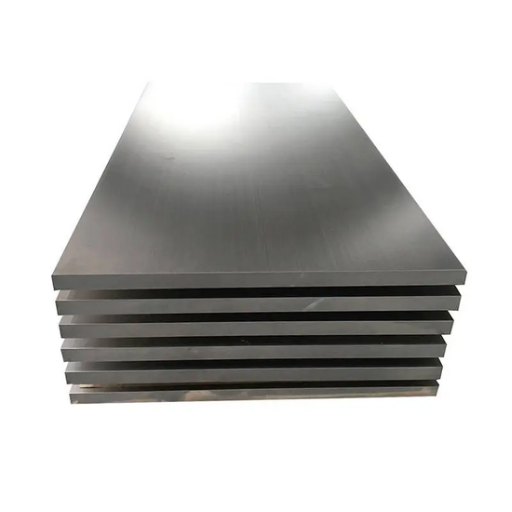
Our aluminum plate range lists T6 and T651, so both sides of this decision cross our desk. Send the drawing and thickness and we’ll confirm which temper the mill will supply.
Key Takeaways
- 6061-T6 and 6061-T651 have the same guaranteed strength: 42 ksi (290 MPa) tensile and 35 ksi (241 MPa) yield for plate through 4 in under ASTM B209 and AMS 4027.
- The difference is residual stress. T651 is stretched 1.5% to 3% before aging, which keeps machined plate flat and holds tolerance after material removal.
- Temper follows product form. Sheet under 0.250 in (6.35 mm) is T6, plate from 0.250 in is normally T651, extruded bar is T6511, and cold-finished bar is T651.
- Thick plate is a different material on paper. Minimum tensile strength steps down above 50 mm in B209M and above 4.000 in in AMS 4027P.
- T651 fixes quench stress, not clamping stress, cutting stress or thin-wall movement. If the part is symmetric and thin, T6 is usually enough.
6061 T6 vs T651: What the Two Tempers Actually Mean
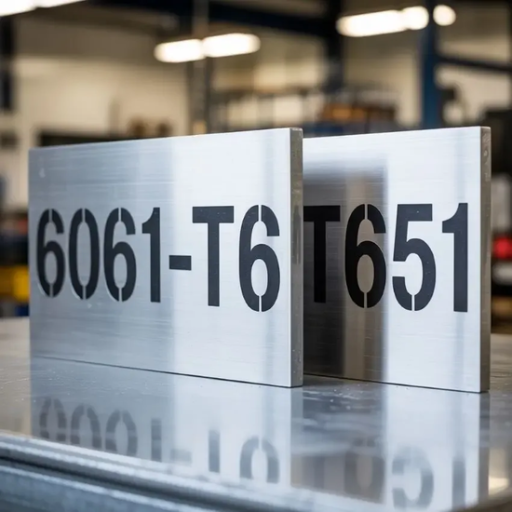
The temper designation tells you what happened after the alloy was quenched. The alloy itself, and its chemistry, do not change.
For 6061, solution treatment runs at roughly 529 °C to 533 °C, followed by a water quench. Artificial aging follows: about 160 °C for 18 hours on rolled and drawn products, or 177 °C for 8 hours on extrusions and forgings. Those temperatures matter later, because sustained service near them will overage the alloy and soften it. 6061 is not a high-temperature material in any temper.
T6 means solution heat treated and artificially aged. Full stop. That is the complete definition, and it is the temper most sheet is sold in.
T651 means solution heat treated, stress relieved by stretching, and then artificially aged. The stretch is a permanent set, not a spring-back. AMS 4027 specifies a nominal permanent set of 1.5% to 3% for 6061-T651 plate. On a 25.4 mm plate, that is 0.38 mm to 0.76 mm of permanent elongation.
T6511 means the same as T651 plus a straightening operation, and it applies to extruded stock. The trailing 1 exists because extrusions come off the press with straightness problems that plate does not have.
| Temper | What happens after the quench | Stress relieved? | Typical stock |
|---|---|---|---|
| T6 | Artificially aged | No | Sheet under 0.250 in; some extrusions |
| T651 | Stretched, then artificially aged | Yes, by stretching | Plate 0.250 in and up; cold-finished bar |
| T6511 | Stretched, aged, then straightened | Yes, by stretching | Extruded bar, rod, shape |
| T451 | Stretched, then naturally aged | Yes, by stretching | Plate for parts formed before final aging |
Two consequences follow directly from those definitions.
First, the “5” in T651 is not a hardness code and not a strength code. It is the designator for stress relief by stretching, and it covers the whole TX51 family: T351, T451, T651, T851 and the T7x51 tempers. Some pages describe it as an extra reduction in hardness. The temper designation system says otherwise.
Second, T651 and T6511 are not interchangeable even though they share a number. T651 comes from plate, rolled or cold-finished stock. T6511 comes from extrusions. A drawing that calls for T651 on an extruded profile is asking the mill for something that product form cannot supply.
Is 6061-T651 Stronger Than 6061-T6?
No. The standards give both tempers the same minimums, and the typical values are identical too.
| Property | 6061-T6 | 6061-T651 |
|---|---|---|
| Typical tensile strength | 310 MPa (45 ksi) | 310 MPa (45 ksi) |
| Typical yield strength (0.2%) | 276 MPa (40 ksi) | 276 MPa (40 ksi) |
| ASTM B209 minimum, plate to 4 in | 290 MPa (42 ksi) | 290 MPa (42 ksi) |
| ASTM B209 minimum yield | 241 MPa (35 ksi) | 241 MPa (35 ksi) |
| Brinell hardness | 95 HB | 95 HB |
| Modulus of elasticity | 68.9 GPa | 68.9 GPa |
| Density | 2.70 g/cm³ | 2.70 g/cm³ |
The typical values come from the Aluminum Association data reproduced in distributor datasheets, including the Aircraft Materials 6061 datasheet.
The minima come from ASTM B209, the sheet and plate specification, and from AMS 4027. AMS 4027 is worth a closer look, because it covers 6061-T6 sheet and 6061-T651 plate together rather than separately.
Read that last point again, because it answers the question on its own. AMS 4027 is one specification covering both tempers, with one table of minimum properties. If T651 were meaningfully stronger, the aerospace specification would not treat them as the same material.
Why the myth survives
Stretching is cold work, and cold work does raise strength in some alloys. That’s the seed of the error. But in the T651 sequence, the stretch happens before the aging treatment, and the aging that follows sets the final strength.
The stretch is there to make the plate yield uniformly. It is not there to add strength.
There’s also a measurement effect that feeds the myth. Stretched plate tends to be more uniform, so its test results cluster closer to typical. Unstretched plate scatters more.
So a buyer who sees a T651 certificate at 44 ksi and a T6 certificate at 42 ksi concludes that T651 is stronger. What they’re actually seeing is the difference between a tight distribution and a loose one. The guaranteed floor didn’t move.
The stiffness trap
Temper does not change modulus. The 68.9 GPa figure holds in O, T4 and T6, and it holds in T651.
This has a practical consequence that’s easy to miss. If your part deflects too much under load, upgrading from T6 to T651 gains you nothing. Stiffness is set by geometry and by the modulus, not by yield strength.
A part that’s deflection-limited needs a thicker section, a different alloy family, or a redesign. If the part is yielding or breaking, then strength matters, and both tempers give you the same strength.
Residual Stress and Why Machined Plate Moves
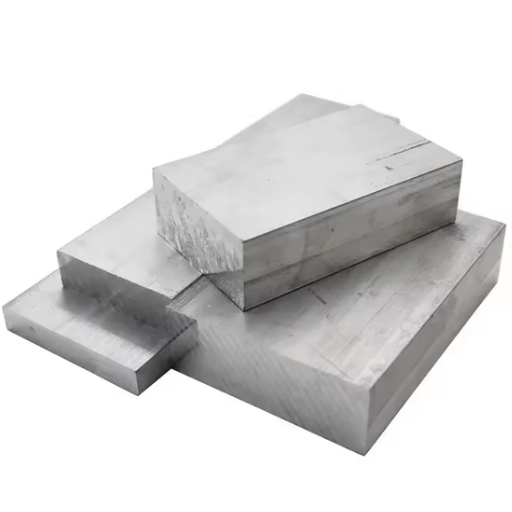
Here is the mechanism that makes T651 worth buying.
Where the stress comes from
A water quench cools the outside of a plate before the inside. The surface contracts while the center is still hot and still expanded. When the center finally cools, it pulls the surface into compression, and the surface pulls the center into tension. The plate ends up holding a self-balanced stress pattern with no external load applied.
Nothing visible happens. The plate sits flat on the rack. Then a machinist removes 8 mm from one face.
The removed material was part of the layer that balanced the stress. With it gone, the remaining stress has nothing to push against, so the part relieves itself by changing shape. It bows, twists, or loses parallelism. The amount depends on how much was removed, from which side, and how thick the remaining section is.
What stretching does
T651 pulls the quenched plate in tension until the surface layers yield. Because the stretch is uniform across the section, the stress pattern relaxes into a much lower, much more even state. The plate is then aged to full strength.
The result is a plate that behaves predictably when you cut it. Remove the same 8 mm and the part stays close to flat. If a flatness callout is on the drawing, T651 is what makes it achievable on a large part.
What T651 does not fix
T651 is not a general cure for parts that move. Four other sources of movement remain untouched:
- Clamping stress. Bolting a plate to a fixture bends it. Cut it in the clamped state and it springs when you release the clamps. No temper fixes this; a relaxed clamping sequence or a stress-relief step between roughing and finishing does.
- Cutting-induced stress. Removing a lot of material generates heat and local deformation. Rough, let the part cool, then finish. This is a process decision, not a material one.
- Thin walls and unsupported features. A 1.5 mm rib will deflect under cutting force regardless of temper. Support it, or accept a finishing pass at low load.
- Asymmetric removal. Taking 20 mm off one face and 2 mm off the other leaves a new imbalance. If the design allows it, remove material evenly from both faces.
A worked example shows how far the temper can carry you. Take a 32 mm 6061-T651 fixture plate, pocketed 14 mm deep into one face over a 600 mm length. The pocket removes 44% of the thickness from one side only. The remaining section now sits well off the neutral axis, and a few tenths of a millimetre of bow across 600 mm is a normal outcome even with low-stress stock.
The fix in that case is not a different temper. It is a roughing pass, a 24-hour hold, and a finish cut with the plate flipped.
None of this argues against T651. It argues for putting T651 on a part whose process is already controlled.
Sheet, Plate, Bar and Extrusion: How Form Decides 6061 T6 vs T651
Most “T6 or T651?” questions resolve themselves once the thickness and product form are on the table.
| Product form | Thickness range | Normal temper | Standard |
|---|---|---|---|
| Sheet | 0.006 to 0.249 in (0.15 to 6.32 mm) | T6 | ASTM B209 |
| Plate | 0.250 in (6.35 mm) and above | T651 | ASTM B209, AMS 4027 |
| Cold-finished bar, rod | All sizes | T651 | ASTM B211, AMS 4117 |
| Extruded bar, rod, shape | All sizes | T6511 | ASTM B221, AMS 4173 |
The 0.250 in line is where sheet becomes plate. It is one thousandth of an inch wide, and three things change when you cross it. The product is normally stocked in T651 rather than T6, a different thickness tolerance row applies, and a flatness allowance written for plate takes over.
The practical trap is metric. A 6 mm product is 0.2362 in, which is sheet. A buyer who orders “6 mm 6061-T6 plate” is using a word the standard doesn’t use for that thickness.
The supplier may ship 6 mm T6 sheet and be entirely correct, or may ship 6.35 mm T651 plate and be equally correct. If the drawing needs one or the other, say which.
The dual certification trap
Extruded T6511 bar is frequently dual-certified to T6, and the certificate will show both. That is normal and legitimate; the mechanical requirements overlap.
Plate T651 is a different case. A plate order calling for T6 cannot be filled with T651 plate in the general case, and a T651 callout above 0.250 in should not be quietly substituted with T6 sheet or plate.
When a quote comes back cheaper than the others for a T651 plate line item, this substitution is one of the reasons. Check the certificate against the callout before the material goes to the machine.
Protomatic made a related observation that still holds. An extrusion substituted for plate will often show grain direction after anodizing, as streaks or color variation. The effect sometimes only appears after the finish is applied. If the part is cosmetic and comes from bar, specify grain direction along with the temper.
What the Standards Guarantee, and Where They Step Down
A specification is only as good as the number at the bottom of its table. For 6061-T6 and T651, that number is not constant across thickness.
Under ASTM B209, 6061-T6 and T651 plate carry a minimum tensile strength of 42 ksi (290 MPa) and minimum yield of 35 ksi (241 MPa) through roughly 4 in.
Then the step-down starts. In the metric edition, B209M, minimum tensile strength drops to 275 MPa above 50 mm. AMS 4027P does the same thing in inch units: 42.0/35.0 ksi through 4.000 in, then 40.0/35.0 ksi from 4.000 to 6.000 in.
Extrusions are lower again. Under ASTM B221, 6061-T6 and T6511 carry 38.0 ksi (262 MPa) minimum tensile and 35.0 ksi (241 MPa) minimum yield.
That is a real difference, and it is one reason a plate callout on an extruded part is a specification error rather than a preference.
Two habits keep drawings out of trouble.
First, separate typical from minimum in every table and every drawing note. The 310 MPa and 276 MPa figures are typical. A drawing that says “6061-T6, 310 MPa min” is asking for a typical value as a guaranteed floor, and most mills won’t certify to it.
If the design truly needs 310 MPa guaranteed, the honest options are a thicker section, a different alloy, or a written agreement with the supplier before the order is placed.
Second, put the standard on the drawing. “6061-T651” names the alloy and temper but not the tolerance table, the test schedule or the certificate format. “6061-T651, ASTM B209, plate, 25 mm” does.
6061 T6 vs T651: When to Specify Each
The decision is about how the part is made, not about what the part carries.
| Situation | Temper | Why |
|---|---|---|
| Machined from plate, flatness or parallelism called out | T651 | Stretch removes the quench stress that bows parts |
| Heavy one-sided material removal | T651 | Balanced stress means predictable post-cut geometry |
| Thin ribs or pockets on a thick base | T651 | Low residual stress keeps the web from moving |
| Cosmetic part from bar, grain direction matters | T651 (plate) or T6511 with grain specified | Grain shows up after anodizing |
| Formed or bent part | T6 sheet | T651 is harder to form |
| Symmetric part, light machining, standard tolerance | T6 | The stretch premium buys little |
| Starting stock is an extrusion | T6511 | T651 does not exist as an extrusion |
Specify T651 when the part is machined from plate and has to stay flat. That covers fixture plates, tooling, mold bases, large brackets with tight parallelism, and any part where a flatness or perpendicularity callout follows a lot of material removal. It also covers parts machined from one side, and parts with thin ribs or pockets on a thick base.
Specify T6 when the stock is sheet. Formed parts, panels, covers, brackets cut from thin stock and light machining jobs don’t benefit from T651, and T6 sheet is what’s stocked. If the part is symmetrical and the material removal is balanced, T6 plate will often hold flatness well enough, and the stretch step buys little.
Specify T6511 when the starting stock is an extrusion. Bars, rods and profiles come in 6061-T6511, and asking for T651 on an extruded section creates a purchasing problem rather than a better part.
What it costs
T651 carries a modest premium over T6 for the stretch operation, the trimmed ends and the extra handling. The premium is usually small next to the cost of the machining it protects. A bowed plate means a second setup, a re-fixture, sometimes a scrapped part, and a schedule slip. On a large part, one scrapped piece usually costs more than the temper premium across the whole order.
Availability is the other half. Above 0.250 in, T651 is the form mills and service centers normally stock, so lead time is often better than for T6 plate in the same thickness. Below 0.250 in, the reverse is true.
The honest answer on price is that it depends on thickness, width, quantity and the mill’s current book. Compare quotes on the same temper, thickness and tolerance before you compare the numbers. If you want that comparison on a real drawing, send it to our technical team and we will quote both tempers on one basis.
How to Write the Specification
A complete callout removes the ambiguity that causes most of these problems. Here is one:
6061-T651, ASTM B209, plate, 25 mm nominal with thickness tolerance, 500 x 500 mm, flatness 1 mm per metre measured on a surface plate, edges sawn, mill certificate to EN 10204 3.1 with heat number and mechanical results, grain direction marked.
Each line does work.
- Alloy, temper, standard and form tell the mill which product and which tolerance table apply.
- Thickness with tolerance prevents the 0.236 in surprise on a 0.250 in callout.
- Flatness with a measurement method gives the inspector something to check. A flatness number without a method is an argument waiting to happen.
- Certificate with heat number ties the plate to its test results. Ask for the standard the certificate is issued against, not just the word “certificate.”
- Grain direction matters when the part is cosmetic or bent, and it is free to specify.
For sheet parts, the same logic applies at a smaller scale. Our guide to 6061 aluminum sheet thickness, temper and tolerance covers the tolerance rows and the 0.249/0.250 boundary in more detail.
The 6061 aluminum alloy guide covers the full temper family, if you need the wider view.
Frequently Asked Questions
Is 6061-T651 stronger than 6061-T6?
No. Both tempers have the same typical strength, 310 MPa tensile and 276 MPa yield. They also share the same guaranteed minimums under ASTM B209 and AMS 4027: 42 ksi (290 MPa) tensile and 35 ksi (241 MPa) yield for plate through 4 in. T651 is stretched to relieve residual stress, not to raise strength.
What does the 5 in 6061-T651 mean?
It designates stress relief by stretching. The “5” sits in the second position of the temper code and belongs to the TX51 family, which covers T351, T451, T651 and similar tempers. AMS 4027 specifies a nominal permanent set of 1.5% to 3% for T651 plate.
Is T651 the same as T6511?
No. T651 is stretched plate, cold-finished bar or rolled stock. T6511 is stretched and then straightened extrusion. They share a strength family but come from different product forms, and a T651 callout on an extrusion is not a valid order.
Can you weld 6061-T651?
Yes, with the same caveats as T6. The heat-affected zone loses temper, so a welded assembly does not carry the base plate’s 241 MPa minimum yield through the joint. Design the joint for the welded condition. Post-weld aging recovers some strength; full T6 requires re-solution treatment and quench, which is rarely practical on a finished fabrication.
Why did my 6061-T6 plate warp after machining?
Quench stress rebalancing after material removal is the usual cause. The warp is the whole part bowing, not a local defect. Unstretched plate holds a self-balanced stress pattern, and cutting one face releases it. The fixes are T651 stock, balanced removal from both faces, a rough-and-finish sequence with a delay, or a stress-relief step between roughing and finishing.
Can I get 6061-T6 in 25 mm plate?
You can ask, but the market normally supplies 25 mm as T651 because the stretch step is what makes thick plate machinable. If a drawing calls for T6 at that thickness, confirm with the supplier what will actually ship, and check whether the intent was temper or flatness.
Conclusion
The 6061 T6 vs T651 choice is not a strength decision. Both tempers are 6061, both are solution treated and aged to the same typical values, and both carry the same minimums in the standards. T651 adds a 1.5% to 3% stretch that removes quench stress, and that is what keeps a machined plate flat.
Use the form of the stock to narrow the choice. Sheet under 0.250 in is T6. Plate from 0.250 in is normally T651, extruded bar is T6511, and cold-finished bar is T651.
Then read the standard for the thickness you’re actually buying, because minimums step down above 50 mm in B209M and above 4.000 in in AMS 4027P.
Write the callout with alloy, temper, standard, form, thickness tolerance, flatness method, certificate and grain direction. That single habit prevents more scrap than any material upgrade.
If you are still weighing 6061 T6 vs T651 for a specific part, send us the drawing, the thickness and the flatness requirement. We supply AA 6061 plate in our aluminum plate range and will confirm what the mill can supply before you commit. For a different strength point in the same family, the 6061 vs 7075 comparison covers the higher-strength option, and the 6061 vs 6063 comparison covers the extrusion alloy.