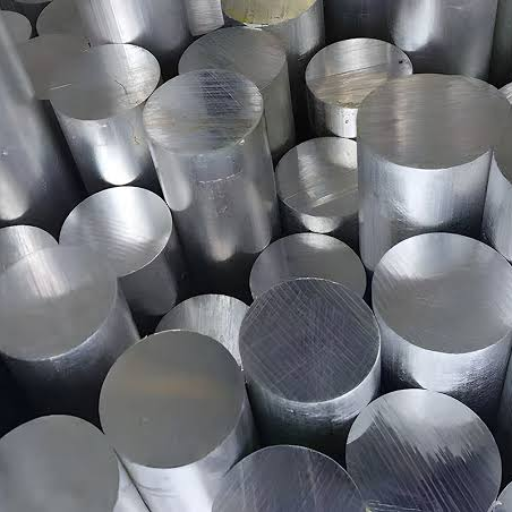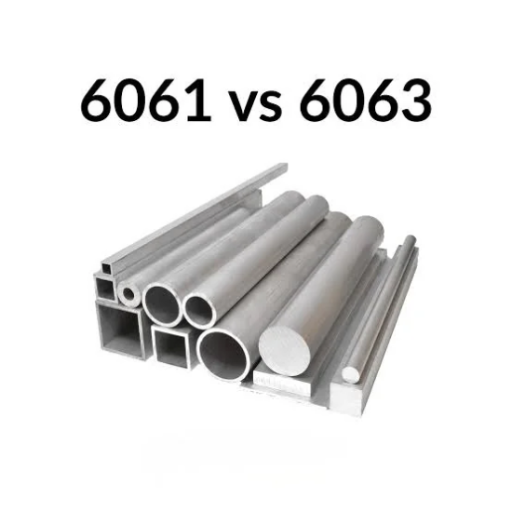
6061 is the stronger, more machinable alloy. 6063 is the easier alloy to extrude and the better substrate for a bright anodized finish. That is the 6061 vs 6063 aluminum comparison in two sentences, and most arguments about these grades come down to which of those two jobs your part actually has.
You have probably read that 6061 is twice as strong as 6063. The claim is not wrong, but it usually hides the comparison: 6061-T6 against 6063-T5. Those are two heat treatments as well as two alloys, so the number overstates the alloy difference.
This article compares them at the same temper, separates minimum values from typical ones, and follows the decision through extrusion, anodizing, welding and cost. It ends with a purchase order checklist a mill can meet. We supply AA 6063 coil and AA 6061 plate, so both sides of this order cross our desk. Send the drawing and temper if you want the alloy confirmed first.
Key Takeaways
- 6061-T6 is about 29% stronger than 6063-T6 at typical values, not twice as strong. The “twice” claim compares 6061-T6 with 6063-T5.
- ASTM minimums are lower than the typical values most supplier tables print: 262/241 MPa for 6061-T6 extrusions, 207/172 MPa for 6063-T6, 152/110 MPa for 6063-T5.
- 6063 wins on extrudability, thin walls, complex hollows, heat sinks and bright anodized finishes. 6061 wins on strength, machining and hardcoat wear resistance.
- Both alloys share a density of 2.70 g/cm³ and a modulus near 69 GPa, so switching to 6061 does not reduce deflection unless the section changes.
- A welded T6 joint loses 40% to 50% of its strength in the heat-affected zone. Design the joint, not the datasheet.
The Short Answer: 6061 vs 6063 Aluminum
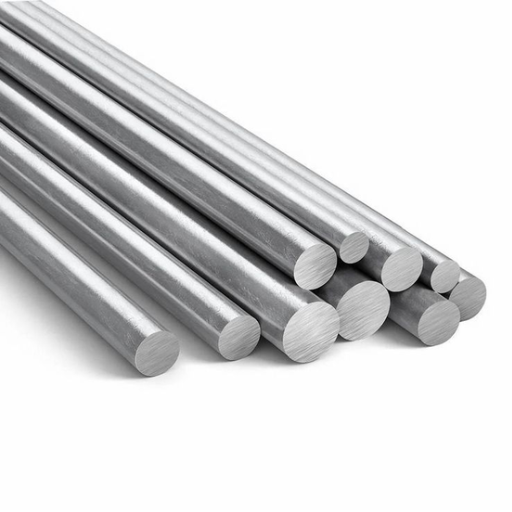
Choose 6063 when the part is an extrusion, when the surface will be anodized and seen, or when the profile is complex and thin-walled. Choose 6061 when the part is machined, carries a load, or needs wear resistance from a hard anodized coating.
| Decision | 6061 | 6063 |
|---|---|---|
| Best process | Machining, plate work, simple solid extrusions | Extrusion, especially complex hollow profiles |
| Typical temper | T6, T651, T6511 | T5 or T52, T6 when more strength is needed |
| Strength at T6 (typical) | 310 MPa tensile, 276 MPa yield | 241 MPa tensile, 214 MPa yield |
| Clear anodized look | Matte gray, some lot-to-lot variation | Bright, uniform silver |
| Machining | Clean chip, holds tolerance | Gummy, prone to built-up edge and burrs |
| Forming | Limited in T6; T4 for tight bends | Bends easily in T5 and T52 |
| Welding | Weldable, more sensitive to strength loss | Excellent weldability |
| Finished cost | Usually a 10% to 25% premium as an extrusion | Usually the lower-cost finished extrusion |
| Typical parts | Fixtures, molds, brackets, valve bodies | Window profiles, handrail, heat sinks, trim |
Three conditions override the rule. If the part is welded after aging, the temper story changes. If the part is deflection-limited rather than strength-limited, neither alloy helps. If the finish is color-critical, the substrate is settled before the strength calculation starts.
6061 vs 6063 Aluminum: What the Designations Mean
Both grades are 6xxx alloys, meaning aluminum with magnesium and silicon. Those elements form magnesium silicide, the precipitate that responds to solution treatment and aging. That is why one chemistry can arrive as soft O, naturally aged T4 or fully aged T6.
The difference is how much is added. 6061 carries more magnesium, silicon, copper and chromium. 6063 stays lean so it can be pressed and finished. Composition limits follow ASTM B221 and the published 6063 datasheet from Aircraft Materials.
| Element (wt%) | 6061 | 6063 |
|---|---|---|
| Silicon | 0.40 to 0.80 | 0.20 to 0.60 |
| Iron | 0.70 max | 0.35 max |
| Copper | 0.15 to 0.40 | 0.10 max |
| Manganese | 0.15 max | 0.10 max |
| Magnesium | 0.80 to 1.20 | 0.45 to 0.90 |
| Chromium | 0.04 to 0.35 | 0.10 max |
| Zinc | 0.25 max | 0.10 max |
| Titanium | 0.15 max | 0.10 max |
More magnesium and silicon means more Mg2Si, so 6061 reaches higher strength and resists hot deformation more, which slows the press. Copper adds strength but trims corrosion resistance and complicates a clear finish, so 6063 caps it at 0.10% for a cleaner oxide. The 6063 aluminum properties that follow, extrudability and finish, come from that leaner chemistry. Read the same tables as 6063 vs 6061 aluminum and nothing changes except the column order.
Temper matters as much as chemistry, and most comparisons skip it.
| Temper | Meaning | Where it is used |
|---|---|---|
| T4 | Solution treated and naturally aged | Forming before final aging |
| T5 | Cooled from extrusion and artificially aged | Standard architectural 6063 extrusion |
| T52 | T5 tube, stress relieved by stretching | Handrail, furniture, structural tube |
| T6 | Solution treated and artificially aged | 6061 default; higher-strength 6063 |
| T651 / T6511 | T6, stress relieved by stretching | Machined plate and extruded bar |
| T832 | Solution treated, cold worked and aged | Drawn tube needing higher strength |
A 6063 T5 aluminum window profile and a 6061-T6 machined bracket are different product categories. Comparing them is what produces the “twice as strong” claim. At the same temper, the gap is real and smaller.
6061 vs 6063 Aluminum Strength: Compare Like Tempers
The top table shows what a purchase order can enforce. The bottom table shows what mills commonly report.
| Product form | Alloy and temper | Tensile minimum | Yield minimum | Elongation minimum |
|---|---|---|---|---|
| Extruded shapes, bars, tube | 6061-T6 / T6511 | 262 MPa (38 ksi) | 241 MPa (35 ksi) | 8% to 10% |
| Sheet and plate | 6061-T6 / T651 | 290 MPa (42 ksi) | 241 MPa (35 ksi) | 8% to 10% |
| Extruded shapes | 6063-T6 | 207 MPa (30 ksi) | 172 MPa (25 ksi) | 8% to 10% |
| Extruded shapes | 6063-T5 | 152 MPa (22 ksi) | 110 MPa (16 ksi) | 6% to 8% |
| Extruded tube | 6063-T52 | 152 MPa (22 ksi) | 110 MPa (16 ksi) | 6% to 8% |
| Drawn seamless tube | 6063-T6 | 228 MPa (33 ksi) | 193 MPa (28 ksi) | 10% to 14% |
| Drawn seamless tube | 6063-T832 | 283 MPa (41 ksi) | 248 MPa (36 ksi) | 5% to 8% |
Standards by row: ASTM B221 for extrusions, ASTM B209 for sheet and plate, ASTM B210 for drawn tube.
Typical values, which are not minimums:
| Property | 6061-T6 | 6063-T6 | 6063-T5 |
|---|---|---|---|
| Ultimate tensile strength | 310 MPa | 241 MPa | 186 MPa |
| Yield strength (0.2%) | 276 MPa | 214 MPa | 145 MPa |
| Elongation | 12% | 12% | 12% |
| Brinell hardness | 95 HB | 73 HB | 60 HB |
| Modulus of elasticity | 68.9 GPa | 69 GPa | 69 GPa |
| Density | 2.70 g/cm³ | 2.70 g/cm³ | 2.70 g/cm³ |
At matched temper, 6061-T6 is about 29% stronger than 6063-T6 in typical tensile and yield. Against 6063-T5, the typical gap is 67% in tensile and 90% in yield. That last pair is what most supplier pages print, and it compares two tempers.
Minimum Values and Why Your Drawing Matters
A mill certificate reports actual test results, which usually sit above the standard minimum. The trouble starts when a drawing copies a typical value and writes “min” beside it.
“6063-T6, 241 MPa min” asks for the typical tensile value as a guaranteed floor. ASTM B221 sets the floor at 207 MPa. The mill may deliver 241 MPa, but the standard does not promise it, so a heat at 220 MPa still passes. The same error appears with “6061-T6, 310 MPa min,” which exceeds both the B221 extrusion minimum of 262 MPa and the B209 sheet and plate minimum of 290 MPa.
Product form changes the number. 6063-T6 drawn tube under ASTM B210 holds higher minimums than 6063-T6 extrusions because cold drawing adds work. 6063-T832 reaches 283/248 MPa minimum, close to 6061-T6. If someone says 6063 cannot carry load, ask which form they mean.
The Bracket That Still Deflected
A machine builder replaced a 6063-T5 bracket with 6061-T6 to stop a guard from flexing. The new bracket was stronger on paper and deflected almost the same amount.
The bracket was stiffness-limited. Deflection depends on modulus and section geometry, and both alloys sit near 69 GPa. A stronger alloy raises the load at which the part yields. It does not make the part stiffer.
The fix was a deeper section and a formed rib in 6063, which cost less than the alloy change.
Extrusion: Why 6063 Exists
6063 was designed around the press. Less Mg2Si means lower flow stress and easier deformation at the same billet temperature, which changes what the press can do. For most architectural work, the aluminum extrusion alloy choice is settled before the strength calculation starts.
- Press speed. Rules of thumb put 6063 at roughly 50 to 60 ft/min and 6061 at 30 to 40 ft/min on the same profile. Real numbers depend on press, profile and temper.
- Extrudability. One published index puts 6061 at about 60% of 6063.
- Wall thickness. Extruders commonly quote minimum walls around 0.8 to 1.0 mm for 6063 and about 1.5 mm for 6061. Treat these as design rules of thumb, not standard limits.
- Temper route. 6063-T5 can be press quenched in air and aged, with no separate solution treatment. 6061-T6 needs the full solution treat and quench.
- Die life. Higher pressure and slower speed wear dies faster on 6061 and raise scrap.
A complex hollow profile with thin walls is usually a 6063 job. Asking for 6061 in the same geometry may need a larger press, a slower run, more die maintenance or thicker walls, and thicker walls can erase the strength gain. A simple solid profile is different: if it carries load, 6061 can justify the slower press. The cost mechanics are set out in this Alexandria Industries white paper.
Buyer rule: start complex profiles in 6063. Start simple load-bearing profiles in 6061, and check whether 6063-T6 meets the requirement at a lower finished cost.
6063 Aluminum Anodizing and Surface Finish
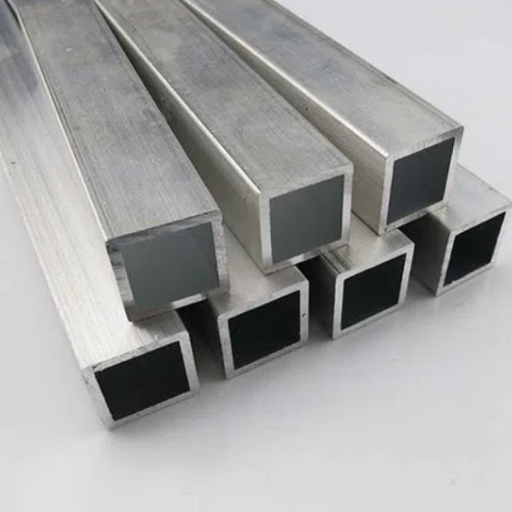
Clear anodizing is where the two alloys look most different, and no polish fixes it.
6063 anodizes to a bright, uniform silver. Low iron and silicon, plus fine grain, give a consistent oxide that takes dye evenly. 6061 anodizes to matte gray and can vary by lot, because coarser silicon- and iron-rich particles disrupt the film and scatter light. The mechanism is described in this PF Online article on clear anodized 6061.
Hard anodizing reverses the preference. Type III coatings on 6061 run tan or gray toward black at thickness, at roughly 400 to 600 HV, which suits machined housings, valve parts and sliding surfaces. Type II sulfuric anodize runs about 5 to 25 µm at roughly 200 to 400 HV; Type III runs 25 to 150 µm.
Specify the Class, Not the Color
“Clear anodized” is not a specification. It leaves thickness, sealing and test method open, and two suppliers can meet it with coatings that age differently outdoors.
| Specification | Requirement | Where it applies |
|---|---|---|
| AAMA 611 Class I | About 18 µm minimum, longer salt spray | North American architectural |
| AAMA 611 Class II | About 10 µm minimum | Interior and light duty |
| ISO 7599 AA15 | 15 µm minimum | International decorative |
| ISO 7599 AA20 | 20 µm minimum | Exterior architectural |
| ISO 7599 AA25 | 25 µm minimum | Severe exterior exposure |
Write “AAMA 611 Class I, clear, 18 µm minimum” or “ISO 7599 AA20” on the PO. The class is what a coater can inspect against.
The Window Frame That Turned Gray
A fabricator swapped a visible window profile from 6063-T5 to 6061-T6 to satisfy a wind-load check. The press ran slower, the walls had to thicken to fill, and the clear anodize came out flat gray instead of matching the adjacent units.
The visible profile never needed the strength. The fix was 6063-T5 for the frame and a hidden 6061 insert at the anchors, where the load concentrates.
If a welded assembly will be anodized, filler matters. 5356 anodizes closer to the base color. 4043 can leave a dark or smeared weld zone. Specify 5356 for visible joints and test a coupon first.
Need consistent 6063 coil for anodizing? We supply AA 6063 aluminum coil in T4, T5 and T6, slit and cut to length, with mill, pre-painted or anodized finishes available.
Machining, Welding and Forming
6061-T6 machines cleanly. It breaks a firm chip, holds tolerance and takes a good finish, which is why fixtures, molds and machined components default to it. 6063 is softer and gummier, building up on the edge and burring unless feeds and speeds are adjusted. Deburring often erases the material saving.
6063-T4 and T5 bend more easily than 6061-T6, which is why handrail, trim and architectural bends are usually 6063. Tight bends in 6061-T6 may need T4, a larger radius or another alloy.
Both alloys weld. 6063 is the more forgiving. 6061 is weldable but more sensitive to cracking and strength loss in thick or restrained joints.
The heat-affected zone over-ages, and a 6061-T6 joint commonly loses 40% to 50% of its tensile strength there. Re-solution treating a welded assembly is rarely practical, so design to as-welded properties.
Filler drives the result. 4043 (Al-5% Si) is fluid, crack-resistant and economical. 5356 (Al-5% Mg) gives higher strength and ductility and anodizes closer to the base metal. For thick butt welds, 4043 can be strength-limited by dilution.
The Welded Frame Designed on the Datasheet
A 6061-T6 frame was designed around the 276 MPa typical yield, and the welded corners were checked against the same number. The prototype passed a static test and cracked at a corner after months of vibration.
The weld was never a 276 MPa region. The HAZ sat closer to 150 to 180 MPa after over-aging, and the design had assumed a property that existed away from the joint.
The fix was to treat the HAZ as the limiting zone, move the gussets and qualify the procedure with 5356 filler. The alloy stayed. The assumed strength changed.
Machining from plate? AA 6061 aluminum plate is supplied in T6, and our 6061 aluminum sheet guide covers where sheet ends and plate begins.
Corrosion and Applications
Both alloys resist atmospheric corrosion well. 6063 is slightly better outdoors because it carries less copper. 6061’s copper buys strength and costs a little corrosion resistance in wet or aggressive service.
Neither is a marine immersion alloy. That matters because product pages and blogs blur it.
6061 suits above-water fittings, trailers and coated structures with dissimilar-metal isolation. It is not a hull alloy, and 6063 is not marine grade. For continuous saltwater exposure, use 5052 or 5083.
| Application | Usual choice | Why |
|---|---|---|
| Window, door and curtain wall profiles | 6063-T5 or T52 | Extrudability and bright anodized finish |
| Handrail, furniture, trim | 6063-T5 or T52 | Formability and finish |
| Heat sinks and LED housings | 6063 | Thermal conductivity around 200 to 209 W/m·K |
| Machined fixtures, jigs and molds | 6061-T6 or T651 | Machinability and strength |
| Valve bodies, manifolds, pneumatic parts | 6061-T6 | Strength and machined finish |
| Structural brackets and frames | 6061-T6 | Strength, with HAZ checked at welds |
| Marine hulls and immersion | 5052 or 5083 | Not a 6061 or 6063 job |
The thermal gap matters on its own. 6061 conducts about 167 W/m·K; 6063 runs about 200 to 209 W/m·K depending on temper. Moving a heat sink from 6061 to 6063 gains thermal performance and extrudes faster with thinner fins, as long as the fins are not load-bearing.
6061 vs 6063 Aluminum Cost and Procurement
The billet price difference is small. One distributor calls it largely negligible at the metal level, so the alloy is not a major cost lever by itself.
The finished part is different. 6063 usually costs less as an extrusion because it presses faster, wears dies less and can use air-quenched T5. Buyers commonly see a 10% to 25% premium for 6061 extrusions, but that is directional: profile complexity, press size, volume and finishing yield move it.
For machined parts the calculation flips. 6061 machines faster and cleaner, so the material premium can disappear in machining cost. Compare cost per finished part, not price per kilogram.
| Product | 6061 | 6063 |
|---|---|---|
| Extruded bars, rods, shapes, tube | ASTM B221 | ASTM B221 |
| Drawn seamless tube | ASTM B210 | ASTM B210 |
| Sheet and plate | ASTM B209 | Less common; confirm |
| Structural shapes | ASTM B308 | Not typical |
| Pipe | ASTM B241 | ASTM B241 |
| European extruded profiles | EN 755-2 | EN 755-2 |
| European precision profiles | EN 12020-2 | EN 12020-2 |
Tolerances follow ANSI H35.2 in the US and EN 755-9 or EN 12020-2 in Europe. The standard you name decides which tolerance table applies, which is why “6063 aluminum” alone is not an order.
Purchase Order Checklist
A complete line names:
- Alloy and temper, for example 6063-T6 or 6061-T651
- Product form and standard, for example extruded profile to ASTM B221
- Dimensions and tolerances for wall, width, length and straightness
- Finish and class, for example AAMA 611 Class I clear anodize, 18 µm minimum
- Mechanical minima stated against the standard, not a typical value
- Heat or lot traceability and a mill certificate with chemistry and mechanical results
- Marking that shows alloy and temper on the bundle
- Packaging and protection for anodized or painted surfaces
A strong line reads: “6063-T6 extruded profile, ASTM B221, 2.0 mm wall, mill finish, AAMA 611 Class I clear anodize, 18 µm minimum, mill certificate with heat number and mechanical results.”
A weak line reads: “6063 aluminum, anodized.” Everything that matters is left to the supplier.
Ask for chemistry, temper, tensile, yield, elongation and heat number on the certificate. For European supply, EN 10204 3.1 is the usual inspection certificate. A certificate that says only “6063” with no temper or mechanical results will not support a structural or architectural claim.
Sorting 6061 from 6063
Mill marking and the certificate come first. Do not sort by eye. XRF reads the chemistry and separates the two cleanly.
A conductivity meter is faster: 6063 typically reads 53% to 55% IACS, 6061-T6 about 40% to 43%. Hardness is a secondary check at roughly 95 HB against 73 HB. Keep the scrap streams separate, because mixing 6061 into a 6063 bale downgrades the load.
What We Supply
DAPU supplies AA 6063 aluminum coil in T4, T5 and T6, slit and cut to length, with mill, pre-painted or anodized finishes available. We also supply AA 6061 aluminum plate in T6. We do not publish extruded profiles, so if your drawing is a profile, we will quote the coil or plate that feeds it and say plainly what we cannot supply.
Frequently Asked Questions
Is 6061 stronger than 6063?
Yes, at the same temper. 6061-T6 is about 29% stronger than 6063-T6 in typical yield and about 27% stronger in minimum tensile. The “twice as strong” claim compares 6061-T6 with 6063-T5.
Which is better for anodizing, 6061 or 6063?
6063, for bright and uniform clear or colored anodize. 6061 takes hardcoat well where wear resistance matters, but its clear anodize is matte gray.
Can 6063 aluminum be welded?
Yes. It welds readily with 4043 or 5356 filler. The HAZ loses strength, so design the joint to as-welded properties.
Is 6063 aluminum marine grade?
No. It resists atmospheric corrosion well but is not intended for continuous saltwater immersion. Use 5052 or 5083 for marine sheet and plate.
Which is cheaper, 6061 or 6063?
6063 is usually cheaper as a finished extrusion because it presses faster. 6061 can be cheaper per finished machined part because it machines faster.
How can I tell 6061 from 6063?
Check the certificate or marking first. XRF or a conductivity meter settles it in the warehouse: 6063 reads 53% to 55% IACS, 6061-T6 about 40% to 43%. Hardness is a secondary check.
How does 6061 compare with 7075?
7075 is substantially stronger and less corrosion resistant, and it is used where strength per weight dominates. Our 6061 vs 7075 aluminum comparison covers that decision. The full property set for 6061 sits in the 6061 aluminum alloy guide.
Conclusion
The 6061 vs 6063 aluminum decision has three parts, and only the first is about alloy. Choose the process route first: 6063 for extrusion and finish, 6061 for machining and load. Choose the temper second, because T6 against T5 inflates the gap. Specify the finish third, by class rather than color.
Then write a purchase order that names the standard, the product form, the minimum values and the certificate. The alloy number is the easy part. The numbers around it decide whether the order works.
If you are sourcing 6063 coil or 6061 plate, send the drawing, temper and finish and we will confirm what we can supply, what the mill will certify, and where a different alloy would serve you better.