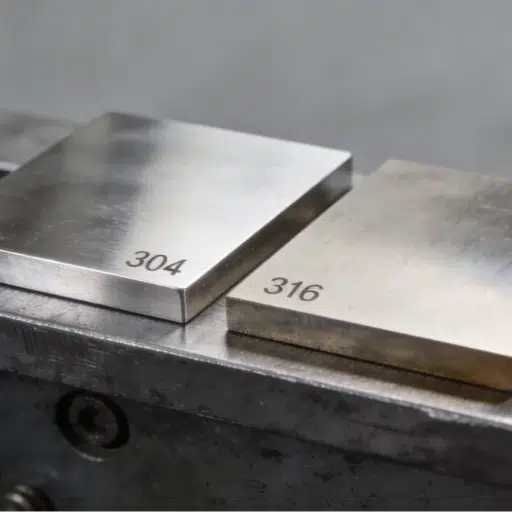
When comparing 304 vs 316 mechanical properties, one fact stands out: in the annealed condition, both grades carry identical minimum specified values. Tensile strength is 515 MPa, yield strength is 205 MPa, and elongation is 40% for each. The two grades are effectively equal in strength at room temperature. Measured values typically run 5-10% higher for 316, and 316 holds a clear advantage at elevated temperatures, but for most designs you should treat them as comparable. Choosing between 304 and 316 should be driven by corrosion environment and service temperature, not raw strength.
When Marcus, a fabrication shop owner in a coastal city, specified 304 for a structural bracket, a supplier insisted 316 was “stronger” and pushed him to upgrade. Marcus checked the datasheets. Both grades listed the same minimum tensile and yield strength. He kept 304, saved the premium, and the bracket has performed perfectly for three years in a dry, indoor environment. The real difference between the grades is corrosion resistance, not strength.
Key Takeaways
- 304 and 316 share identical specified minimums: 515 MPa tensile, 205 MPa yield, 40% elongation in the annealed condition.
- Measured values typically run 5-10% higher for 316, though this rarely affects design.
- 304 work-hardens more aggressively than 316 because it forms strain-induced martensite more readily during cold working.
- Cold-worked 304 becomes magnetic (permeability up to ~1.8) while 316 stays nearly non-magnetic, so a magnet test cannot reliably tell the grades apart.
- 316 is the stronger choice at elevated temperature: it retains more strength above 300°C and has more than twice the creep life of 304.
Are 304 and 316 the Same Strength?

Yes, in practical terms. Both grades are austenitic stainless steels in the 300 series, and both carry the same minimum mechanical property requirements in the annealed condition under ASTM A240. For a full overview of the grade family, our complete stainless steel guide covers every grade in the series:
| Property | 304 Minimum | 316 Minimum |
|---|---|---|
| Tensile strength | 515 MPa (75 ksi) | 515 MPa (75 ksi) |
| Yield strength (0.2% proof) | 205 MPa (30 ksi) | 205 MPa (30 ksi) |
| Elongation | 40% | 40% |
| Hardness | 92 HRB / 201 HB max | 95 HRB / 217 HB max |
The answer gets more nuanced when you compare actual measured values rather than specified minimums. In practice, 316 often tests slightly higher thanks to its molybdenum content. One published comparison measured 316 at 79,800 psi ultimate tensile strength versus 73,200 psi for 304, with corresponding hardness of 80 HRB versus 70 HRB. The difference is real but small, roughly 5-10%, and it rarely changes an engineering decision.
For design purposes, treat the grades as equivalent in strength. If you are choosing 316 for a room-temperature, non-corrosive application expecting more strength, you are paying a premium you will not recover in performance. Our 304 vs 316 comparison walks through all the differences side by side.
304 vs 316 Mechanical Properties Comparison Table
Here is the full mechanical properties comparison for 304 and 316 in the annealed condition. Values come from ASTM A240 and common supplier data:
| Property | 304 | 316 | Notes |
|---|---|---|---|
| Tensile strength (min) | 515 MPa | 515 MPa | Identical minimums |
| Yield strength (min) | 205 MPa | 205 MPa | Identical minimums |
| Elongation (min) | 40% | 40% | Measured 304 often slightly higher |
| Reduction of area | 50-60% | 50-60% | Similar for both |
| Hardness (max) | 92 HRB / 201 HB | 95 HRB / 217 HB | 316 marginally harder |
| Modulus of elasticity | 193-200 GPa | 193-200 GPa | Identical stiffness |
| Shear strength (annealed) | ~400 MPa | ~400 MPa | Similar |
| Poisson’s ratio | 0.28 | 0.28 | Identical |
| Density | 8,000 kg/m³ | 7,990 kg/m³ | Nearly identical |
| Magnetic (annealed) | ~1.0-1.005 µ | ~1.0-1.005 µ | Both non-magnetic when annealed |
Notice how close the grades are. The modulus of elasticity, which controls stiffness and deflection, is identical. Density, which affects weight and load calculations, is essentially the same. The differences that do exist appear under cold working and at high temperature, which we cover next.
Why Composition Drives Mechanical Behavior
The mechanical differences between 304 and 316 trace back to two composition changes. 316 contains 2-3% molybdenum, which 304 lacks entirely, and 316 carries more nickel (10-14% versus 8-10.5%) with slightly less chromium (16-18% versus 18-20%).
Molybdenum serves two roles. It boosts pitting and crevice corrosion resistance, which is why 316 is the standard for marine and chloride service. It also helps stabilize the austenitic structure. That stabilization reduces the material’s tendency to transform into martensite during cold working, which is the key to understanding how the grades behave differently under forming.
Nickel does similar work. Austenite is the non-magnetic, ductile phase of stainless steel. Higher nickel content makes that phase more stable, so it resists transformation under stress. This is why 316 stays less magnetic after forming and work-hardens at a lower rate than 304.
If you need a deeper look at the chemistry, our stainless steel composition guide breaks down every element in detail.
Work Hardening: How 304 and 316 Respond to Cold Working
Work hardening, also called strain hardening, is the strengthening that occurs when metal is deformed. Bending, drawing, rolling, and stamping all push dislocations through the crystal structure, and the material resists further deformation as a result.
Both 304 and 316 work-harden faster than carbon steel because their austenitic, face-centered cubic structure allows more dislocation movement. But the grades differ in one important way. 304 work-hardens more aggressively than 316 because cold working transforms some of its austenite into martensite, a harder, stronger phase. 304’s lower alloy content makes it more metastable, so the transformation happens readily.
316 resists that transformation. Its higher nickel and molybdenum content stabilizes the austenite, so it work-hardens at a lower rate. For severe forming operations, this is often a practical advantage: 316 may tolerate fewer intermediate annealing steps than 304 before splitting becomes a risk.
You will also see claims that “316 work-hardens 15% faster than 304.” Those claims come from machining guides and are actually describing machinability, not metallurgical hardening. 316 is harder to machine because it generates more cutting force and heat, wearing tools faster.
Its machinability rating is about 36% versus 45% for 304. That is a real fabrication difference, but it is not the same thing as strain hardening.
For a full treatment of how these grades behave in fabrication, see our 304 vs 316 welding guide.
Cold Work Strengthening: Properties After Forming
Cold working strengthens both grades substantially. Cold rolling, wire drawing, and stamping raise yield and tensile strength while reducing ductility. The table below shows typical changes as cold reduction increases:
| Condition | Yield Strength | Tensile Strength | Hardness | Elongation |
|---|---|---|---|---|
| Annealed (0%) | ~205-310 MPa | ~515-620 MPa | ~190 HV | 40-60% |
| ~10% cold work | +30-50% | +15-25% | ~220-250 HV | ~25-35% |
| ~30% cold work | +60-80% | +30-40% | ~260-290 HV | 12-25% |
This is why cold-worked stainless is specified for springs, fasteners, and structural members where extra strength is needed without extra material. ASTM A666 covers the different tempers, from quarter-hard to full-hard.
The practical takeaway for engineers is simple. If you need higher strength, cold working delivers it in both grades. If you need ductility for deep drawing or multi-stage stamping, 304’s higher elongation and better formability make it the usual choice. 304 is the general-purpose default for drawn parts; 316 is chosen when corrosion resistance matters more than forming margin.
Magnetic Properties: Why 304 and 316 Behave Differently After Forming

Both grades are non-magnetic in the annealed condition, with relative permeability around 1.0-1.005. A magnet will not stick to either. That changes after cold working.
Cold work transforms some austenite into martensite, and martensite is magnetic. The degree of transformation depends on the grade’s stability:
- 304 is quite susceptible. Wire drawing, deep drawing, rolling, and thread rolling can make it noticeably magnetic. Randomly selected cold-worked 304 fasteners have shown permeabilities around 1.8.
- 316 stays nearly non-magnetic in most cases. Its higher nickel and molybdenum stabilize the austenite, suppressing martensite formation. Only intensive cold work, such as severe deep drawing, produces any real magnetic response.
The practical consequence is that the magnet test cannot distinguish 304 from 316. A cold-worked 304 fastener attracts a magnet while an annealed 316 fastener does not. Welds and castings add another wrinkle: delta ferrite in the weld metal makes both grades slightly magnetic.
If you need to verify a grade, use a molybdenum spot test, portable XRF, or a mill test certificate instead. The British Stainless Steel Association explains the permeability differences in detail.
Want to check what grade you are actually holding? Our technical team can help you verify material identity and specifications through technical consultation.
High-Temperature Mechanical Performance
Here is where the strength difference stops being academic. Above roughly 300°C, 316 clearly outperforms 304. Molybdenum and nickel stabilize the microstructure, helping 316 retain strength and resist creep where 304 weakens.
| Temperature | 304 Strength | 316 Strength |
|---|---|---|
| Room temperature | ~515-620 MPa | ~520-620 MPa |
| 300°C | ~420-450 MPa | ~460-490 MPa |
| 600°C | ~280-310 MPa | ~330-360 MPa |
| 800°C | Yield ~125 MPa | Yield ~150 MPa |
The gap widens as temperature rises. At 600°C, 316 retains roughly 15-20% more strength than 304. Even more important for long-term service, 316’s creep resistance is superior: its high-temperature creep life is more than twice that of 304. That is why 316 is specified for heat exchangers, boiler components, and high-pressure equipment operating above 425°C.
Both grades oxidize well up to similar limits, roughly 870°C for intermittent service and 925°C for continuous service. And both are vulnerable to sensitization, the precipitation of chromium carbides, when held in the 425-870°C range. For long-term elevated-temperature service, consider the H grades (304H, 316H) or stabilized grades such as 321 and 347. Low-carbon 316L is the default for welded process piping where corrosion, not just strength, is the governing factor.
When Daniel’s team rebuilt a chemical plant heat exchanger, they initially priced 304 tubes. The design temperature of 400°C meant 304 would creep-deform over a 20-year life. Switching to 316 added cost but doubled the expected service life, and the exchanger has run for six years without tube sag. For heated service, 316 is the stronger grade where it counts.
304L vs 316L: How Low Carbon Changes Mechanical Properties
The low-carbon variants, 304L and 316L, cap carbon at 0.03% versus 0.08% in the standard grades. Lower carbon reduces sensitization risk during welding, which is why L grades are standard for welded corrosive service.
The tradeoff is slightly lower minimum strength in some product specifications. Pipe spec ASTM A312, for example, lists 485 MPa tensile and 170 MPa yield for the L grades, versus 515 MPa and 205 MPa for standard grades. In practice, many mills supply dual-certified 304/304L and 316/316L material that meets both sets of requirements, and the strength reduction rarely drives a design change.
If you are welding for corrosive service, the L grades are usually the right call. Our 304L vs 316L guide covers when low carbon matters and when it does not.
Fastener and Property-Class Requirements
Stainless fasteners are specified differently from sheet and plate. Bolts and screws use property classes, not the annealed minimums discussed above. The common classes are A2 (304) and A4 (316), with strength levels of 70, 80, and sometimes 100:
| Class | Material | Tensile Strength (min) |
|---|---|---|
| A2-70 | 304 cold worked | 700 MPa |
| A2-80 | 304 cold worked | 800 MPa |
| A4-70 | 316 cold worked | 700 MPa |
| A4-80 | 316 cold worked | 800 MPa |
Cold working gives fasteners their strength, so an A4-80 bolt is significantly stronger than annealed 316 plate. When you specify fasteners, match the property class to the load requirement and the environment. In marine or chloride service, A4 (316) fasteners resist corrosion far better than A2 (304), even though the strength levels are identical. Our 304 vs 316 fastener guide covers the details.
When the Strength Difference Actually Matters

For the vast majority of room-temperature applications, the strength difference between 304 and 316 is irrelevant. Stiffness (modulus of elasticity) is identical, density is identical, and minimum strength is identical. Corrosion environment, cost, and availability should drive the decision.
There are specific cases where the small difference does matter:
- Thin-walled structural members. The Eurocode design standard for stainless structures (EN 1993-1-4) assigns design strength of roughly 210 MPa for 304 and 220 MPa for 316. For thin sections governed by buckling or local stability, that small difference can be meaningful.
- Elevated-temperature service. Above 300°C, the gap widens and 316 is the correct choice for pressure and load-bearing components.
- Cold-worked and fastener applications. Property classes and tempers define strength more than the base grade; specify the class you need.
For everything else, choose on corrosion. 304 handles fresh water, food, and indoor environments well. 316 is worth the premium where chlorides, saltwater, or chemical exposure are present. If you need help matching a grade to an environment, our stainless steel corrosion resistance guide is a useful starting point.
Which Is Stronger, 304 or 316?
The honest answer depends on the question you are asking:
- At room temperature: They are equal. Specified minimums are identical, and 316 tests only 5-10% higher in practice.
- After cold working: Both strengthen substantially. 304 work-hardens faster; 316 starts slightly stronger in the annealed condition.
- At high temperature: 316 wins clearly. It retains more strength above 300°C and has more than twice the creep life.
Lena, a procurement manager for an industrial equipment maker, used to specify 316 for everything out of caution. After reviewing actual load requirements and corrosion exposure, she switched most indoor components to 304 and kept 316 only for washdown and outdoor equipment. The change cut material cost on that product line by roughly 30% without a single field failure in three years. Understanding mechanical properties let her spend the budget where it mattered.
For most buyers, the selection framework comes down to three questions: Is there chloride or salt exposure? Is the service temperature above 300°C? Is the part welded for corrosive service?
If the answer to any is yes, consider 316 or 316L. If all are no, 304 will almost certainly save you money without sacrificing strength.
Frequently Asked Questions
Which is stronger, 304 or 316 stainless steel?
They have identical minimum specified tensile (515 MPa) and yield (205 MPa) strength in the annealed condition. Measured values for 316 typically run 5-10% higher, and 316 is clearly stronger at elevated temperatures, but at room temperature treat them as comparable.
Is 316 stainless steel harder than 304?
Marginally. The maximum hardness spec is 95 HRB for 316 versus 92 HRB for 304. In practice, both feel similar, and the difference rarely affects machining or wear performance enough to matter.
What is the yield strength of 316?
The minimum yield strength is 205 MPa (30 ksi) in the annealed condition. Cold-worked forms, such as fasteners, can reach much higher values depending on the property class.
Which is more ductile, 304 or 316?
304 generally shows slightly better elongation and formability, which is why it is preferred for deep drawing and multi-stage stamping. Both grades are highly ductile compared with carbon steel.
Does 304 become magnetic after cold working?
Yes. Cold working transforms some austenite into magnetic martensite, so 304 can become noticeably magnetic after drawing, rolling, or thread forming. 316 resists this transformation and stays nearly non-magnetic in most cases.
Does 316 work harden faster than 304?
No. Metallurgically, 304 work-hardens faster because it forms strain-induced martensite more readily. Claims that 316 work-hardens faster are usually describing machining difficulty, not strain hardening.
Is 316 better than 304 for high-temperature applications?
Yes. Above roughly 300°C, 316 retains more strength and has more than twice the creep life of 304, making it the standard choice for heat exchangers, boilers, and high-pressure heated equipment.
Conclusion
The 304 vs 316 mechanical properties question has a clear answer: at room temperature, the grades are effectively equal in strength, with identical minimums for tensile, yield, and elongation. The differences that exist show up under cold working, where 304 hardens faster and becomes magnetic, and at elevated temperature, where 316 is clearly the stronger and more creep-resistant grade.
When you select material, let the environment and service temperature drive the grade. Choose 316 for chlorides, saltwater, chemical exposure, or sustained high temperature. Choose 304 for clean, dry, room-temperature service where its lower cost and excellent formability deliver the same strength at a better price. Every batch we supply ships with a mill test certificate that documents the actual mechanical values, so you can verify performance before fabrication begins.
Ready to specify the right grade for your project? Contact LIANYUNGANG DAPU METAL for certified 304, 316, 304L, and 316L in sheets, coils, and pipes, with full material documentation and material selection guidance from our engineers. Request a quote today.