2024 aluminum is the stronger alloy. In the T3 temper it reaches about 483 MPa ultimate tensile strength against roughly 310 MPa for 6061-T6, and it holds up substantially better under repeated load. 6061 aluminum is the more usable alloy. It welds, resists corrosion without cladding, anodizes cleanly, costs less, and sits on more shelves.
That is the short answer to 2024 vs 6061 aluminum, and it is where most comparisons stop. The useful answer starts with a different question: what will the part be exposed to, and what will happen to it in the shop?
Most 2024 aluminum vs 6061 aluminum searches start with strength and end with fabrication, because that is where the expensive surprises are.
Choose 2024 when the part is fatigue-critical, never welded, and protected or clad. Choose 6061 when the part is welded, exposed, anodized, cosmetic, or bought on price and lead time.
Most of the cost of getting this wrong is not the material. It is the welded frame that cracks in service, the anodized housing that comes back blotchy, or the 2024 bracket that costs 60% more and deflects the same amount as the 6061 part it replaced.
Our aluminum plate range covers both alloys, so we see these decisions at the quotation stage. Send the drawing, temper, and service environment, and we will confirm what the mill can actually supply.
Key Takeaways
- 2024-T3 is about 56% stronger in ultimate tensile strength and 25% stronger in yield than 6061-T6, but only 3% stiffer per unit mass.
- 2024 is effectively unweldable by arc processes. 6061 welds easily, but its heat-affected zone loses 40% to 50% of the T6 strength.
- 6061-T6 is the safer default in chloride and outdoor service. Bare 2024 needs Alclad, coating or inspection, and cut edges expose the core.
- Temper matters as much as alloy. 2024-T3 is sheet; 2024-T351 is stress-relieved plate. 6061-T6 is sheet and extrusion; 6061-T651 is plate.
- Neither alloy suits continuous marine immersion. 5052 or 5083 does.
2024 vs 6061 Aluminum at a Glance
| Property | 2024-T3 | 2024-T351 | 6061-T6 |
|---|---|---|---|
| Typical tensile strength | 483 MPa | 470 MPa | 310 MPa |
| Typical yield strength | 345 MPa | 325 MPa | 276 MPa |
| Minimum tensile / yield, ASTM B209 | 435 / 290 MPa | See AMS 4037 thickness table | 290 / 241 MPa |
| Typical elongation | 18% | 10% (minimum) | 12% |
| Hardness | 120 HB | 120 HB | 95 HB |
| Modulus of elasticity | 73.1 GPa | 73.1 GPa | 68.9 GPa |
| Density | 2.78 g/cm³ | 2.78 g/cm³ | 2.70 g/cm³ |
| Thermal conductivity | 121 W/m·K | 121 W/m·K | 167 W/m·K |
| Melting range | 502 to 638 °C | 502 to 638 °C | 582 to 652 °C |
| Arc welding | Not recommended | Not recommended | Good |
| Bare corrosion resistance | Fair to poor | Fair to poor | Good |
| Decorative anodizing | Poor | Poor | Excellent |
| Relative material cost | High | High | Baseline |
The table is accurate and still misleading, for three reasons.
The 2024 minimums are not one number. AMS 4037 sets 2024-T351 tensile minimums around 435 to 440 MPa in thin sections and lets them fall to roughly 380 MPa as plate thickness approaches 100 to 120 mm. A 6 mm sheet and a 120 mm plate are the same alloy and not the same material on a drawing. 6061 does the same thing, but the step is smaller because it starts lower.
The strength gap is not the stiffness gap. Aluminum alloys all sit within a narrow modulus band. 2024 is 6% stiffer than 6061 in absolute terms and 3% stiffer per unit mass. If your part is limited by deflection rather than yield, switching to 2024 buys almost nothing.
Fabrication can cost more than the metal. A 2024 part that needs cladding, painting, or a coating system to survive its environment can erase the price difference and then some. The material premium is only part of the total.
2024 vs 6061 Aluminum: What Each Alloy Actually Is
Both are heat-treatable wrought alloys. That is where the similarity ends.
2024: copper-bearing, naturally aged
2024 is a 2xxx alloy built on copper and magnesium. The spec limits are roughly 3.8 to 4.9% copper, 1.2 to 1.8% magnesium, 0.3 to 0.9% manganese, with iron and silicon capped at 0.50% each. Copper is what raises the strength, and copper is also what causes most of the alloy’s problems.
Strengthening comes from the precipitation of copper and magnesium-rich phases, including S-phase (Al2CuMg), during natural aging at room temperature. Natural aging is slow but relentless. 2024 reaches most of its strength within days of quenching and continues to drift for months. That’s why forming operations are usually scheduled soon after solution treatment, and why 2024 isn’t a good choice for a part that will be severely formed after sitting in a warehouse.
The common tempers follow from that behavior. T3 is solution heat treated, cold worked, and naturally aged, and it is the standard temper for sheet. T351 is solution heat treated, stress relieved by stretching, and naturally aged, and it is the standard temper for plate. T4 is solution heat treated and naturally aged with no cold work, which gives slightly lower strength and better formability than T3.
6061: magnesium-silicon, artificially aged
6061 is a 6xxx alloy built on magnesium and silicon, with roughly 0.8 to 1.2% magnesium, 0.40 to 0.80% silicon, 0.15 to 0.40% copper, and 0.04 to 0.35% chromium. Chromium controls grain structure and improves corrosion behavior. There’s no large copper addition to cause trouble.
Strengthening comes from magnesium silicide (Mg2Si) precipitated during artificial aging, typically in the range of 160 to 180 °C. Because aging happens in an oven on a schedule, 6061 is stable at room temperature. It does not keep changing on the shelf, and its properties are easier to predict and certify.
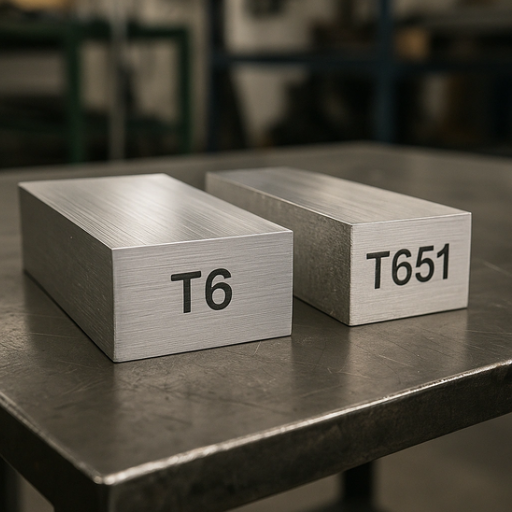
T6 means solution heat treated and artificially aged. T651 means the same plus stress relief by stretching before aging. The strength is identical; the difference is residual stress and how flat the plate stays after machining. Our 6061 aluminum alloy guide covers the tempers and applications in more depth.
The temper suffix changes the answer
Two misunderstandings cause most of the bad decisions in this comparison.
The first is treating T3 and T351 as interchangeable. They’re not, because they belong to different product forms. T3 is a sheet temper with cold work in it. T351 is a plate temper that has been stretched.
A 50 mm plate can’t be supplied as 2024-T3. If a drawing calls for T3 on thick plate, the mill will either counter-offer T351 or refuse the order.
The second is assuming 6061-T6 and 6061-T651 are different materials. They are the same material with different residual stress. On a thin, symmetric part, T6 is fine. On a plate part that gets heavily machined, T651 is what keeps it flat.
| Temper | Alloy | What happened | Typical product |
|---|---|---|---|
| 2024-O | 2024 | Annealed | Forming stock |
| 2024-T3 | 2024 | Solution treated, cold worked, natural aged | Sheet, thin plate |
| 2024-T351 | 2024 | Solution treated, stretched, natural aged | Plate, thick section |
| 2024-T4 | 2024 | Solution treated, natural aged | Sheet and bar, formed parts |
| 2024-T81 / T851 | 2024 | Cold worked or stretched, artificially aged | Sheet and plate needing better SCC resistance |
| 2024-T72 | 2024 | Overaged | Product needing maximum SCC resistance |
| 6061-T6 | 6061 | Solution treated, artificially aged | Sheet, extrusion |
| 6061-T651 | 6061 | Solution treated, stretched, artificially aged | Plate |
The T72, T81 and T851 tempers exist for one reason: stress-corrosion resistance. They give up some strength to get it, and they matter most in thick plate under sustained tensile load. More on that below.
Strength and Fatigue: How Much Stronger Is 2024, Really?
Static strength
On typical handbook values from the 2024 aluminum datasheet, 2024-T3 at 483 MPa is 56% stronger than 6061-T6 at 310 MPa, according to the 6061 aluminum datasheet. If you are comparing 2024 T3 vs 6061 T6 sheet, these are the numbers that matter.
Yield strength is 345 MPa against 276 MPa, a 25% advantage. On guaranteed minimums, the gap narrows but does not close: 435 MPa against 290 MPa in tension, 290 against 241 in yield.
Expressed per unit weight, 2024-T3 delivers about 174 kN·m/kg of ultimate strength against 115 for 6061-T6, a 51% advantage. Specific yield is 124 against 102, a 21% advantage.
Then the number that decides most real parts: specific stiffness. 2024 has a modulus of 73.1 GPa at a density of 2.78 g/cm³. 6061 has 68.9 GPa at 2.70 g/cm³. The ratio is 26.3 against 25.5, a difference of about 3%.
So 2024 is much stronger and barely stiffer. That single sentence explains why the alloy swap so often disappoints.
A part fails or performs badly for one of two reasons. Either it yields or fractures, which is a strength problem, or it deflects too much or vibrates at the wrong frequency, which is a stiffness problem. 2024 helps with the first and almost not at all with the second.
When the strength gap matters. Thin-walled parts loaded close to yield. Weight-critical structures where every kilogram compounds. Fasteners, fittings, and highly loaded joints where the section is already as small as manufacturing allows. Fatigue-critical parts, which is really the next section.
When it does not. Brackets and housings sized by deflection. Panels sized by buckling, where stiffness and geometry dominate. Parts that will be welded, because welding erases the advantage. Anything where the 2024 version needs a protective coating that the 6061 version does not.
A bracket that did not need 2024
A design team specified 2024-T351 for a machined mounting bracket because the program was aerospace and 2024 was the alloy on the previous drawing. The bracket was not strength-limited. It was deflection-limited: a 200 mm cantilever with a 1.5 kN load, and the tip movement had to stay under 0.5 mm.
Recalculating with the actual moduli showed the 2024 part moved 1.40 mm and the 6061-T651 part moved 1.49 mm. Both failed the requirement for the same reason: the section was too thin, not the alloy too weak. Thickening the web by 2 mm in 6061 solved it at lower material cost and shorter lead time.
The lesson is not that 2024 is bad. It is that the alloy cannot fix a geometry problem.
Fatigue: where 2024 earns its reputation
Fatigue is where 2024 earns its reputation, and where the comparison is most often reduced to a slogan.
Distributor datasheets commonly list 2024-T3 at about 138 to 140 MPa endurance limit on a 5 × 10⁸ cycle, fully reversed rotating-beam basis. 6061-T6 is typically listed at 96.5 MPa on a comparable basis. That is roughly a 40% to 45% advantage for 2024, and unlike the stiffness number, it is large enough to change a design.
Two caveats keep that number honest.
First, endurance limits are measured on polished, unnotched specimens. Real parts have fillets, holes, machining marks, fretting contacts and corrosion pits. Any of those can cut fatigue life by more than the alloy difference. A well-designed 6061 part with generous fillets routinely outlasts a poorly detailed 2024 part with a sharp corner.
Second, the environment matters. A corrosion pit is a crack starter. In a chloride environment, bare 2024 can lose its fatigue advantage because the surface degrades faster than 6061’s. This is exactly the case Alclad was invented for.
Alclad 2024 carries a thin layer of 1230 aluminum, roughly 2.5% of the total thickness per side on standard sheet. The cladding is sacrificial and protects the core from pitting. It does not restore the fatigue limit of a polished bare specimen, because the cladding is softer than the core, but it protects the surface condition in service, which is what usually governs.
When 2024 is the right fatigue choice. Airframe skins and internal structure, wing and empennage components, dynamically loaded fittings, and any part with a known high-cycle load spectrum where the section cannot simply be enlarged. These are the applications where the alloy was developed and where it still wins.
When 6061 is adequate. Low-cycle or occasional loading. Parts with generous safety factors. Structures where the load spectrum is not well defined and the design is stiffness-driven anyway. Most industrial machinery falls here.
Corrosion: The Decision That Usually Settles It
Bare 2024 has fair to poor corrosion resistance. The copper that provides the strength also creates microscopic galvanic cells between copper-rich particles and the surrounding aluminum matrix. In humid or chloride-bearing service, that shows up as pitting, and in thick sections as intergranular attack.
6061 has good resistance to atmosphere, fresh water, and moderate chloride exposure. It isn’t immune. It will stain and eventually pit in coastal or deicing-salt environments, and it isn’t the right alloy for permanent immersion. But it doesn’t need a protective system to survive a normal outdoor life.
That difference alone decides many projects.
Alclad 2024: what it fixes and what it does not
Alclad is a metallurgical coating, not a paint. A 1230 aluminum layer is roll-bonded to the 2024 core during rolling. Because 1230 is anodic to 2024, it corrodes preferentially and protects the core galvanically. The cladding thickness is typically about 2.5% of total thickness per side, which is enough to survive years of service but not enough to be machined away.
Three limits matter in practice.
Cut edges expose the core. A sheared or sawed edge has no cladding on it, so every cut edge is a bare 2024 surface. This is why aerospace practice calls for edge protection or careful inspection on Alclad parts.
Machining removes the cladding. If you machine a pocket through the cladding, that surface is now bare 2024. Alclad is a sheet and plate product for formed or lightly machined parts, not for heavily machined ones.
It is not a cosmetic finish. Alclad surfaces are soft, scratch easily, and do not anodize into a decorative finish. If the part needs to look good, Alclad is the wrong starting point.
Stress-corrosion cracking and thick plate
Stress-corrosion cracking (SCC) is the failure mode that almost no comparison article covers, and it is the one that most often restricts 2024 in thick sections.
SCC needs three things at once: a susceptible microstructure, a sustained tensile stress, and a corrosive environment. In 2024 thick plate, the susceptible path is the short-transverse direction, which is the through-thickness direction of the plate. A part machined so that it carries sustained tension through the thickness, such as a lug or a heavily loaded fitting, is the classic risk case.
The standard answer is temper selection. 2024-T351 and T4 are the most susceptible. 2024-T851, T81 and T72 are progressively more resistant because the artificial aging and overaging change the grain-boundary microstructure. The trade is strength: T72 is noticeably weaker than T351, and T851 sits between them.
6061-T6 is far more tolerant. It is not immune, and 6061-T4 is more susceptible than T6, but the alloy does not carry the same thick-plate restriction. For a part in chloride service with sustained tensile stress through the thickness, 6061-T651 is usually the lower-risk choice, and if the stress is severe the answer may be a 5xxx alloy rather than either of these.
Galvanic coupling and real environments
Both alloys are anodic to steel, stainless steel and titanium, so bare aluminum in contact with those metals will corrode at the joint. 2024 is more noble than 6061 because of its copper content, which means that in a 2024-to-6061 joint, the 6061 side becomes the anode. Neither pairing should be left unprotected in a wet environment.
Practical rules that apply to both alloys: isolate dissimilar fasteners with coatings or insulating washers, seal faying surfaces, avoid trapping water in crevices, and do not rely on anodizing alone as a corrosion barrier at cut edges and threaded holes.
For continuous immersion, saltwater tanks, or hull structure, the right comparison is not 2024 against 6061. It is 5052 or 5083 against both. The 5xxx alloys give up strength and gain real marine corrosion resistance.
If the part will live outdoors, near the coast, or in a wash-down environment, the alloy decision is usually settled before strength enters the conversation. Send us the service environment and we will tell you whether 2024 is realistic or whether the drawing should change.
Welding and Joining: The Hard Gate
If the part will be arc welded, the comparison is over. 6061 is the answer.
2024 is not considered fusion weldable by normal arc processes. The copper-rich microstructure is hot-short, meaning it has poor ductility at the temperatures where the weld pool solidifies, and it is prone to solidification cracking. There is no common filler metal that turns 2024 into a reliable arc-welded joint. Some fabricators will attempt it with 2319 or 4043 filler and report success on a bench test, but it is not a producible, certifiable process for structural work.
The exceptions are worth knowing. Friction stir welding works on 2024 because it never melts the alloy, and it is used in aerospace applications. Riveting, adhesive bonding and bolted joints are all standard. But if the drawing says “weld,” 2024 is the wrong alloy.
6061 welds well with 4043 or 5356 filler. The problem is not the weld. It is the heat-affected zone.
Welding 6061-T6 takes the material through a thermal cycle that overages and anneals the region beside the weld. The heat-affected zone typically loses 40% to 50% of its T6 strength, with yield strength falling into roughly the 165 to 200 MPa range depending on the filler, procedure and amount of heat input. The weld metal itself may test higher than the HAZ, which is why the HAZ is what governs the design.
Three consequences follow.
Design to the HAZ allowable, not the parent metal. A joint that is adequate in 6061-T6 base metal can be inadequate in the same geometry after welding.
Post-weld artificial aging can recover some strength, but it also introduces distortion and is not always practical on a finished assembly. It does not restore the original T6 properties.
Thicker sections and higher heat input widen the soft zone. A welder who runs hot to get penetration is making the part weaker, not stronger.
The welded frame that changed alloy
A machine frame was designed in 2024-T351 for stiffness and strength, then sent out for welding because the fabrication route had changed from bolted to welded. The first shop declined. The second welded it with 4043 and the joints cracked during inspection.
The redesign moved to 6061-T651, increased the corner gussets, and set the design allowable to 170 MPa in the HAZ rather than 276 MPa in the base metal. The frame came out slightly heavier and passed the load test. The material cost went down. The schedule recovered because the part could actually be built.
Anodizing, Machining and Total Cost
These three factors decide more projects than the datasheet does, and they all favor 6061.
Anodizing: 6061 wins clearly
Anodizing 2024 produces a dark, blotchy, uneven coating. The copper-rich phases do not anodize at the same rate as the matrix, and the result is visible even under a dyed finish. It can be used for functional or hard anodizing where appearance does not matter, and hard anodizing can improve wear resistance, but it will never look like a decorative finish.
6061 anodizes cleanly and takes dye evenly. Clear, black, and colored finishes are all routine. If the part is visible, cosmetic, or customer-facing, this single property usually decides the alloy.
One caveat applies to both: anodizing is a surface conversion, not a repair. It does not hide scratches, machining marks or weld porosity. It also reduces fatigue strength slightly, because the coating is brittle and can crack under cyclic strain. Do not anodize a fatigue-critical part without accounting for that.
Machining: different, not better or worse
Both alloys machine well, and both are commonly used in CNC work. The differences are in feel and tool life, not in feasibility.
2024 is generally rated good to excellent for machinability. It produces short, crisp chips, takes a fine finish, and holds detail well. The copper content increases tool wear slightly compared with 6061, and it is less forgiving of poor coolant coverage.
6061 is the benchmark against which other aluminum alloys are judged. It cuts easily, welds easily, deburrs easily, and is available in more forms and thicknesses than any other alloy in its class.
For dimensional stability after machining, temper matters more than alloy. 2024-T351 and 6061-T651 are both stress relieved by stretching and will hold tolerance far better than T3 sheet or T6 plate. A heavily machined pocket in non-stress-relieved stock will move regardless of which alloy you chose.
Cost: the 40% to 100% premium
2024 typically costs 40% to 100% more than 6061 depending on form, temper, thickness and quantity. Alclad adds more. The premium is real, and it is not the whole cost.
- Add the protective system. Bare 2024 outdoors needs Alclad, paint, powder coat, or a conversion coating plus inspection. 6061 often needs nothing beyond a mill finish or a simple anodize.
- Add the fabrication risk. 2024 is less forgiving in forming, can’t be welded, and has a narrower supply base. A special mill run in 2024-T351 can carry a lead time that 6061 stock doesn’t.
- Subtract the value of the strength. If the 2024 part can be thinner, material weight falls, and on a weight-critical program that can justify the premium. On a ground-based bracket, it rarely does.
The honest summary is that 2024 is worth its premium in fatigue-critical, weight-critical, non-welded, protected structures. Everywhere else, 6061 is the better buy.
The anodized enclosure
A prototype electronics enclosure was machined from 2024 plate because it was the closest stock on the shelf. The parts were functional and the schedule was met. Then the customer asked for black anodized finish.
The first batch came back dark, patchy, and visibly different from part to part. The anodizer explained that the copper was the cause and that no amount of process tuning would make 2024 look like 6061. The design moved to 6061-T651, the finish became consistent, and the material cost dropped by about a third.
2024 vs 6061 Aluminum: How to Choose and Specify
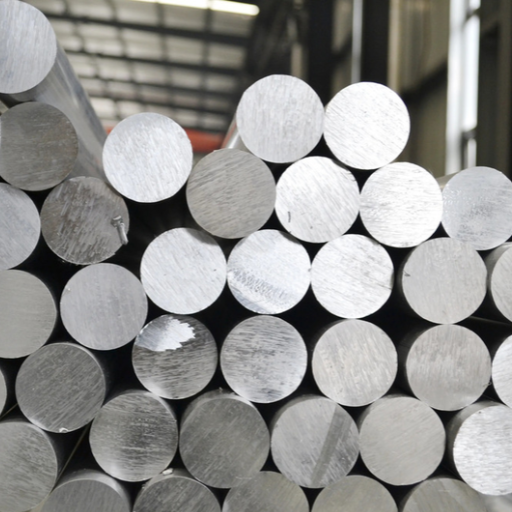
The decision usually collapses to a small number of hard constraints. Work through them in order.
| Requirement | Better choice | Reason |
|---|---|---|
| Highest tensile and yield strength | 2024-T3 or T351 | 56% higher UTS, 25% higher yield |
| Fatigue life under high-cycle loading | 2024-T3 | Roughly 40% higher endurance limit |
| Deflection- or vibration-limited | Neither, change geometry | Specific stiffness differs by only 3% |
| Arc-welded construction | 6061 | 2024 hot-cracks |
| Marine, coastal or wash-down service | 6061, or 5052/5083 | 2024 needs cladding or coating |
| Decorative anodized finish | 6061 | 2024 anodizes dark and blotchy |
| Flat, tight-tolerance part after machining | 2024-T351 or 6061-T651 | Both are stress relieved by stretching |
| Lowest material and total cost | 6061 | 40% to 100% cheaper plus no coating |
| Fast availability in many forms | 6061 | Broad distributor stock |
| Thick plate under sustained through-thickness tension | 6061-T651, or 2024-T851/T72 | SCC resistance |
Choose 2024 when the part is fatigue-critical, the weight saving is worth the premium, the part will not be welded, and the environment is either protected or clad. Typical cases: airframe structure, highly loaded fittings, dynamically loaded components, precision parts where T351 stability matters.
Choose 6061 when the part is welded, exposed, anodized, cosmetic, cost-sensitive, or needed quickly. That covers most industrial machinery, marine hardware, architectural components, pneumatic and hydraulic hardware, jigs, fixtures, and general fabrication.
Choose neither when the requirement is outside both alloys. For maximum strength in a protected environment, 7075 is stronger than 2024, with its own SCC limitations. For marine immersion or welded hull structure, 5052 or 5083 is the right family. For welded structural extrusions in Europe, 6082 is often more available than 6061.
What to put on the purchase order
A specification that names only the alloy will produce surprises. These are the lines that matter.
For 2024 sheet or plate:
Aluminum alloy 2024-T351 plate, ASTM B209, thickness 25 mm, width 1250 mm, length 2500 mm, flatness tolerances per ASTM B209, mill certificate with chemical composition and mechanical properties required.
For Alclad 2024:
Aluminum alloy Alclad 2024-T3 sheet, AMS-QQ-A-250/5, cladding thickness 2.5% per side nominal, thickness 1.6 mm, mill certificate required.
For 6061 plate:
Aluminum alloy 6061-T651 plate, ASTM B209, thickness 30 mm, flatness 1 mm per metre, mill certificate with tensile and yield results required.
Four details do most of the work: the temper, the product form, the standard, and the certificate. Add grain direction and ultrasonic inspection if the part is critical. Add cladding thickness if the material is Alclad. Do not accept “2024” or “6061” alone, because the alloy name does not tell the mill what to roll or how to heat treat it.
One more point for buyers: distinguish typical from minimum. The 483 MPa figure for 2024-T3 is a typical value. The guaranteed minimum in ASTM B209 is lower, and the guaranteed minimum for thick 2024-T351 plate is lower again. Design to the minimum for the thickness you are buying, not to the handbook headline.
Frequently Asked Questions
Is 2024 aluminum stronger than 6061?
Yes. 2024-T3 is typically about 483 MPa ultimate tensile and 345 MPa yield, against 310 MPa and 276 MPa for 6061-T6. That is roughly 56% stronger in tension and 25% stronger in yield. The advantage in stiffness is only about 3% per unit mass, so 2024 helps strength-limited parts far more than deflection-limited ones.
Can you weld 2024 aluminum?
Not by normal arc welding. 2024 is hot-short and prone to solidification cracking, and there is no common filler that makes a reliable structural joint. Friction stir welding is used in aerospace, and riveting or adhesive bonding are standard alternatives. If the part must be welded, use 6061 instead.
Which alloy is better for anodizing?
6061, without question. Its low copper content allows a clean, even coating that takes dye well. 2024 anodizes dark and blotchy because the copper-rich phases react unevenly. 2024 can be hard anodized for wear resistance, but it will not give a decorative finish.
Is 6061 or 2024 better for marine use?
6061-T6, and even then only for above-water or splash-zone service. Bare 2024 needs Alclad or a coating system, and cut edges and machined surfaces expose the core. For continuous immersion, neither alloy is ideal; 5052 or 5083 is the better choice.
What is the difference between 2024-T3 and 2024-T351?
Both are solution heat-treated and naturally aged. T3 is cold worked and is a sheet temper. T351 is stress-relieved by stretching and is a plate temper.
Typical strength is nearly the same. T351 holds flatness and machined tolerance better, and it’s the temper you’ll actually be offered in thick plate.
What is the difference between 2024 and 6061 aluminum?
2024 is a copper-bearing 2xxx alloy with higher strength and fatigue resistance. 6061 is a magnesium-silicon 6xxx alloy with better corrosion resistance, weldability and anodizing response. The 6061 vs 2024 aluminum choice usually turns on welding, environment and finish rather than on the strength table.
Is Alclad 2024 worth the extra cost?
Only if the part needs bare 2024’s strength or fatigue performance in a corrosive environment and cannot be painted or otherwise protected. Alclad protects the faces but not cut edges or machined pockets, and it cannot be given a decorative anodized finish. If the environment is mild, 6061 is usually cheaper and simpler.
Conclusion
2024 and 6061 are not rivals so much as different answers to different questions. 2024 is the high-strength, high-fatigue alloy for protected, non-welded, weight-conscious structures. 6061 is the fabrication alloy: weldable, corrosion-resistant, anodizable, available and affordable.
The 2024 vs 6061 aluminum decision is not settled by the strength table. It is settled by whether the part will be welded, what it will be exposed to, whether it needs to look good, and whether it is limited by strength or by stiffness. Answer those four questions and the alloy usually chooses itself.
If you are still between the two, send the drawing with the temper, thickness, quantity and service environment. We supply 2024 and 6061 aluminum plate, sheet and coil, and we will confirm what the mill can hold before you commit to a specification. Request a quote.