Every construction site or industrial facility contains Schedule 40 piping systems. The system delivers water to sprinklers, supplies air to pneumatic tools, and moves process fluids throughout manufacturing facilities. Steel pipe sales show Schedule 40 as the leading option which engineers select for most piping needs.
The common use of the material causes people to become confused about its actual purpose. Engineers routinely mix up Nominal Pipe Size (NPS) with actual dimensions. Contractors assume Schedule 40 works for any pressure. Procurement managers want to understand why Schedule 80 costs so much more than the similar-looking pipe.
The guide contains all necessary dimensional information about Schedule 40 piping systems, which range from NPS 1/8″ to 24″. The document provides pressure ratings weight calculations specification standards and practical selection guidance. The reference material provides everything you need to size water distribution systems and specify fire suppression piping systems.
If you need help selecting the right pipe schedule for your pressure and application requirements, our technical consultation team can provide project-specific guidance.
What is Schedule 40 Pipe?
The Schedule Number System Explained
Schedule numbers classify pipe wall thickness. Unlike tube specifications, where the dimension refers to actual outer diameter, schedule numbers represent a relationship between wall thickness and pressure capacity. The system is defined by ASME B36.10M for carbon/alloy steel pipe and ASME B36.19M for stainless steel.
The key principle: for any given Nominal Pipe Size, the outer diameter remains constant regardless of schedule. As the schedule number increases, the wall thickness increases, and the inner diameter decreases.
Why “40”? Historical Origin
The schedule numbering system has existed since the early 20th century. The original numbering system used numbers to show wall thickness measurements, which ranged between one hundredth and two hundredths of an inch for a specific reference size. Schedule 40 nominally represented 0.040″ wall thickness—though this relationship only held at specific sizes.
ASME established its current system in the 1930s, which uses pressure capability as its standard instead of fixed dimensional measurements. Schedule 40 became the “standard weight” classification—the baseline wall thickness for general-purpose applications. Schedule 80 was designated “extra strong” for higher-pressure service.
Schedule 40 Today
Modern Schedule 40 pipe serves as the industrial default. It’s specified when:
- Operating pressures remain below 300 PSI (varies by size)
- Cost efficiency matters
- Weight reduction benefits the project
- Standard fittings and valves are preferred
The “standard weight” designation reflects its position as the most economical choice that meets typical industrial requirements.
Relationship to NPS
Nominal Pipe Size creates the most confusion for new engineers. NPS is not the actual diameter—it’s a designation that corresponds to standardized outer diameters. For NPS 1/8″ through 12″, the outer diameter is larger than the nominal size. At NPS 14″ and above, NPS equals the actual outer diameter.
This distinction matters for fabrication. A spool piece designed for NPS 6″ pipe must match the 6.625″ outer diameter—not 6.000″. We’ll cover the complete NPS-to-OD relationship in the dimension tables below.
Schedule 40 Dimensions and Size Chart
Understanding NPS vs Actual Dimensions
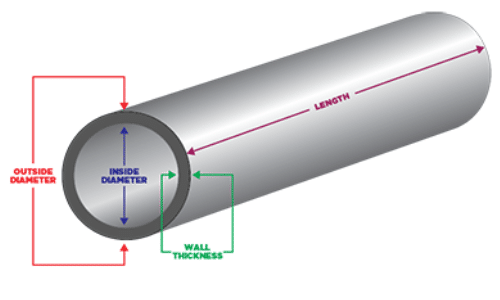
Before diving into tables, understand three critical dimensions:
- NPS (Nominal Pipe Size): The designation used for ordering and specifications
- OD (Outer Diameter): The actual outside measurement—constant for a given NPS regardless of schedule
- ID (Inner Diameter): The flow path—varies by wall thickness/schedule
The 14-Inch Transition: For NPS 14″ and larger, the nominal size equals the actual OD. Below 14″, OD is larger than the nominal designation. This creates a common specification error—designers assuming NPS 2″ pipe has a 2.000″ OD when it’s actually 2.375″. See our nominal pipe size guide for complete NPS-to-OD relationships.
Complete Schedule 40 Dimension Table (NPS 1/8″ to 24″)
| NPS | OD (in) | OD (mm) | Wall (in) | Wall (mm) | ID (in) | ID (mm) | Weight (lb/ft) | Weight (kg/m) |
|---|---|---|---|---|---|---|---|---|
| 1/8″ | 0.405 | 10.3 | 0.068 | 1.73 | 0.269 | 6.8 | 0.24 | 0.36 |
| 1/4″ | 0.540 | 13.7 | 0.088 | 2.24 | 0.364 | 9.2 | 0.42 | 0.63 |
| 3/8″ | 0.675 | 17.1 | 0.091 | 2.31 | 0.493 | 12.5 | 0.57 | 0.85 |
| 1/2″ | 0.840 | 21.3 | 0.109 | 2.77 | 0.622 | 15.8 | 0.85 | 1.27 |
| 3/4″ | 1.050 | 26.7 | 0.113 | 2.87 | 0.824 | 20.9 | 1.13 | 1.68 |
| 1″ | 1.315 | 33.4 | 0.133 | 3.38 | 1.049 | 26.6 | 1.68 | 2.50 |
| 1-1/4″ | 1.660 | 42.2 | 0.140 | 3.56 | 1.380 | 35.1 | 2.27 | 3.38 |
| 1-1/2″ | 1.900 | 48.3 | 0.145 | 3.68 | 1.610 | 40.9 | 2.72 | 4.05 |
| 2″ | 2.375 | 60.3 | 0.154 | 3.91 | 2.067 | 52.5 | 3.65 | 5.44 |
| 2-1/2″ | 2.875 | 73.0 | 0.203 | 5.16 | 2.469 | 62.7 | 5.79 | 8.63 |
| 3″ | 3.500 | 88.9 | 0.216 | 5.49 | 3.068 | 77.9 | 7.58 | 11.29 |
| 3-1/2″ | 4.000 | 101.6 | 0.226 | 5.74 | 3.548 | 90.1 | 9.11 | 13.57 |
| 4″ | 4.500 | 114.3 | 0.237 | 6.02 | 4.026 | 102.3 | 10.79 | 16.07 |
| 5″ | 5.563 | 141.3 | 0.258 | 6.55 | 5.047 | 128.2 | 14.62 | 21.77 |
| 6″ | 6.625 | 168.3 | 0.280 | 7.11 | 6.065 | 154.1 | 18.97 | 28.26 |
| 8″ | 8.625 | 219.1 | 0.322 | 8.18 | 7.981 | 202.7 | 28.55 | 42.55 |
| 10″ | 10.750 | 273.0 | 0.365 | 9.27 | 10.020 | 254.5 | 40.48 | 60.31 |
| 12″ | 12.750 | 323.8 | 0.375 | 9.53 | 12.000 | 304.8 | 49.56 | 73.82 |
| 14″ | 14.000 | 355.6 | 0.375 | 9.53 | 13.250 | 336.6 | 54.57 | 81.28 |
| 16″ | 16.000 | 406.4 | 0.375 | 9.53 | 15.250 | 387.4 | 62.58 | 93.22 |
| 18″ | 18.000 | 457.0 | 0.375 | 9.53 | 17.250 | 438.2 | 70.59 | 105.16 |
| 20″ | 20.000 | 508.0 | 0.375 | 9.53 | 19.250 | 489.0 | 78.60 | 117.10 |
| 24″ | 24.000 | 610.0 | 0.375 | 9.53 | 23.250 | 590.6 | 94.62 | 140.97 |
Dimensions per ASME B36.10M for carbon steel pipe. Weight calculated using nominal dimensions and steel density of 0.2833 lb/in³.
Key Observations from the Dimension Table
Wall Thickness Pattern: The Schedule 40 wall thickness pattern shows non-proportionality because its wall thickness increases with larger pipe dimensions. The wall thickness of small pipes which range from 1/2″ to 2″ in diameter, exceeds the wall thickness of large pipes. The 2″ pipe contains a wall thickness of 3.91mm, while the 24″ pipe uses a wall thickness of 9.53mm, which maintains a 2.4x thicker dimension because its diameter reaches 12x more than its original size.
Weight Scaling: Weight increases dramatically with diameter. The 24″ Schedule 40 pipe weighs 94.62 lb/ft which equals 111 times the weight of 1/2″ pipe although its diameter is only 48 times greater. The non-linear scaling behavior impacts both transportation expenses and structural support system needs.
ID for Flow Calculations: Engineers need actual internal diameter measurements for pump sizing and pressure drop calculations instead of using NPS measurements. The 3″ Schedule 40 pipe contains an internal diameter of 3.068″ which Schedule 80 pipe converts to 2.900″. Flow capacity shows major differences between these two elements.
For detailed pipe weight calculations including formulas, see our steel pipe weight chart guide or explore our carbon steel pipe products for available sizes and specifications.
Schedule 40 vs Other Pipe Schedules
Schedule Number Reference
| Schedule | Common Name | Wall Thickness | Typical Application |
|---|---|---|---|
| 5S | Extra Light | Thinnest | Low-pressure, corrosion allowance |
| 10 | Light Wall | ~50% of Sch 40 | Utilities, low-pressure systems |
| 40 | Standard Weight | Baseline | General industrial piping |
| 80 | Extra Strong | ~1.5x Sch 40 | High-pressure, process piping |
| 120 | Extra Heavy | ~2.0x Sch 40 | High-pressure steam, oil/gas |
| 160 | Double Extra Strong | ~2.5x Sch 40 | Extreme pressure, refineries |
Multi-Schedule Wall Thickness Comparison
| NPS | Sch 10 | Sch 40 | Sch 80 | Sch 120 | Sch 160 |
|---|---|---|---|---|---|
| 1/2″ | 0.083″ | 0.109″ | 0.147″ | — | 0.188″ |
| 2″ | 0.109″ | 0.154″ | 0.218″ | — | 0.344″ |
| 4″ | 0.120″ | 0.237″ | 0.337″ | — | 0.531″ |
| 6″ | 0.134″ | 0.280″ | 0.432″ | — | 0.719″ |
| 8″ | 0.148″ | 0.322″ | 0.500″ | 0.594″ | 0.906″ |
| 12″ | 0.180″ | 0.375″ | 0.500″ | 0.844″ | 1.312″ |
When to Upgrade from Schedule 40
Schedule 80 becomes necessary when:
- Operating pressure exceeds Schedule 40 rating (see pressure table below)
- External loading requires additional strength
- Corrosion allowance must be maintained over service life
- Code requirements mandate thicker walls (some chemical processes)
Cost and Weight Impact: Schedule 80 pipe costs 35-60% more than Schedule 40 and weighs 40-60% more. These factors multiply across large projects—a 6″ water main requiring 1,000 feet of pipe sees significant cost differences.
Mixed Schedule Systems: Systems can combine schedules, but the pressure rating is limited by the thinnest component. If Schedule 40 pipe connects to Schedule 80 fittings, the system rating remains at Schedule 40 levels. This creates potential specification errors when contractors substitute materials.
For a complete comparison, see our Schedule 40 vs Schedule 80 pipe guide. For higher pressure applications, explore our Schedule 80 pipe options or contact our technical team for selection assistance.
Schedule 40 Pressure Ratings
Pressure Rating by Pipe Size
Schedule 40 pressure ratings vary by pipe size because wall thickness doesn’t increase proportionally with diameter. Smaller pipes withstand higher pressures than larger pipes of the same schedule.
| NPS | OD (in) | Wall (in) | Max Pressure (PSI) | Max Pressure (bar) |
|---|---|---|---|---|
| 1/4″ | 0.540 | 0.088 | 7,985 | 550 |
| 1/2″ | 0.840 | 0.109 | 6,358 | 438 |
| 3/4″ | 1.050 | 0.113 | 5,273 | 363 |
| 1″ | 1.315 | 0.133 | 4,956 | 342 |
| 1-1/2″ | 1.900 | 0.145 | 3,631 | 250 |
| 2″ | 2.375 | 0.154 | 3,177 | 219 |
| 3″ | 3.500 | 0.216 | 3,024 | 209 |
| 4″ | 4.500 | 0.237 | 2,581 | 178 |
| 6″ | 6.625 | 0.280 | 2,071 | 143 |
| 8″ | 8.625 | 0.322 | 1,829 | 126 |
| 10″ | 10.750 | 0.365 | 1,664 | 115 |
| 12″ | 12.750 | 0.375 | 1,440 | 99 |
Pressure ratings calculated for ASTM A53 Grade B at ambient temperature (73°F/23°C) using Barlow’s formula with allowable stress of 20,000 PSI and quality factor E = 1.0.
Barlow’s Formula Explained
Engineers calculate maximum allowable pressure using Barlow’s Formula:
P = (2 × S × t × E) / D
Where:
- P = Maximum allowable pressure (PSI)
- S = Allowable stress (20,000 PSI for ASTM A53 Grade B at ambient)
- t = Wall thickness (inches)
- E = Quality factor (1.0 for seamless, 0.85 for ERW)
- D = Outside diameter (inches)
Worked Example: Calculate maximum pressure for 2″ Schedule 40 pipe
- S = 20,000 PSI
- t = 0.154″
- E = 1.0 (seamless)
- D = 2.375″
P = (2 × 20,000 × 0.154 × 1.0) / 2.375 = 3,177 PSI
Temperature Derating
Pressure capacity decreases at elevated temperatures. For ASTM A53 Grade B:
| Temperature | Derating Factor | Max Pressure (2″ Sch 40) |
|---|---|---|
| 73°F (23°C) | 1.00 | 3,177 PSI |
| 200°F (93°C) | 0.93 | 2,955 PSI |
| 300°F (149°C) | 0.88 | 2,796 PSI |
| 400°F (204°C) | 0.82 | 2,605 PSI |
| 500°F (260°C) | 0.76 | 2,415 PSI |
Always apply the appropriate derating factor for operating temperature. Systems approaching pressure limits at ambient conditions will fail safety margins when heated.
Safety Factor Considerations
The calculated pressures represent maximum allowable working pressure (MAWP) per code. Engineering practice typically applies additional safety factors:
- Design pressure = MAWP × 0.80 (20% safety margin)
- Hydrostatic test pressure = 1.5 × MAWP
For a 2″ Schedule 40 pipe with MAWP of 3,177 PSI, design pressure would be approximately 2,500 PSI and hydrostatic test pressure approximately 4,750 PSI.
Material Specifications
ASTM A53 (Carbon Steel)
ASTM A53 is the most common specification for Schedule 40 carbon steel pipe. It covers:
- Type S: Seamless pipe (Grades A and B)
- Type E: Electric-resistance welded (ERW) pipe (Grades A and B)
- Type F: Furnace-butt welded, continuous weld (Grade A only)
Grade B is the standard choice for Schedule 40 applications:
- Minimum tensile strength: 60,000 PSI (415 MPa)
- Minimum yield strength: 35,000 PSI (240 MPa)
- More common and economical than Grade A
ASTM A106 (High-Temperature Service)
ASTM A106 covers seamless carbon steel pipe for high-temperature service (up to 750°F/400°C). Key differences from A53:
- Seamless only (no welded pipe)
- Higher temperature ratings
- Better for boilers and heat exchangers
- Grade B most common
API 5L (Line Pipe)
API 5L specifies pipe for oil and natural gas transmission pipelines. It includes:
- Grade B (similar to ASTM A53 Grade B)
- X grades (X42, X52, X60, X65, X70) with higher strength
- Both seamless and welded
- Often dual-certified to ASTM A53
Stainless Steel Schedules
Stainless steel pipe uses slightly different schedule designations per ASME B36.19M:
- Schedule 40S: Matches carbon steel Schedule 40 dimensions for NPS 1/8″ through 10″
- Schedule 5S and 10S: Thin-wall stainless options not available in carbon steel
- Common grades: 304/304L, 316/316L
| Specification | Grade | Application | Schedule Availability |
|---|---|---|---|
| ASTM A53 | Grade B | General purpose | 40, 80, 160, XXS |
| ASTM A106 | Grade B | High temperature | 40, 80, 160, XXS |
| API 5L | Grade B, X52 | Oil/gas pipelines | 40, 80, 160 |
| ASTM A312 | 304, 316 | Corrosion resistance | 40S, 80S, 160S |
For corrosion-resistant applications, explore our stainless steel pipe products available in Schedule 40S and other schedules.
Seamless vs Welded Schedule 40 Pipe
Manufacturing Processes
Electric Resistance Welded (ERW) pipe starts as flat steel strip. The edges are heated by electrical resistance and pressed together to form a longitudinal seam. The weld is then heat-treated to normalize the microstructure. ASTM A53 Type E requires post-weld heat treatment at minimum 1000°F (540°C).
Seamless pipe begins as a solid steel billet. It’s heated and pierced to create a hollow shell, then rolled and stretched to final dimensions. No weld seam exists—hence “seamless.”
Performance Differences
| Characteristic | Seamless | ERW Welded |
|---|---|---|
| Pressure rating | Higher | ~15% lower (E = 0.85 in Barlow’s formula) |
| Corrosion resistance | Uniform | Weld zone slightly more susceptible |
| Cost | 20-40% higher | More economical |
| Size availability | Limited over 24″ | Wide size range |
| Quality consistency | Excellent | Good (requires weld inspection) |
ASTM A53 Types
- Type S: Seamless, Grades A and B
- Type E: Electric-resistance welded, Grades A and B
- Type F: Furnace-welded, Grade A only (less common)
Selection Guidelines
Choose seamless when:
- Operating above 15% of Schedule 40 pressure rating
- High-temperature cycling causes thermal stress
- Corrosive environment targets weld zones
- Specification explicitly requires seamless
Choose ERW when:
- Standard water, air, or gas service
- Large diameter required (over 24″)
- Cost optimization matters
- ASTM A53 Type E is acceptable per design code
The 20-40% cost premium for seamless pipe is justified only when application demands warrant it. For most Schedule 40 applications—water systems, HVAC, general process—ERW pipe performs adequately at lower cost. For a detailed comparison of manufacturing methods, see our seamless vs welded pipe guide.
Schedule 40 Pipe Applications
Water Supply and Distribution
Schedule 40 dominates municipal and industrial water systems:
- Distribution mains (typically 4″ to 12″)
- Building supply lines (1/2″ to 3″)
- Irrigation systems
- Cooling water circuits
Pressure requirements for water systems rarely exceed 150 PSI, well within Schedule 40 capacity for all sizes.
HVAC Systems
Heating, ventilation, and air conditioning use Schedule 40 extensively:
- Chilled water distribution
- Hot water heating loops
- Condensate drainage
- Compressed air for controls (up to 150 PSI)
The weight savings of Schedule 40 vs Schedule 80 becomes significant in overhead installations. A 6″ Schedule 80 pipe weighs 28.6 lb/ft compared to 19.0 lb/ft for Schedule 40—a 50% difference that affects hanger spacing and structural loading.
Fire Protection Systems
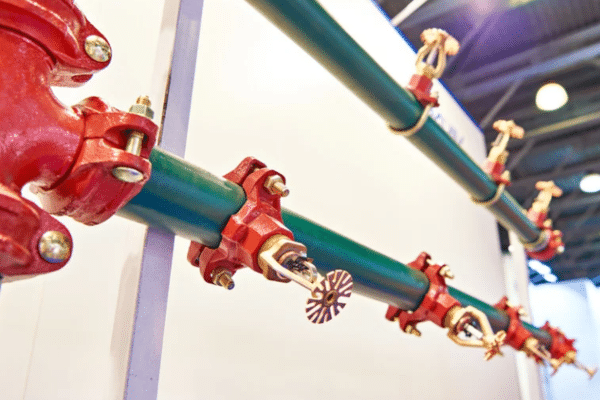
NFPA standards permit Schedule 40 for sprinkler systems when:
- Working pressure remains below 175 PSI
- Pipe size is 6″ or larger
- Specific listing requirements are met
The fire protection contractor Marcus Chen from Chicago discovered that he needed to understand specification details better. He installed Schedule 40 for a warehouse sprinkler system, only to discover the design pressure of 200 PSI exceeded Schedule 40 capacity for the 4″ main. His client faced an additional expense of $12,000 for material and labor because they needed to upgrade to Schedule 80. The pressure requirements must be verified through rating tables before specifications are determined.
Low-Pressure Process Piping
Chemical and process industries use Schedule 40 for:
- Gravity drainage
- Vent lines
- Low-pressure product transfer
- Utility water and air
When process requirements stay below Schedule 40 pressure limits, the cost savings multiply across extensive piping networks.
Structural Applications
Beyond fluid transport, Schedule 40 serves structural needs:
- Handrails and guardrails
- Equipment supports
- Conduit and cable protection
- Sign posts and bollards
The consistent OD allows standard fittings and connections regardless of schedule, simplifying fabrication.
When NOT to Use Schedule 40
Avoid Schedule 40 when:
- Operating pressure exceeds rating for pipe size
- External loads require additional wall thickness
- High-temperature service derates pressure capacity below requirements
- Severe corrosion will reduce wall thickness significantly
- Code requirements mandate heavier schedules
How to Read Pipe Specifications
NPS vs OD vs ID on Drawings
Engineering drawings should specify pipe by:
- NPS (Nominal Pipe Size) for ordering
- Schedule for wall thickness
- Material specification (ASTM A53, etc.)
Refer to our nominal pipe size guide for a detailed explanation of NPS-to-OD relationships and common specification pitfalls.
Example specification: “NPS 4″, Sch 40, ASTM A53 Grade B”
This translates to:
- Outer diameter: 4.500″
- Wall thickness: 0.237″
- Inner diameter: 4.026″
- Carbon steel, welded or seamless
Schedule Notation Examples
| Notation | Meaning |
|---|---|
| Sch 40 | Schedule 40 (most common) |
| STD | Standard weight (same as Sch 40 for NPS 1/8″-10″) |
| S/40 | Abbreviated Schedule 40 |
| 40S | Schedule 40 stainless steel |
Reading Mill Certificates
Mill certificates (Material Test Reports) provide actual measured dimensions and chemistry. Key fields to verify:
- Heat Number: Traceability to production batch
- Chemical Composition: Verify meets specification
- Mechanical Properties: Tensile and yield strength
- Hydrostatic Test Pressure: Confirms pressure integrity
- Dimensions: Actual OD, wall thickness, length
For ASTM A53 pipe, verify:
- Type (S for seamless, E for ERW, F for furnace welded)
- Grade (A or B)
- Heat treatment condition (normalized if Type E)
Common Specification Errors
- Confusing NPS with OD: Designing spool pieces using NPS as actual dimension causes fit-up problems
- Mixing schedules without pressure checking: System limited by weakest component
- Ignoring temperature derating: Hot service reduces pressure capacity
- Assuming all schedules have same OD: They do—but fabricators sometimes forget
Pipe vs Tube Dimension Differences
Pipe uses NPS and schedule:
- NPS 1″ = 1.315″ OD
- Wall thickness varies by schedule
Tube uses actual outside diameter:
- 1″ tube = exactly 1.000″ OD
- Wall thickness stated directly (0.065″, etc.)
They are not interchangeable. A 1″ pipe fitting will not fit 1″ tube.
FAQ
What is schedule 40 pipe used for?
Schedule 40 pipe provides essential piping solutions for industrial facilities that require water systems, HVAC systems and fire protection systems which operate below designated pressure limits and various low-pressure process systems and structural support functions. The system operates with maximum pressures of approximately 300 PSI for its smaller components which decrease to around 150 PSI for 12″ pipe.
What is the pressure rating of schedule 40 pipe?
The pressure ratings of Schedule 40 pipes differ based on their specific pipe dimensions. The 1/2″ pipes can endure pressures of 6,000 PSI whereas the 12″ pipes can withstand 1,400 PSI. The rating decreases as pipe diameter increases because wall thickness doesn’t scale proportionally. The temperature derating factors need application whenever equipment operates at elevated temperature conditions.
What is the difference between schedule 40 and 80?
Schedule 80 has thicker walls than Schedule 40—typically 40-60% thicker depending on pipe size. The system will experience pressure rating enhancements between 50% to 70% but the system will require additional weight and cost of 40% to 60%. Schedule 80 serves as the standard for high-pressure systems which require operating pressures that exceed the established limits of Schedule 40.
How thick is schedule 40 pipe?
The thickness of schedule 40 pipe reaches different measurements for various pipe sizes because its wall thickness starts at 0.068″ (1.73mm) for 1/8″ NPS and extends to 0.375″ (9.53mm) for 14″ NPS and all larger sizes. The schedule number indicates a single thickness yet ASME B36.10M standard specifies multiple wall dimensions for each distinct NPS measurement.
What does schedule 40 mean?
ASME B36.10M establishes Schedule 40 as a pipe wall thickness standardization system. The “40” originated from early 20th-century pipe standards but no longer directly corresponds to dimension. The standard now determines specific wall thickness values which differ by pipe diameter to create moderate pressure capacity suitable for common industrial uses.
Is schedule 40 pipe pressure rated?
Schedule 40 pipe has specific pressure ratings that depend on its size and material composition. The pressure rating for ASTM A53 Grade B Schedule 40 pipe reaches between 1,400 PSI and 8,000 PSI according to its pipe diameter, which ranges from 1/4″ to 12″. The pressure ratings decrease when temperatures increase according to ASME derating standards.
What is the ID of schedule 40 pipe?
The inner diameter of Schedule 40 pipe can be calculated by subtracting double the wall thickness from its outer diameter. For common sizes: 1/2″ NPS = 0.622″ ID, 2″ NPS = 2.067″ ID, 4″ NPS = 4.026″ ID, 6″ NPS = 6.065″ ID. For flow calculations, the actual ID must be used instead of NPS.
Can a schedule 40 pipe be threaded?
Schedule 40 pipe allows for threading operations to take place. The wall thickness provides adequate material for standard tapered pipe threads (NPT). Threading is common for sizes 1/2″ through 4″ in plumbing and industrial applications. The larger sizes of pipes usually require welded connections or flanged connections instead of threading.
Conclusion
Schedule 40 pipe earns its position as the industrial default through balanced performance. It provides adequate pressure capacity for 80% of piping applications while remaining economical and lightweight compared to heavier schedules.
The key takeaways:
- Schedule 40 represents standard weight—the baseline for general-purpose piping
- Pressure ratings vary by size—smaller pipes handle higher pressures
- NPS does not equal actual diameter—use dimension tables for fabrication
- Seamless vs welded—choose based on pressure requirements and cost constraints
- Temperature derating matters—hot service reduces pressure capacity
- Always verify specifications—mixed schedules limit system pressure to the weakest component
Remember the engineer from our opening who mixed up specifications? After reviewing the dimension tables and pressure ratings in this guide, he now specifies Schedule 40 with confidence for appropriate applications—while knowing exactly when to upgrade to Schedule 80 or specify seamless construction.
When you need Schedule 40 pipe with certified specifications for your project, contact our team for competitive pricing and global delivery. We supply ASTM A53 Grade B Schedule 40 pipe in sizes from 1/2″ to 24″ with full mill test reports and international certification.