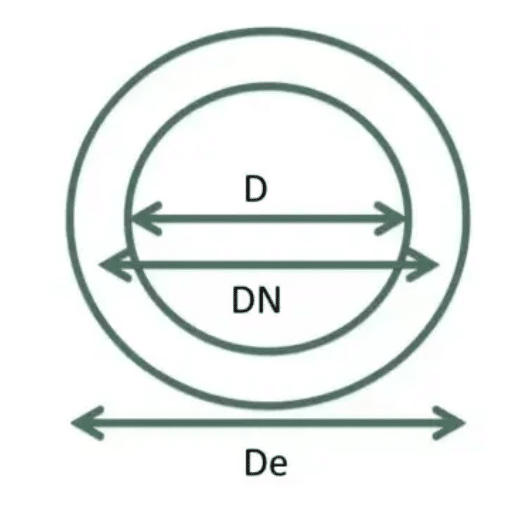
The actual size of a pipe does not match its nominal pipe size designation. A 2-inch NPS pipe has an outside diameter of 2.375 inches, not 2.000 inches. The number serves as a label that maintains consistent value through all schedules while the wall thickness of the product varies.
The procurement manager at a Mumbai engineering firm faced this challenge after Raj Patel learned his professional lesson. His project required 50 lengths of 2-inch stainless steel pipe for a chemical process line. He ordered 2-inch stainless steel tubing without checking the specifications. The shipment arrived with tubes that had outer dimensions of 2.000 inches. The tubes had dimensions that prevented their use with the 2-inch flanges already present on the site. His company lost 800 in return freight costs plus two weeks of production time because of the mismatch. The entire problem would have been solved through a single check of the OD dimension table.
The article explains nominal pipe size as a concept that shows why this size differs from actual pipe dimensions while describing how to read NPS markings in fieldwork. The document contains a complete pipe size chart which shows all required dimensions and NPS-to-DN conversion data together with instructions for measuring pipes when their markings have become worn or completely missing.
Key Takeaways
- Nominal pipe size (NPS) is a label, not a measurement — a 2-inch NPS pipe measures 2.375 inches on the outside.
- All pipes with the same NPS share the same outside diameter (OD), regardless of schedule or wall thickness.
- NPS is the North American standard; DN (diameter nominal) is the metric equivalent used in Europe and China.
- Pipe and tube use different sizing systems — pipe uses NPS, tube uses actual OD — and mixing them causes fit-up failures.
- You can identify NPS in the field by measuring OD with calipers and matching it to standard values.
What Is Nominal Pipe Size?

Nominal pipe size (NPS) is a standardized designation system for pipe dimensions defined by ASME B36.10M for carbon and alloy steel pipe and ASME B36.19 for stainless steel pipe. The system applies to North America, the Middle East, and many Asian markets that follow ANSI/ASME standards. For a broader overview of stainless steel grades and specifications, see our complete stainless steel guide.
The term nominal means that something exists only in its formal designation. The NPS number shows a close estimation of the internal diameter measurement for early pipe designs but fails to match any actual contemporary pipe dimensions. The actual diameter measurement, which buyers need to understand, shows the difference between nominal pipe size and actual pipe diameter specification. The inside diameter of Schedule 40 NPS 1/2 pipe measures 0.622 inches, while its outside diameter measures 0.840 inches. The two measurements both fall short of reaching 0.500 inches.
The current method of naming pipes originated during the early 20th century because pipe manufacturers of that time produced less accurate products. The pipe size system used an approximate bore measurement, which became the pipe’s permanent name even though manufacturing processes improved. Engineers and buyers need to use nominal pipe size today as a common reference system which does not represent actual pipe dimensions.
The NPS pipe size system covers a wide range. ASME B36.10M lists dimensions from NPS 1/8 inch (3.2 mm) up to NPS 80 inches (2,032 mm). The typical range that most industries keep in stock extends from NPS 1/8 to NPS 24 while customers need to place special orders for larger sizes.
Nominal Pipe Size vs Actual Diameter: The Key Concept
The first rule of pipe sizing establishes that all nominal pipe sizes maintain constant outside diameter dimensions, which remain unchanged through different piping schedule requirements. The pipe wall thickness will determine both the internal pipe diameter and the associated pressure rating of the system.
The 4-inch nominal pipe size maintains a constant outside diameter of 4.500 inches across all Schedule 5, Schedule 40, Schedule 80 and Schedule 160 pipe variants. The pipe ID decreases when the schedule number increases because different wall thicknesses are used. Thicker walls result in reduced pipe diameters, which allow for greater pressure handling capabilities while increasing the weight per foot of the pipe.
NPS Pipe Size Chart: Standard Dimensions
| NPS | OD (in) | OD (mm) | Sch 40 ID (in) | Sch 80 ID (in) | Sch 40 Weight (lb/ft) | Sch 80 Weight (lb/ft) |
|---|---|---|---|---|---|---|
| 1/8″ | 0.405 | 10.3 | 0.269 | 0.215 | 0.24 | 0.31 |
| 1/4″ | 0.540 | 13.7 | 0.364 | 0.302 | 0.42 | 0.54 |
| 3/8″ | 0.675 | 17.1 | 0.493 | 0.423 | 0.57 | 0.74 |
| 1/2″ | 0.840 | 21.3 | 0.622 | 0.546 | 0.85 | 1.09 |
| 3/4″ | 1.050 | 26.7 | 0.824 | 0.742 | 1.13 | 1.47 |
| 1″ | 1.315 | 33.4 | 1.049 | 0.957 | 1.68 | 2.17 |
| 1-1/2″ | 1.900 | 48.3 | 1.610 | 1.500 | 2.72 | 3.63 |
| 2″ | 2.375 | 60.3 | 2.067 | 1.939 | 3.65 | 5.03 |
| 3″ | 3.500 | 88.9 | 3.068 | 2.900 | 7.58 | 10.26 |
| 4″ | 4.500 | 114.3 | 4.026 | 3.826 | 10.79 | 14.99 |
| 6″ | 6.625 | 168.3 | 6.065 | 5.761 | 18.97 | 28.60 |
| 8″ | 8.625 | 219.1 | 7.981 | 7.625 | 28.55 | 43.43 |
| 10″ | 10.750 | 273.1 | 10.020 | 9.562 | 40.48 | 64.49 |
| 12″ | 12.750 | 323.9 | 11.938 | 11.374 | 53.52 | 88.71 |
The pipe size chart demonstrates that NPS numbers do not provide sufficient information to estimate dimensions through their use. The outer diameter measurements display non-proportional increments, which create different sizes. NPS 3 shows a diameter increase of 47% when compared to NPS 2. NPS 12 shows an 18% diameter increase when compared to NPS 10. The manufacturing standards of the past, together with industry standardization practices, created this specific method of progression, which does not adhere to engineering design principles.
The field experience shows confusion because the NPS measurement system states that NPS sizes above 12 use the OD measurement, which equals the NPS value in inches. NPS 14 has a 14.000-inch OD. NPS 20 has a 20.000-inch OD. The NPS system at dimensions below NPS 12 creates different actual size measurements that exist outside of established mathematical links to NPS dimensions.
NPS vs DN vs IPS: Understanding Size Standards

Pipe sizing standards vary by region and application. Engineers working on international projects must know when to specify NPS, when to use DN, and how the two systems relate.
NPS vs DN: Metric Conversion Table
| NPS (in) | DN (mm) | Common OD (mm) |
|---|---|---|
| 1/2″ | DN 15 | 21.3 |
| 3/4″ | DN 20 | 26.7 |
| 1″ | DN 25 | 33.4 |
| 1-1/2″ | DN 40 | 48.3 |
| 2″ | DN 50 | 60.3 |
| 3″ | DN 80 | 88.9 |
| 4″ | DN 100 | 114.3 |
| 6″ | DN 150 | 168.3 |
| 8″ | DN 200 | 219.1 |
| 10″ | DN 250 | 273.1 |
| 12″ | DN 300 | 323.9 |
NPS remains the leading system for North America, the Middle East, and most Asian markets that export goods. The European Union and China domestic projects and ISO-standard specifications use DN (diameter nominal) as their metric standard. The two systems are not identical — DN values are rounded metric approximations — but the OD dimensions are close enough that NPS and DN pipes of the same nominal size typically mate with compatible fittings.
The outer diameter (OD) of a DN 50 pipe measures 60.3 mm, which corresponds perfectly to the NPS 2 standard. The outer diameter (OD) of a DN 100 pipe measures 114.3 mm, which corresponds to the NPS 4 standard. Engineers working with mixed standards should always verify the actual OD rather than assuming equivalence.
NPS vs IPS
IPS stands for Iron Pipe Size. In most industrial contexts, NPS and IPS are interchangeable for steel pipe. However, IPS also appears in plumbing contexts where it refers to the thread standard (NPT — National Pipe Taper) rather than the pipe dimension itself.
The key distinction: NPS refers to the pipe body dimension. NPT refers to the thread form. A pipe can be NPS 2 with NPT threads. Confusing the two can lead to ordering errors, particularly when purchasing threaded fittings or valves.
For global procurement, always specify both the dimension standard and the thread standard. “NPS 2, Schedule 40, NPT threads” leaves no ambiguity. “2-inch pipe” does not.
How to Measure and Identify NPS in the Field
Not every pipe arrives with clear markings. Field crews often encounter pipe with faded stencils, painted-over labels, or no markings at all. Here is how to determine NPS with basic tools.
Step 1: Measure the Outside Diameter
Use a digital caliper or pipe OD tape. Measure at least two points 90 degrees apart to check for out-of-roundness. Match your measurement to the standard OD values:
- 0.840 inches = NPS 1/2
- 1.050 inches = NPS 3/4
- 1.315 inches = NPS 1
- 1.900 inches = NPS 1-1/2
- 2.375 inches = NPS 2
- 3.500 inches = NPS 3
- 4.500 inches = NPS 4
- 6.625 inches = NPS 6
If your measurement is within 1% of a standard value, you have identified the nominal pipe size. Manufacturing tolerances allow small deviations, so a reading of 2.360 inches on a caliper almost certainly means NPS 2.
Step 2: Measure Wall Thickness
Use a digital wall thickness gauge or an ultrasonic tester. Compare your reading to standard schedule values to identify the schedule number. A pipe with 2.375-inch OD and 0.154-inch wall thickness is NPS 2, Schedule 40. The same OD with 0.218-inch wall is NPS 2, Schedule 80.
Step 3: Read the Stencil (If Present)
Standard pipe markings follow a set format. A typical stencil reads: NPS 4 SCH 40 ASTM A53 GR B SEAMLESS. From left to right, this tells you the nominal pipe size, schedule, material specification, grade, and manufacturing method. If the marking includes “SMLS,” that means seamless. “ERW” means electric resistance welded. Learn more about manufacturing methods in our seamless vs welded pipe comparison.
Carlos Mendez, a field supervisor on a refinery turnaround in Texas, found this process essential during a midnight emergency repair. A corroded section of process line needed replacement, but the original pipe markings had worn off after 15 years of service. Carlos measured the OD at 4.498 inches and the wall at 0.237 inches. He cross-referenced the values against the pipe OD chart and confirmed nominal pipe size 4, Schedule 40, ASTM A53. The replacement pipe arrived by 6:00 a.m. and the unit restarted on schedule. Without the measurement technique, the crew would have guessed — and a wrong guess on a 400 PSI line could have been catastrophic.
Pipe Schedule and NPS: How They Work Together

The complete specification requires both NPS and pipe schedule, which function as its two components. NPS establishes the external diameter of the pipe. The schedule defines the pipe’s wall thickness. The two measurements establish three pipe properties, which include inside diameter and flow capacity and pressure rating.
NPS alone does not provide sufficient information to determine pressure capacity. NPS 4 indicates an outer diameter of 4.500 inches. The information does not reveal the pipe’s pressure capacity. The schedule provides required information, which includes Schedule 40, 80, 160, or any other designation to establish wall thickness and perform pressure rating calculations.
A higher schedule number increases wall thickness and decreases inside diameter while boosting pressure capacity and pipe weight for each NPS measurement. The relationship between two variables does not follow a straight path. Schedule 80 wall thickness is roughly 40-70% thicker than Schedule 40, depending on NPS, but the pressure increase varies by size because the diameter-to-thickness ratio changes.
Engineers sometimes need to increase pressure capacity without changing the nominal pipe size. Specifying a higher schedule achieves this without modifying flange bolt patterns or support spacing, since the OD stays the same. This is one reason Schedule 80 is popular for high-pressure retrofits — you can swap Schedule 40 for Schedule 80 without changing any surrounding hardware.
For a deeper look at how schedule affects pressure ratings and weight, see our Schedule 80 pipe guide. The relationship between nominal pipe size and schedule is what determines the actual pressure capacity of any given pipe.
Common NPS Sizes and Applications
Different industries favor different NPS ranges based on flow requirements, pressure levels, and structural needs.
| NPS Range | Typical Applications |
|---|---|
| 1/8″ – 3/4″ | Instrument tubing, small-bore process piping, hydraulic lines, sampling systems |
| 1″ – 2″ | Utility piping, process branches, HVAC distribution, boiler feed lines |
| 3″ – 6″ | Main process piping, water distribution headers, fire protection mains, steam lines |
| 8″ – 12″ | Pipeline trunk lines, cooling water intakes, large process headers, storage tank connections |
| 14″ – 24″ | Transmission pipelines, raw water intakes, power plant circulating water |
| 30″+ | Offshore pipelines, large-diameter water mains, tunnel ventilation (special order) |
Most industrial suppliers stock NPS 1/2 through 24 in standard schedules. Sizes above NPS 24 typically require mill orders with longer lead times. If your project needs NPS 36 or larger, plan for 8-12 week manufacturing cycles depending on the material grade and wall thickness.
For corrosive service, 304 stainless steel and 316 stainless steel pipe in standard NPS sizes offers longer service life than carbon steel. Grade 304 handles most industrial applications, while 316 provides superior chloride resistance for marine and chemical environments.
Pipe vs Tube: The Critical Sizing Difference

This is the mistake that costs procurement teams the most money and time. Pipe and tube use completely different sizing systems, and a 1-inch pipe is not the same as a 1-inch tube.
Pipe uses NPS. The OD is standardized per ASME B36.10M and does not match the NPS number. A 1-inch NPS pipe has a 1.315-inch OD.
Tube uses actual outside diameter. A 1-inch tube has exactly a 1.000-inch OD. Tube wall thickness is expressed as a gauge number or a decimal measurement, not as a pipe schedule.
| Description | OD (inches) | Sizing System |
|---|---|---|
| 1″ NPS pipe | 1.315 | Nominal pipe size |
| 1″ tube | 1.000 | Actual OD |
| 2″ NPS pipe | 2.375 | Nominal pipe size |
| 2″ tube | 2.000 | Actual OD |
The difference between the two options shows a significant contrast. A 1-inch tube has 24% less OD than a 1-inch NPS pipe, which shows different fitting requirements. The system will experience connection problems because your system requires an NPS pipe, but you ordered a tube.
Tube serves structural functions and heat exchange systems, and scientific instruments that need exact outer diameter specifications. Pipe serves three main purposes, which include transporting liquids and containing pressure and establishing process piping systems that require standard fittings and flanges.
The proper procedure requires you to measure the outer diameter, which lets you verify the results using the pipe outer diameter chart. Your measurement indicates that you possess a pipe when it matches the standard nominal pipe size measurement. Your measurement indicates that you possess a tube when it matches the specified size measurement exactly.
If your project requires both pipe and tube, or if you are unsure which specification applies, our technical consultation team can review your drawings and recommend the correct sizing system.
Frequently Asked Questions About Nominal Pipe Size
What is nominal pipe size?
Nominal pipe size serves as the standard measurement system that North America uses to define pipe dimensions. The NPS number is a label, not an actual measurement. The historical system used to estimate the internal diameter of early pipe models, but current measurements fail to match the actual system. The outside diameter of NPS 2 pipe measures 2.375 inches instead of its stated size of 2.000 inches.
What is the difference between nominal pipe size and actual diameter?
The nominal pipe size vs actual diameter difference is the most common source of confusion in pipe procurement. NPS serves as a designation system which identifies pipe size, while actual diameter of the pipe indicates its measurable outside diameter and inside diameter dimensions. A 1-inch NPS pipe measures 1.315 inches on the outside. A 4-inch NPS pipe measures 4.500 inches on the outside. The NPS number never equals any actual dimension for sizes below NPS 14.
How do you convert NPS to DN?
NPS to DN conversion is straightforward for common sizes. The NPS number should be multiplied by 25 and the result should be rounded to the nearest standard DN value. NPS 1/2 converts to DN 15. NPS 2 converts to DN 50. NPS 4 converts to DN 100. NPS 6 converts to DN 150. The matching NPS and DN sizes share the same outside diameter measurements, which allows for the interchangeability of fittings. For exact conversions, reference the pipe size chart in this article.
Does nominal pipe size include wall thickness?
The nominal pipe size system defines only the outside diameter of pipes. The pipe schedule determines the wall thickness which includes Schedule 40 and 80 and 160 and other designations. Two pipes with the same NPS but different schedules have identical outside diameters but different wall thicknesses inside diameters and pressure ratings.
What is the difference between NPS and IPS?
NPS (Nominal Pipe Size) and IPS (Iron Pipe Size) are generally interchangeable for industrial steel pipe. IPS can refer to thread standards instead of pipe dimensions. NPT (National Pipe Taper) is the thread form that pairs with NPS pipe. The ordering process requires you to provide dimension standard and thread standard information by using the following example “NPS 2 Schedule 40 NPT threads.”
Conclusion
The concept of nominal pipe size exists as the most misunderstood aspect of industrial procurement because it determines all components of piping system design. The NPS number serves as a designation which does not function as a precise measurement tool. The exterior diameter of a 2-inch pipe measures 2.375 inches. All pipes with the same nominal pipe size share the same OD, while schedule determines wall thickness, ID, and pressure capacity.
The international standards system requires knowledge of both NPS and DN because these two systems create different measurement standards. Proper field measurement of OD prevents errors during ordering because unclear markings lead to potential confusion. The pipe and tube sizing system requires different approaches, which will help you avoid costly fitting errors.
The pipe size chart in this article needs to become your bookmark before your upcoming procurement process. You must verify the OD and confirm the schedule while checking whether your specification requires pipe or tube. The three checks require less than one minute to complete, and they will stop the type of mismatch that cost Raj Patel 800 and two weeks.
Request a quote for NPS pipe in carbon steel, stainless steel pipe, or alloy grades. LIANYUNGANG DAPU METAL CO., LTD supplies standard and custom nominal pipe sizes with full mill certifications, custom cutting, and global delivery to your project site.