
Spring Steel: Engineered
for Resilience.
Designed for high yield strength and exceptional fatigue resistance. Our spring steel grades provide the reliability needed for automotive suspensions, industrial tools, and precision machinery.
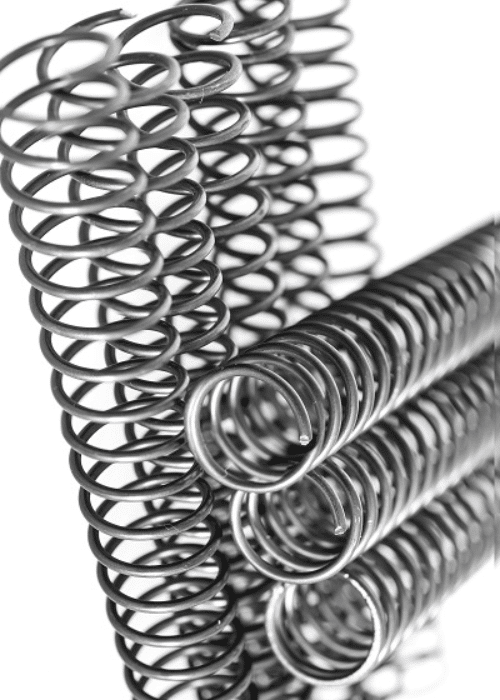
Critical Engineering Benefits
Spring steel is defined by its ability to withstand high stress levels and return to its original shape without permanent deformation.
High Yield Strength
Engineered with an exceptional elastic limit, allowing components to endure heavy loads and return to their original profile with zero plastic deformation.
Fatigue Life
Specifically alloyed to withstand cyclic loading. Through precise heat treatment, it maintains structural integrity over millions of compression and tension cycles.
Uniform Hardness
Excellent hardenability ensures deep and consistent through-hardening, even in large sections, providing a perfect balance between surface rigidity and core toughness.
Impact Toughness
The unique metallurgical structure provides superior shock absorption, making it ideal for high-impact mechanical parts, cutting tools, and heavy-duty springs.
Strategic Grade Matrix
Select the optimal alloy based on fatigue requirements and tensile strength.
Standard choice for saw blades, flat springs, and agricultural machinery parts.
Engineered for heavy-duty coil springs and automotive suspension systems.
Ideal for high-stress valve springs and high-temperature industrial components.
The Hardening & Tempering Cycle
Spring steel achieves its performance through a strictly controlled thermal transformation process.
Forming
Hot or cold coiling into shape. Internal stresses are introduced during this mechanical deformation stage.
Hardening
Heating above the critical temperature (Austenitizing) followed by rapid quenching to create a Martensitic structure.
Tempering
Reheating to a specific range to reduce brittleness while locking in the maximum elastic limit and toughness.
Shot Peening
Bombarding the surface with steel shot to create compressive residual stress, exponentially increasing fatigue life.
The TTT Curve Importance
Precise control over the cooling rate ensures the avoidance of pearlite formation, securing a 100% martensitic transformation for uniform elasticity across the entire component.
Proven Industrial Success
From high-speed precision instruments to heavy-duty machinery.
Automotive
- Suspension Coil Springs
- Clutch Diaphragms
- Engine Valve Springs
Industrial
- Conveyor Scrapers
- Mechanical Fasteners
- Vibration Dampers
Tooling
- High-Strength Saw Blades
- Professional Pliers
- Scrapers & Spatulas
Specialized
- Aerospace Elastic Links
- Medical Surgical Clips
- Precision Measuring Tapes