
AISI 1084
High Carbon Steel
The legendary "beginner-friendly" steel that performs like a pro. Perfect for forging, grinding, and easy heat treating without a kiln.
The "Goldilocks" Steel
Not too simple, not too complex. Why 1084 sits in the perfect "sweet spot" for heat treatment.
The Magic of 0.84% Carbon
In metallurgy, steel with ~0.8% carbon is called Eutectoid. This is the exact saturation point where iron absorbs carbon perfectly without leaving excess carbides.
What this means for you: You don't need to "soak" the steel at specific temperatures for 10-20 minutes like you do with other alloys. Once 1084 reaches critical temperature (becomes non-magnetic), it's ready to quench immediately. It solves the biggest problem for beginners: temperature control.
A great steel, but "Hypereutectoid" (excess carbon). It requires extremely fast quench oil and precise temps.
- Needs Parks 50 (Fast Oil)
- Small window for success
- Prone to cracking
The ultimate balance. Can be heat treated in a simple gas forge or even a coal fire with great results.
- Works in Canola Oil
- "Heat & Dunk" simple
- Forgiving of errors
Very tough, but requires a "Soak Time" (holding temp for 10-20 mins) to dissolve alloys properly.
- Needs Temp Control Kiln
- Will not harden fully in a forge
- More expensive
Technical Specifications
Understanding the chemistry behind the performance. Why 1084 behaves the way it does.
Chemical Composition
| Element | Range (%) | Function in Blades |
|---|---|---|
| C Carbon | 0.80 - 0.93 | Hardness & Edge Retention. The primary hardening element. |
| Mn Manganese | 0.60 - 0.90 | Hardenability (Crucial). Allows the steel to harden deeply in slower oils (like Canola) without cracking. |
| P Phos. | 0.030 max | Impurity. Kept low to prevent brittleness. |
| S Sulfur | 0.050 max | Impurity. Kept low to ensure forgeability. |

*Distinctive high-carbon spark stream (lots of bursts).
Hardness Potential (Rockwell C)
*1084 gets extremely hard out of the quench. Tempering brings it back to the usable 58-62 HRC range.
The 1084 "Recipe"
Follow these steps to turn soft steel into a high-performance blade.
Note: Temperatures are in Fahrenheit (°F) as per industry standard.
1. Forging
1500°F - 2150°FForge the steel while it is hot (bright orange/yellow). Stop hammering when the color drops to a dull red. Do not overheat past bright yellow, as this causes grain growth.
2. Normalizing (3 Cycles)
1600°F → Air CoolEssential to relieve stress after forging. Heat the blade to non-magnetic, then let it cool in still air until black. Repeat this process 3 times, lowering the temp slightly each time.
3. The Quench
~1500°F → Warm OilHeat the blade until a magnet no longer sticks to it (Curie point is ~1414°F). Go just a shade brighter red than that point. Plunge immediately into warm oil (130°F).
Recommended Oil: Canola Oil (works great!) or Parks 50.
4. Tempering
400°F (2 Hours x 2)The blade is now glass-hard and brittle. You must temper it immediately in a kitchen oven to add toughness. Perform two cycles of 2 hours each.
| Target Use | Temp (°F) | Result (HRC) |
|---|---|---|
| Kitchen / Slicers | 375°F - 400°F | 61 - 62 HRC |
| General / Hunting (Best) | 400°F - 425°F | 60 HRC |
| Choppers / Axes | 450°F + | 57 - 58 HRC |
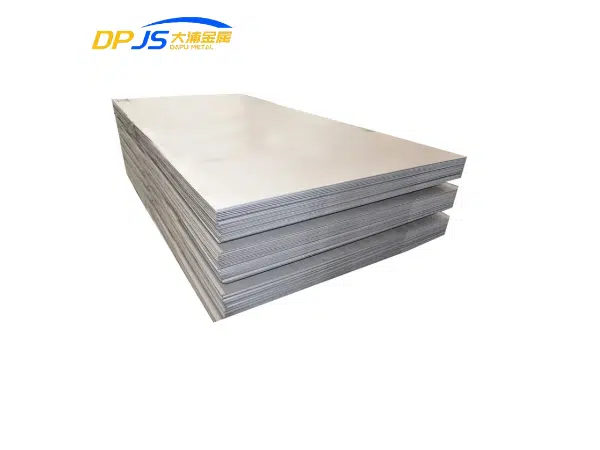
In-Stock Flat Bars
Hot rolled, annealed, and pickled. Ready to grind.
Standard Lengths: 12", 24", 36", 48".
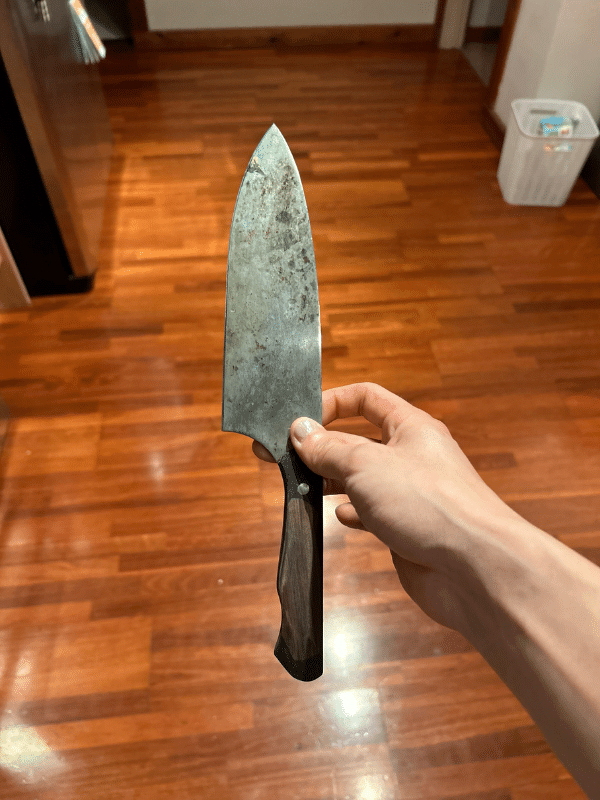
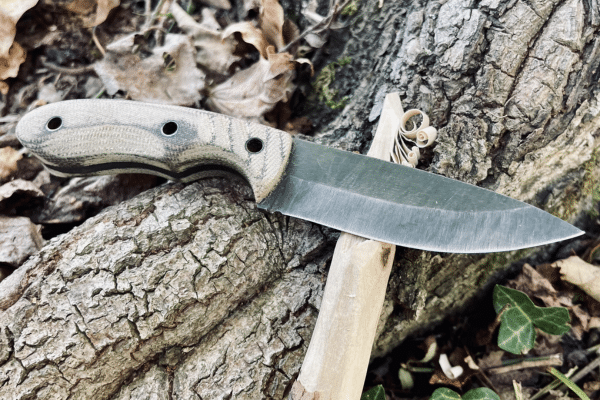
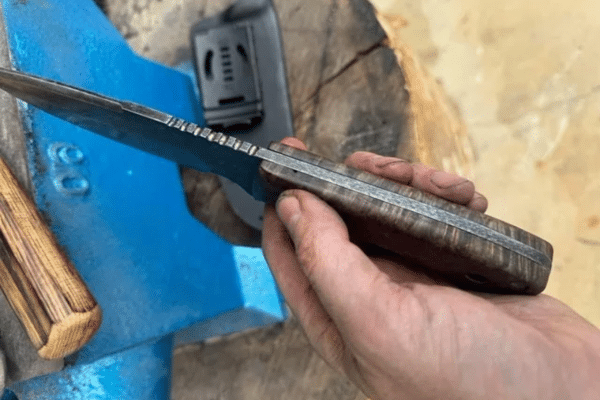
Made with 1084
From rugged bushcraft tools to refined kitchen cutlery. See what incredible performance you can achieve with simple heat treating.
Common Questions
Everything you need to know before you start grinding.